


The inclusion of mobilisation with movement to a standard exercise programme for patients with rotator cuff related pain: a randomised, placebo-controlled protocol trial
- PMID: 33183274
- PMCID: PMC7663889
- DOI: 10.1186/s12891-020-03765-6
The inclusion of mobilisation with movement to a standard exercise programme for patients with rotator cuff related pain: a randomised, placebo-controlled protocol trial
Abstract
Background: Rotator cuff related pain (RCRP) is one of the most common sources of musculoskeletal shoulder pain affecting the general population. Conservative treatment, in the form of exercise, is considered the first line approach, nonetheless, improvements seem to be modest. One therapeutic modality that might be an adjunct to the treatment of this condition is mobilisation with movement (MWM). MWM is a pain-free manual procedure that targets restricted and painful movements, commonly seen in patients with RCRP. The purpose of clinical trial is to determine whether MWM with exercise has benefits over sham MWM with exercise in RCRP.
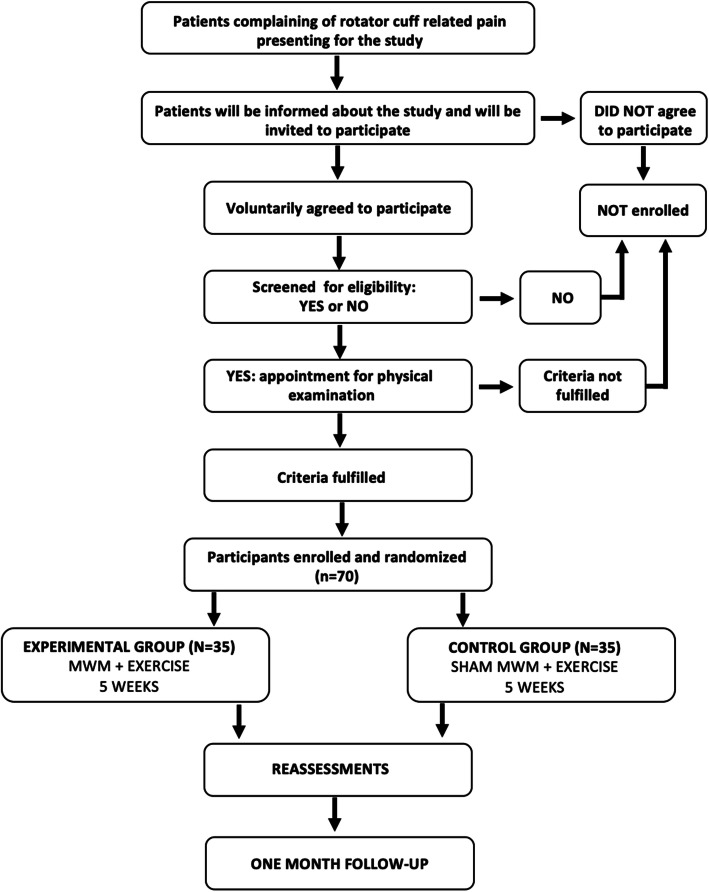
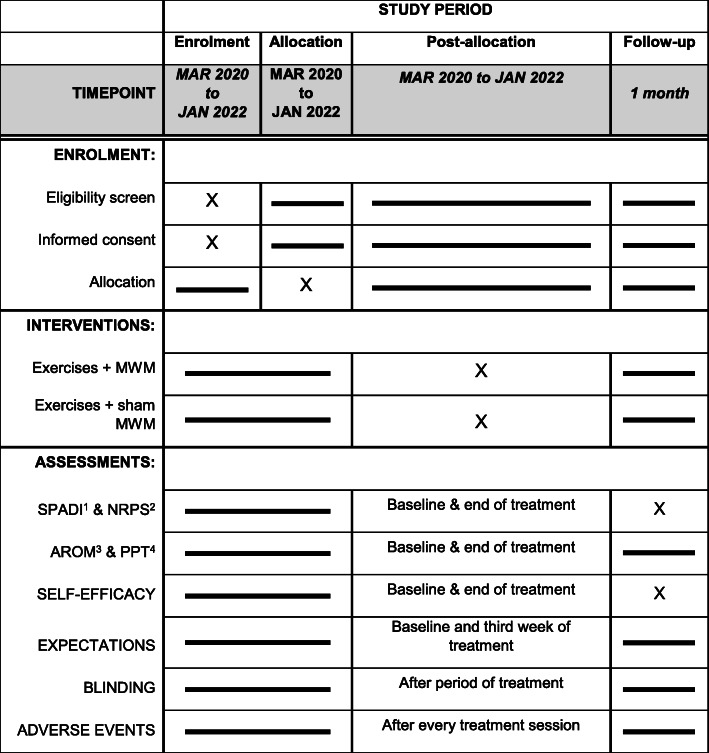
Methods: A randomised, sham-controlled trial of 70 adults complaining of RCRP will compare the effects of MWM combined with exercise over sham MWM with exercise. Participants will be allocated to one of two groups: exercise and MWM (EG) or exercise and sham MWM (CG). Two weekly individual treatment sessions will be conducted over five weeks. All assessments will be performed by a blinded assessor. Primary outcome measures will be the shoulder pain and disability index (SPADI) and the numeric pain rating scale (NPRS), assessed at baseline, discharge and one-month follow-up. Secondary outcome measures will be active range of motion, self-efficacy and the global rating of change scale. The analyses will be conducted considering a statistically significant p-value ≤0.05. Normality will be assessed with the Kolmogorov-Smirnov test and homogeneity with the Levene's test. For the primary outcome measures (SPADI and NPRS) and self-efficacy, a 2 × 3 ANOVA with treatment group (EG versus CG) and time (baseline, end of the treatment and follow-up) factors will be performed. Separate 2 × 2 ANOVA will be used for range of motion (baseline and end of the treatment). Global rating scale of change analysis will be conducted using descriptive statistics. Intention-to-treat analysis will be adopted.
Discussion: As there is a paucity of longitudinal studies investigating the use of MWM in patients with RCRP, this study will help to better understand its role together with a structured exercise programme.
Trial registration: Clinical Trials Registry number NCT04175184 . November, 2019.
Keywords: Exercise; Mobilisation with movement; Musculoskeletal manipulations; Rotator cuff; Shoulder pain.
Conflict of interest statement
The authors declare that they have no competing interests.
Figures
References
-
- Karel YHJM, Verhagen AP, Thoomes-de-Graaf M, Duijn E, van den Borne MPJ, Beumer A, et al. Development of a prognostic model for patients with shoulder complaints in physical therapist practice. Phys Ther. 2017;91(1):72–80. - PubMed
-
- Hegedus EJ, Goode A, Campbell S, Morin A, Tamaddoni M, Moorman CT, 3rd, et al. Physical examination tests of the shoulder: a systematic review with meta-analysis of individual tests. Br J Sports Med. 2008;42(2):80–92; discussion. - PubMed
Publication types
MeSH terms
Associated data
LinkOut - more resources
Full Text Sources
Medical
Research Materials
