Review
. 2020 Nov 12;17(1):174.
doi: 10.1186/s12985-020-01449-0.

Role of γδ T cells in controlling viral infections with a focus on influenza virus: implications for designing novel therapeutic approaches

Affiliations
Review

Role of γδ T cells in controlling viral infections with a focus on influenza virus: implications for designing novel therapeutic approaches

Ailar Sabbaghi et al. Virol J. .

Abstract

Background: Influenza virus infection is among the most detrimental threats to the health of humans and some animals, infecting millions of people annually all around the world and in many thousands of cases giving rise to pneumonia and death. All those health crises happen despite previous and recent developments in anti-influenza vaccination, suggesting the need for employing more sophisticated methods to control this malign infection. Main body The innate immunity modules are at the forefront of combating against influenza infection in the respiratory tract, among which, innate T cells, particularly gamma-delta (γδ) T cells, play a critical role in filling the gap needed for adaptive immune cells maturation, linking the innate and adaptive immunity together. Upon infection with influenza virus, production of cytokines and chemokines including CCL3, CCL4, and CCL5 from respiratory epithelium recruits γδ T cells at the site of infection in a CCR5 receptor-dependent fashion. Next, γδ T cells become activated in response to influenza virus infection and produce large amounts of proinflammatory cytokines, especially IL-17A. Regardless of γδ T cells' roles in triggering the adaptive arm of the immune system, they also protect the respiratory epithelium by cytolytic and non-cytolytic antiviral mechanisms, as well as by enhancing neutrophils and natural killer cells recruitment to the infection site.

Conclusion: In this review, we explored varied strategies of γδ T cells in defense to influenza virus infection and how they can potentially provide balanced protective immune responses against infected cells. The results may provide a potential window for the incorporation of intact or engineered γδ T cells for developing novel antiviral approaches or for immunotherapeutic purposes.

Keywords: Adaptive immunity; Gamma-delta T cells; Influenza virus; Innate immunity; Vaccine.


Conflict of interest statement

The authors declare that they have no competing interests.

Figures
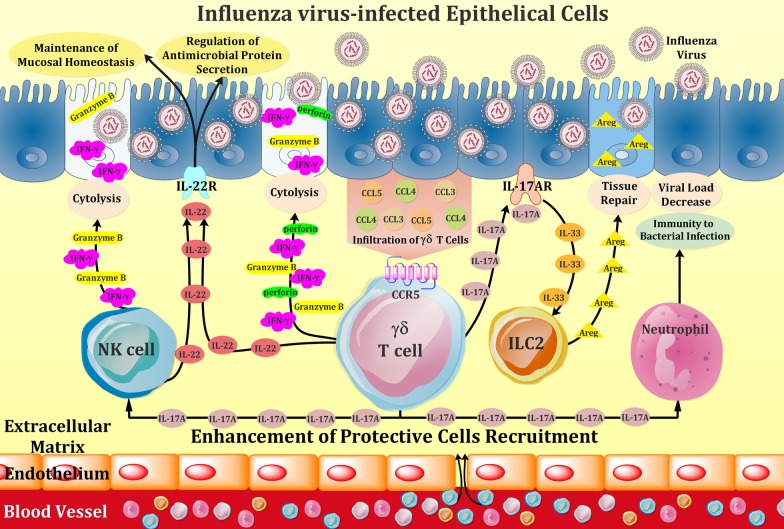
Fig. 1
Fig. 1
Schematic representation of effector mechanisms of γδ T cells in response to influenza virus infection of respiratory epithelium. Upon infection with influenza virus, infected cells secrete CCL3, CCL4, and CCL5 chemokines and thereby recruit γδ T cells, harnessing chemokine-binding CCR5 receptor, to the site of infection. Activated effector γδ T cells release cytokines and chemokines such as IFN-γ, IL-17, IL-22, as well as cytolytic proteins including perforin and granzyme B, which can directly lyse the infected cells and can also recruit other immune cells such as natural killer (NK) cells and neutrophils to aid killing or healing infected cells. Moreover, γδ T cells expressing IL-17A, binds to IL-17A receptor on lung epithelial cells, producing IL-33 and thereafter drive colonic group 2 innate lymphoid cell (ILC2) activation during influenza virus infection. The activated ILC2 produces Amphiregulin (Areg), which participates in pulmonary tissue repair upon influenza infection. In addition, IL-22, released from both γδ T cells and activated NK cells, is effective in preserving the homeostasis of mucosal barrier of influenza-infected respiratory tract and also plays a key regulatory role in microbial host defense after influenza infection
Fig. 2
Fig. 2
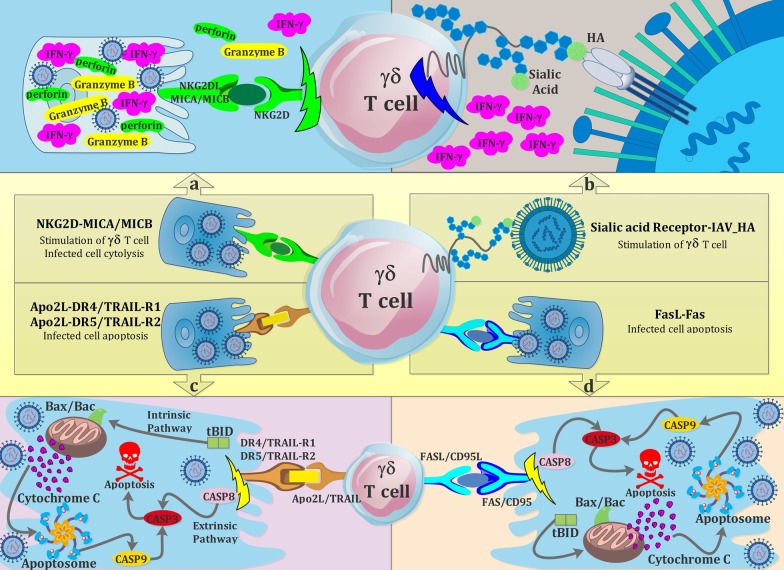
Cartoon overview of γδ T cells receptor-dependent interaction with influenza virus or influenza-virus-infected respiratory cells. a Activation of γδ T cells by the interaction between NKG2D (natural killer group 2D) receptor of γδ T cells with its ligands, MHC class I chain-related sequence A and B (MICA and MICB), expressed on the surface of influenza-infected epithelial cells, inducing the release of some cytokines and cytolytic proteins, somehow halting the influenza infection. b The interaction of influenza haemagglutinin (HA) on the surface of influenza viruses with sialic acid receptors plays a key role in the activation of γδ T cells, triggering the production of interferon-γ (IFN-γ). c γδ T cells utilize TNF-related apoptosis inducing ligand (TRAIL) for killing of influenza-infected cells. Infected epithelial cells express death receptors TRAIL-R1 or TRAIL-R2, identifying their ligand (Apo2 ligand) on the surface of influenza infection-activated γδ T cells and undergo apoptosis through Caspase-dependent pathways. d) FAS ligand expressed by γδ T cells, when exposed to FAS receptor available on influenza-infected cells surface activates the pathway of FAS-FASL apoptosis to destroy the infected cell

References

    1. Thompson WW, Shay DK, Weintraub E, Brammer L, Cox N, Anderson LJ, et al. Mortality associated with influenza and respiratory syncytial virus in the United States. JAMA. 2003;289(2):179–186. doi: 10.1001/jama.289.2.179. - DOI - PubMed
    1. Rossman JS, Lamb RA. Influenza virus assembly and budding. Virol. 2011;411(2):229–236. doi: 10.1016/j.virol.2010.12.003. - DOI - PMC - PubMed
    1. Kikkert M. Innate immune evasion by human respiratory RNA viruses. J Innate Immun. 2020;12(1):4–20. doi: 10.1159/000503030. - DOI - PMC - PubMed
    1. Sabbaghi A, Miri SM, Keshavarz M, Zargar M, Ghaemi A. Inactivation methods for whole influenza vaccine production. Rev Med Virol. 2019;29(6):e2074. doi: 10.1002/rmv.2074. - DOI - PubMed
    1. Iwasaki A, Pillai PS. Innate immunity to influenza virus infection. Nat Rev Immunol. 2014;14(5):315–328. doi: 10.1038/nri3665. - DOI - PMC - PubMed

Publication types