


Longitudinal changes in mental health and the COVID-19 pandemic: evidence from the UK Household Longitudinal Study
- PMID: 33183370
- PMCID: PMC7737138
- DOI: 10.1017/S0033291720004432
Longitudinal changes in mental health and the COVID-19 pandemic: evidence from the UK Household Longitudinal Study
Abstract
Background: The COVID-19 pandemic has had a range of negative social and economic effects that may contribute to a rise in mental health problems. In this observational population-based study, we examined longitudinal changes in the prevalence of mental health problems from before to during the COVID-19 crisis and identified subgroups that are psychologically vulnerable during the pandemic.
Methods: Participants (N = 14 393; observations = 48 486) were adults drawn from wave 9 (2017-2019) of the nationally representative United Kingdom Household Longitudinal Study (UKHLS) and followed-up across three waves of assessment in April, May, and June 2020. Mental health problems were assessed using the 12-item General Health Questionnaire (GHQ-12).
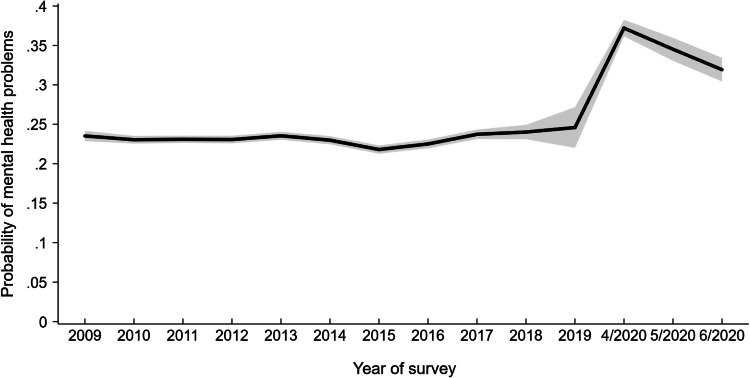
Results: The population prevalence of mental health problems (GHQ-12 score ⩾3) increased by 13.5 percentage points from 24.3% in 2017-2019 to 37.8% in April 2020 and remained elevated in May (34.7%) and June (31.9%) 2020. All sociodemographic groups examined showed statistically significant increases in mental health problems in April 2020. The increase was largest among those aged 18-34 years (18.6 percentage points, 95% CI 14.3-22.9%), followed by females and high-income and education groups. Levels of mental health problems subsequently declined between April and June 2020 but remained significantly above pre-COVID-19 levels. Additional analyses showed that the rise in mental health problems observed throughout the COVID-19 pandemic was unlikely to be due to seasonality or year-to-year variation.
Conclusions: This study suggests that a pronounced and prolonged deterioration in mental health occurred as the COVID-19 pandemic emerged in the UK between April and June 2020.
Keywords: COVID-19; Coronavirus infection; longitudinal research; mental health; nationally representative study; psychological distress.
Conflict of interest statement
ER has previously received research funding from Unilever and the American Beverage Association for unrelated research.
Figures
References
-
- Aalto, A.-M., Elovainio, M., Kivimäki, M., Uutela, A., & Pirkola, S. (2012). The Beck Depression Inventory and General Health Questionnaire as measures of depression in the general population: A validation study using the Composite International Diagnostic Interview as the gold standard. Psychiatry Research, 197(1–2), 163–171. - PubMed
-
- Andrew, A., Cattan, S., Costa Dias, M., Farquharson, C., Kraftman, L., Krutikova, S., … Sevilla, A. (2020). How are mothers and fathers balancing work and family under lockdown? IFS Briefing Note BN290. Retrieved from https://www.ifs.org.uk/uploads/BN290-Mothers-and-fathers-balancing-work-....
-
- Bell, D. N., & Blanchflower, D. G. (2020). US and UK labour markets before and during the Covid-19 crash. National Institute Economic Review, 252, R52–R69.
-
- Benzeval, M., Burton, J., Crossley, T. F., Fisher, P., Jäckle, A., Low, H., & Read, B. (2020). The idiosyncratic impact of an aggregate shock: the distributional consequences of COVID-19. Understanding Society Working Paper Series 2020–09. Retrieved from https://www.understandingsociety.ac.uk/sites/default/files/downloads/wor....
Publication types
MeSH terms
LinkOut - more resources
Full Text Sources
Medical
Miscellaneous
