


Conduct of Clinical Trials in the Era of COVID-19: JACC Scientific Expert Panel
- PMID: 33183511
- PMCID: PMC7836888
- DOI: 10.1016/j.jacc.2020.09.544
Conduct of Clinical Trials in the Era of COVID-19: JACC Scientific Expert Panel
Abstract
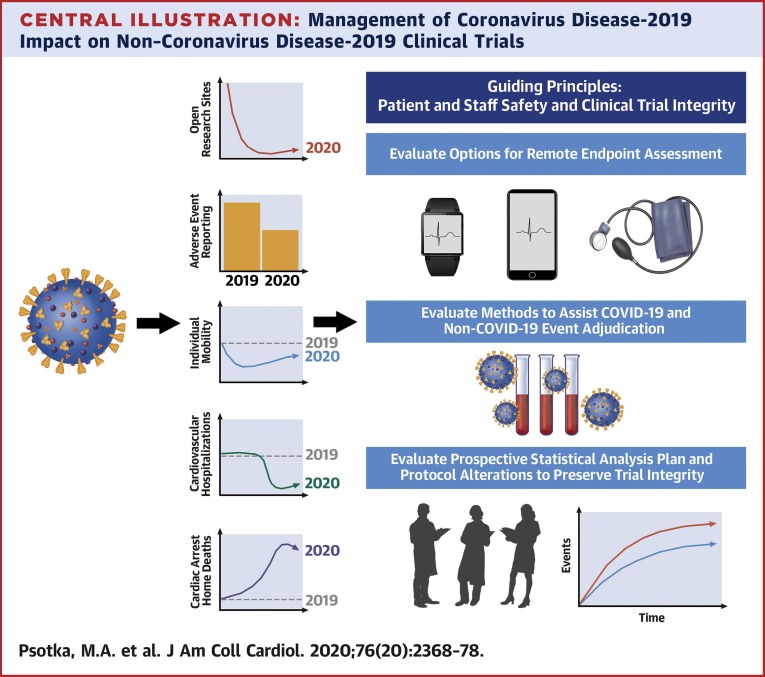
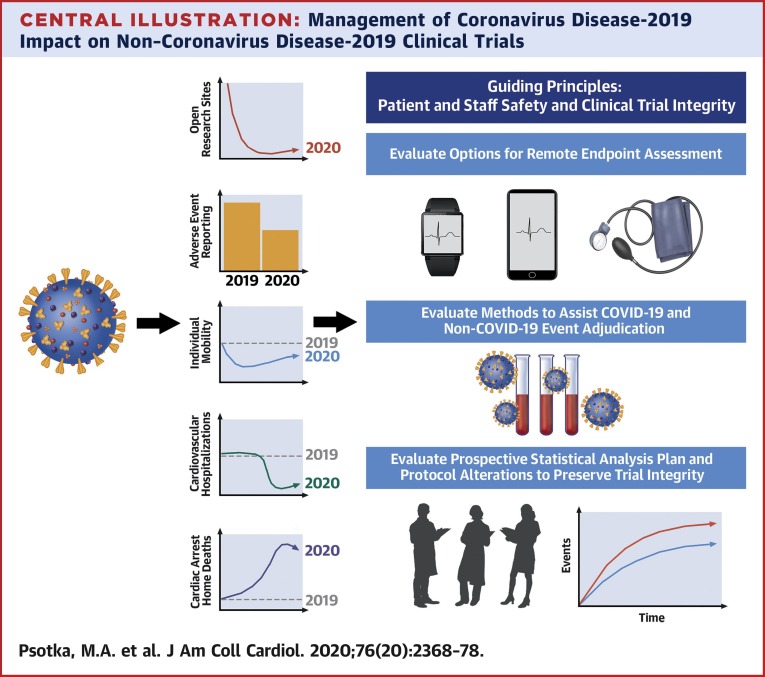
The coronavirus disease-2019 (COVID-19) pandemic has profoundly changed clinical care and research, including the conduct of clinical trials, and the clinical research ecosystem will need to adapt to this transformed environment. The Heart Failure Academic Research Consortium is a partnership between the Heart Failure Collaboratory and the Academic Research Consortium, composed of academic investigators from the United States and Europe, patients, the U.S. Food and Drug Administration, the National Institutes of Health, and industry members. A series of meetings were convened to address the challenges caused by the COVID-19 pandemic, review options for maintaining or altering best practices, and establish key recommendations for the conduct and analysis of clinical trials for cardiovascular disease and heart failure. This paper summarizes the discussions and expert consensus recommendations.
Keywords: COVID-19; clinical trial; endpoint ascertainment; heart failure.
Copyright © 2020 The Authors. Published by Elsevier Inc. All rights reserved.
Conflict of interest statement
Author Relationship With Industry Dr. Psotka has received consulting fees from Amgen, Cytokinetics, and Windtree; and has received grant support from the U.S. Food and Drug Administration. Dr. Abraham has received consulting fees from Abbott, Boehringer Ingelheim, CVRx, Edwards Lifesciences, and Respicardia; has received salary support from V-Wave; and has received research support from the U.S. National Institutes of Health/National Heart, Lung, and Blood Institute. Dr. Filippatos has received consulting income from Boehringer Ingelheim, Medtronic, Novartis, Servier, and Vifor; and has received lecture fees from Merck. Dr. Lindenfeld has received consulting fees from Novartis, Abbott, ResMed, V-Wave, CVRx, and Cytokinetics. Dr. Ahmad has received consulting fees from Amgen, Cytokinetics, Relypsa, and Novartis. Dr. Bhatt has received consulting fees from Sanofi Pasteur; and participates in clinical endpoint committees for the U.S. National Institutes of Health. Dr. Cleland has received consulting fees from Abbott, Amgen, Bayer, Medtronic, Novartis, Pharmacosmos, Vifor, Bristol Myers Squibb, and Servier; and has received research grants from Amgen, Bayer, Novartis, Pharmacosmos, Vifor, Bristol Myers Squibb, and Servier. Dr. Felker has received research grants from the National Heart, Lung, and Blood Institute, American Heart Association, Amgen, Merck, Cytokinetics, and Roche Diagnostics; and has received consulting fees from Novartis, Amgen, Bristol Myers Squibb, Cytokinetics, Medtronic, Cardionomic, Relypsa, V-Wave, Myokardia, Innolife, EBR Systems, Arena, Abbott, Sphingotec, Roche Diagnostics, Alnylam, LivaNova, Windtree Therapeutics, Rocket Pharma, and scPharmaceuticals. Dr. Januzzi is a trustee of the American College of Cardiology; has received grant support from Applied Therapeutics, Novartis Pharmaceuticals, and Abbott Diagnostics; has received consulting income from Abbott, Janssen, Novartis, Pfizer, Merck, and Roche Diagnostics; and participates in clinical endpoint committees/data safety monitoring boards for Abbott, AbbVie, Amgen, Boehringer Ingelheim, Janssen, and Takeda. Dr. Kitzman has received consulting fees from AstraZeneca, Bayer, Novartis, Merck, Pfizer, Boehringer Ingelheim, AbbVie, DCRI, and Corvia; has received grant support from AstraZeneca, Bayer, and Novartis; and has stock in Gilead. Dr. Lewis has received consulting fees from Novartis; and has received institutional research grant support from Amgen, Novartis, and Sanofi. Dr. McMurray has received financial support from Bayer, Cardiorentis, Amgen, Oxford University, Theracos, Abbvie, DalCor, Pfizer, Merck, Novartis, GlaxoSmithKline, Bristol Myers Squibb, Vifor-Fresenius, Kidney Research UK, and AstraZeneca. Dr. Mentz has received consulting fees from Abbott, Amgen, AstraZeneca, Bayer, Boston Scientific, Janssen, Luitpold, Medtronic, Merck, Novartis, and Sanofi; and has received research grants from Akros, Amgen, AstraZeneca, Bayer, Bristol Myers Squibb, GlaxoSmithKline, Gilead, InnoLife, Luitpold/American Reagent, Novartis, Otsuka, ResMed, and the U.S. National Institutes of Health grants U01HL125511-01A1 and R01AG045551-01A1. Dr. Solomon has received research grants from Alnylam, Amgen, AstraZeneca, Bellerophon, Bristol Myers Squibb, Celladon, Cytokinetics, Eidos, Gilead, GlaxoSmithKline, Ionis, Lone Star Heart, Mesoblast, MyoKardia, U.S. National Institutes of Health/National Heart, Lung, and Blood Institute, Novartis, Sanofi Pasteur, and Theracos; and has received consulting fees from Akros, Alnylam, Amgen, AstraZeneca, Bayer, Bristol Myers Squibb, Cardior, Corvia, Cytokinetics, Gilead, GlaxoSmithKline, Ironwood, Merck Sharp & Dohme, Novartis, Roche, Takeda, Theracos, Quantum Genetics, Cardurion, AoBiome, Janssen, and Cardiac Dimensions. Dr. Teerlink has received consulting fees from Amgen, Bayer, Cytokinetics, Novartis, and Stealth Health; and has received research funding from Abbott, Amgen, Bayer, Bristol Myers Squibb, Novartis, and scPharmaceuticals. Dr. Vaduganathan is supported by the KL2/Catalyst Medical Research Investigator Training award from Harvard Catalyst (NIH/NCATS Award UL 1TR002541); and has served on Advisory Boards for Amgen, AstraZeneca, Baxter Healthcare, Bayer AG, Boehringer Ingelheim, Cytokinetics, and Relypsa. Dr. Vardeny has received consulting fees from Novartis; and has received research grants from AstraZeneca and Sanofi Pasteur. Dr. Whellan has received grant support from the U.S. National Institutes of Health (R01AG045551). Dr. Wittes reports that the company for which she works, Statistics Collaborative, has contracts with many companies, some of which are developing treatments for heart failure. Dr. Anker has received clinical trial–related fees from Abbott Vascular, Servier, Vifor, Bayer, Boehringer Ingelheim, Thermo Fisher, Respicardia, and Novartis. Dr. O’Connor has received research support from Roche Diagnostics and Merck; has been a consultant for Bristol Myers Squibb, Merck, Windtree, and Neurotronik; and is a co-owner of Biscardia. All other authors have reported that they have no relationships relevant to the contents of this paper to disclose.
Figures
References
-
- WCG Resource Center: COVID-19 and Clinical Trial Operations. https://www.wcgclinical.com/covid-19/ Available at:
-
- Medidata . Release 4.0. 2020. COVID 19 and Clinical Trials: The Medidata Perspective.https://www.medidata.com/en/insight/covid-19-and-clinical-trials-the-med... Available at:
-
- U.S. Food and Drug Administration FDA Guidance on Conduct of Clinical Trials of Medical Products During COVID-19 Public Health Emergency. 2020. https://www.fda.gov/media/136238/download Available at:
-
- National Institutes of Health Guidance for NIH-funded Clinical Trials and Human Subjects Studies Affected by COVID-19. 2020. https://grants.nih.gov/grants/guide/notice-files/NOT-OD-20-087.html Available at:
-
- European Medicines Agency Guidance on the Management of Clinical Trials during the COVID-19 (Coronavirus) Pandemic. 2020. https://ec.europa.eu/health/sites/health/files/files/eudralex/vol-10/gui... Available at:
