


Enhanced bioelectrochemical treatment of petroleum refinery wastewater with Labaneh whey as co-substrate
- PMID: 33184377
- PMCID: PMC7665216
- DOI: 10.1038/s41598-020-76668-0
Enhanced bioelectrochemical treatment of petroleum refinery wastewater with Labaneh whey as co-substrate
Abstract
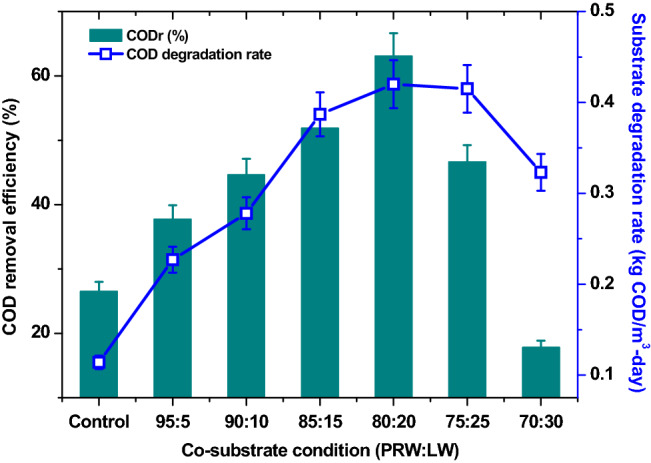
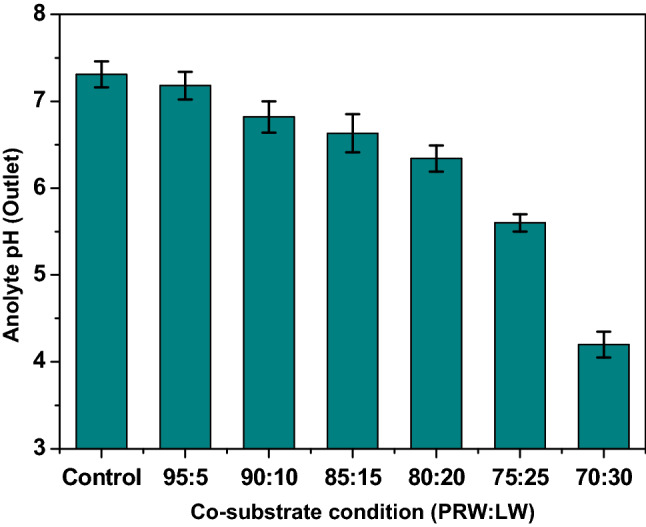
Petroleum refinery wastewater (PRW) that contains recalcitrant components as the major portion of constituents is difficult to treat by conventional biological processes. Microbial fuel cells (MFCs) which also produce renewable energy were found to be promising for the treatment of PRW. However, due to the high total dissolved solids and low organic matter content, the efficiency of the process is limited. Labaneh whey (LW) wastewater, having higher biodegradability and high organic matter was evaluated as co-substrate along with PRW in standard dual chambered MFC to achieve improved power generation and treatment efficiency. Among several concentrations of LW as co-substrate in the range of 5-30% (v/v) with PRW, 85:15 (PRW:LW) showed to have the highest power generation (power density (PD), 832 mW/m2), which is two times higher than the control with PRW as sole substrate (PD, 420 mW/m2). On the contrary, a maximum substrate degradation rate of 0.420 kg COD/m3-day (ξCOD, 63.10%), was registered with 80:20 feed. Higher LW ratios in PRW lead to the production of VFA which in turn gradually decreased the anolyte pH to below 4.5 (70:30 feed). This resulted in a drop in the performance of MFC with respect to power generation (274 mW/m2, 70:30 feed) and substrate degradation (ξCOD, 17.84%).
Conflict of interest statement
The authors declare no competing interests.
Figures



References
-
- Guo X, Zhan Y, Chen C, Cai B, Wang Y, Guo S. Influence of packing material characteristics on the performance of microbial fuel cells using petroleum refinery wastewater as fuel. Renew. Energy. 2016;87:437–444. doi: 10.1016/j.renene.2015.10.041. - DOI
-
- Yu L, Han M, He F. A review of treating oily wastewater. Arab. J. Chem. 2017;10:S1913–S1922. doi: 10.1016/j.arabjc.2013.07.020. - DOI
-
- Wang Y, Wang Q, Li M, Yang Y, He W, Yan G, Guo S. An alternative anaerobic treatment process for treatment of heavy oil refinery wastewater containing polar organics. Biochem. Eng. J. 2016;105:44–51. doi: 10.1016/j.bej.2015.08.012. - DOI
-
- Mohanakrishna G, Abu-Reesh IM, Al-Raoush RI. Biological anodic oxidation and cathodic reduction reactions for improved bioelectrochemical treatment of petroleum refinery wastewater. J. Cleaner Prod. 2018;190:44–52. doi: 10.1016/j.jclepro.2018.04.141. - DOI
-
- Dold PL. (1989) Current practice for treatment of petroleum refinery wastewater and toxics removal. Water Qual. Res. J. Can. 1989;24(3):363–390. doi: 10.2166/wqrj.1989.023. - DOI
Publication types
LinkOut - more resources
Full Text Sources
