


Environmental contamination and risk factors for geohelminth transmission in three informal settlements in Durban metropole, South Africa
- PMID: 33184546
- PMCID: PMC7596138
- DOI: 10.1007/s12639-020-01270-0
Environmental contamination and risk factors for geohelminth transmission in three informal settlements in Durban metropole, South Africa
Abstract
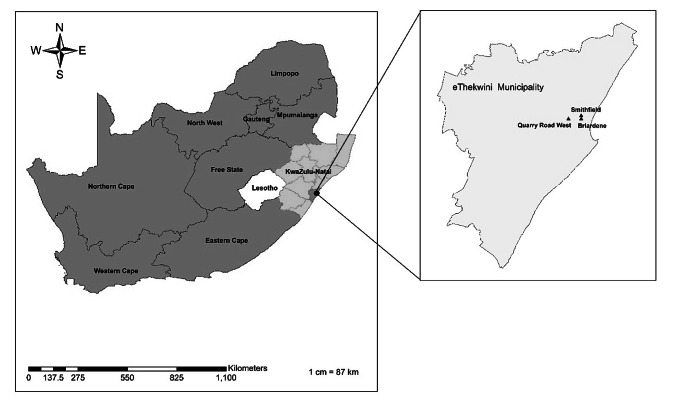
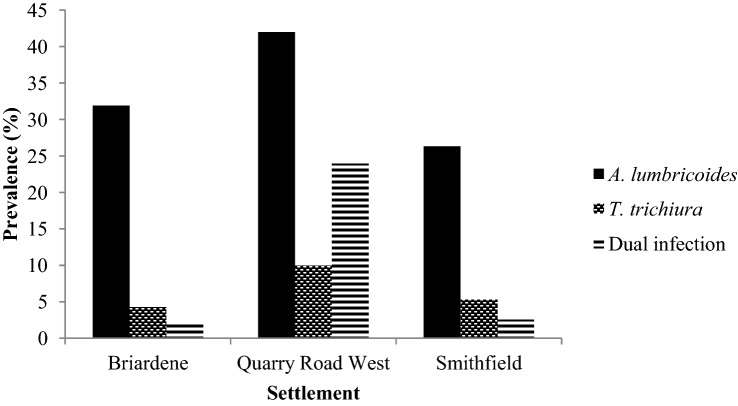
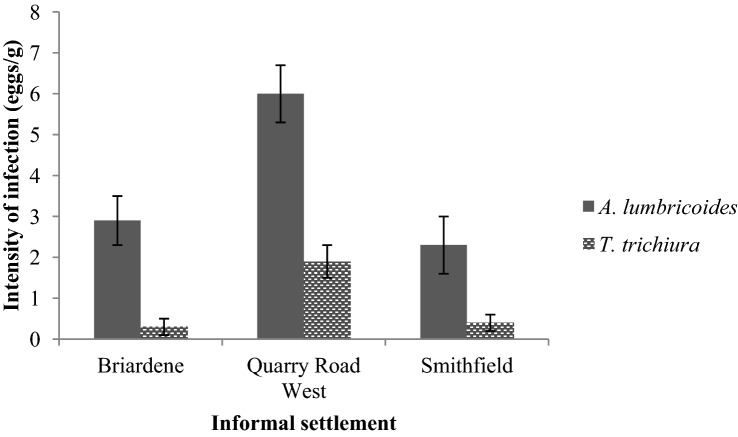
Informal settlements/slums are characterised by a lack of adequate sanitation and safe drinking water. Contaminated soil and water sources combined with poor hygiene and environmental conditions results in the transmission of soil transmitted helminths to humans. The aim of the present study was to assess environmental contamination and risk factors for geohelminth transmission in three informal settlements in Durban, South Africa. Each settlement had different types of sanitation facilities namely; flush toilets, pit latrines and chemical toilets. Thirty adult members from 30 households from each settlement were interviewed to determine their knowledge, attitudes and behaviour on geohelminth transmission. Furthermore, two hundred soil samples were collected from areas considered potential sources of infection and processed for the detection and identification of geohelminth eggs. Prevalence and intensities of geohelminth infections from school-age children were also assessed. From the total collection in the three settlements, 31.6% (95/190) were positive for geohelminth eggs with Ascaris lumbricoides, Trichuris trichiura and Taenia spp. eggs being recovered. Quarry Road West (57%; 114/200) showed the highest levels of soil contamination followed by Briardene (27%; 54/200) and Smithfield (11%; 22/200). Stool samples collected from 135 children were found to contain parasite eggs of A. lumbricoides and T. trichiura. Prevalences and intensities of infection were highest in Quarry Road West for both A. lumbricoides (42%, 57/135; 6.0eggs/g) and T. trichiura (10%, 14/135; 1.9eggs/g) and 9.6% (13/135) harboured dual infections. Open defaecation by community members was observed as the main contributing factor for the presence of geohelminth eggs in soil.
Keywords: Geohelminth eggs; Infection rates; Informal settlements; Sanitation; Soil contamination.
© Indian Society for Parasitology 2020.
Conflict of interest statement
Conflict of interestThe authors declare they have no conflict of interest.
Figures
References
-
- Amadi EC, Uttah EC. Bionomics of geohelminth nematodes in contaminated foci in parts of Abua Communities, Niger Delta, Nigeria (A) J Environ Mang. 2010;14:61–64.
-
- Amaechi EC, Taiwo OO, Edungbola LE, Nyamngee A, Ikpi RT. Soil-transmitted nematode infections in school children in a peri-urban area, north central Nigeria. Sri Lankan J Biol. 2019;4:1–12.
-
- Appleton CC, Gouws E. The distribution of common intestinal nematodes along an altitudinal transect in KwaZulu-Natal, South Africa. Ann Trop Med Parasit. 1996;90:181–188. - PubMed
-
- Appleton C, Maurihungirire M, Gouws M. The distribution of helminth infections along the coastal plain of KwaZulu-Natal province, South Africa. Ann Trop Med Parasit. 1999;93:859–868. - PubMed
-
- Appleton CC, Mosala TI, Levin J, Olsen A. Geohelminth infection and re-infection after chemotherapy among slum-dwelling children in Durban, South Africa. Ann Trop Med Parasit. 2009;103:2–13. - PubMed
LinkOut - more resources
Full Text Sources
Miscellaneous