


Evaluation of the effect of Peganum harmala extracts on the in vitro viability of Leishmania tropica promastigotes in comparison to Glucantime
- PMID: 33184551
- PMCID: PMC7596110
- DOI: 10.1007/s12639-020-01232-6
Evaluation of the effect of Peganum harmala extracts on the in vitro viability of Leishmania tropica promastigotes in comparison to Glucantime
Abstract
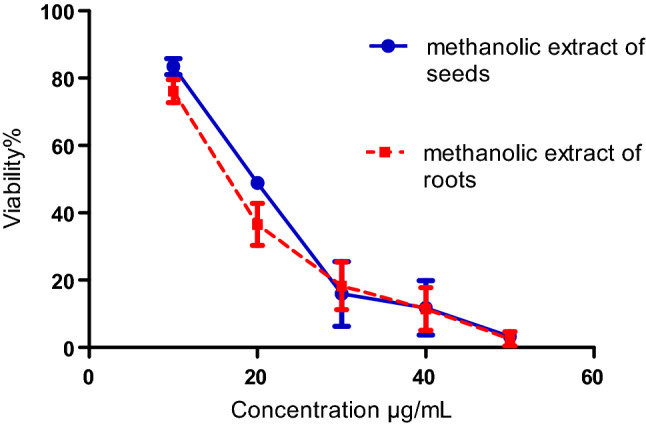
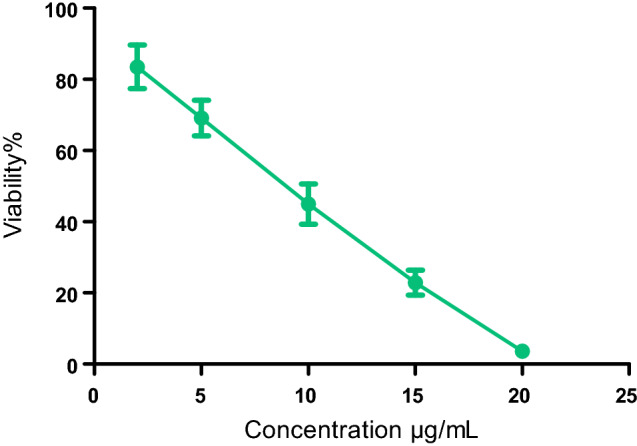
Cutaneous leishmaniasis is a skin disease that pretends with skin lesions, mainly ulcers, on exposed parts of the body. It's caused mainly by parasites belonging to the genus Leishmania, such as L. tropica. Medicinal plants, which have sparked recent researches attention, consider one of the richest sources of active compounds against the Leishmania parasite including Peganum harmala. This study was conducted to investigate the antileishmanial effect of different extracts of Peganum harmala grown in Syria, particularly the methanolic extract of seeds and roots as well as its alkaloid fractions on Leishmania tropica promastigotes growth in vitro. After culturing promastigotes and incubating with extracts for 72 h, the surviving promastigotes were counted. The half maximal (50%) inhibitory concentration (IC50) was determined. The experiments were repeated at least three times. The in vitro experiment has demonstrated a concentration-dependent decrease of parasites number caused by the extracts with an IC50 value of 18.61 ± 0.87 µg/mL and 16.41 ± 0.71 µg/mL for the methanolic extract of seeds and roots respectively. While the IC50 of the alkaloid fractions of seeds and roots were 4.97 ± 0.43 μg/mL and 9.23 ± 0.86 μg/mL respectively. There was a significant difference between all extracts and Glucantime which had IC50 = 32.62 ± 0.66 µg/mL.
Keywords: Alkaloids; Cutaneous leishmaniasis; Glucantime; Leishmania tropica; Medicinal plants; Peganum harmala.
© Indian Society for Parasitology 2020.
Conflict of interest statement
Conflict of interestThe authors declare that they have no conflict of interest.
Figures



References
-
- Asgarpanah J, Ramezanloo F. Chemistry, pharmacology and medicinal properties of Peganum harmala L. Afr J Pharm Pharmacol. 2012;6(22):1573–1580. doi: 10.5897/ajpp11.876. - DOI
-
- Brobst A, Lewis J, Klett B, Haustein C, Shriver J. The free base extraction of harmaline from Penganum harmala. Am J Undergrad Res. 2009;8:2–3. doi: 10.33697/ajur.2009.013. - DOI
-
- Das BB, Ganguly A, Majumder HK. DNA topoisomerases of Leishmania: the potential targets for anti-leishmanial therapy. In: Majumder HK, editor. Drug targets in Kinetoplastid parasites. New York: Springer Science and Business Media; 2008. pp. 103–115. - PubMed
LinkOut - more resources
Full Text Sources