Review
. 2021 Feb 1;320(2):H584-H592.
doi: 10.1152/ajpheart.00634.2020. Epub 2020 Nov 13.

Coronary remodeling and biomechanics: Are we going with the flow in 2020?

Affiliations
Review

Coronary remodeling and biomechanics: Are we going with the flow in 2020?

Patricia E McCallinhart et al. Am J Physiol Heart Circ Physiol. .

Abstract

Under normal conditions, coronary blood flow (CBF) provides critical blood supply to the myocardium so that it can appropriately meet the metabolic demands of the body. Dogmatically, there exist several known regulators and modulators of CBF that include local metabolites and neurohormonal factors that can influence the function of the coronary circulation. In disease states such as diabetes and myocardial ischemia, these regulators are impaired or shifted such that CBF is reduced. Although functional considerations have been and continued to be well studied, more recent evidence builds upon established studies that collectively suggest that the relative roles of coronary structure, biomechanics, and the influence of cardiac biomechanics via extravascular compression may also play a significant role in dictating CBF. In this mini review, we discuss these regulators of CBF under normal and pathophysiological conditions and their potential influence on the control of CBF.

Keywords: biomechanics; coronary blood flow; function; stiffness; structure.


Conflict of interest statement

No conflicts of interest, financial or otherwise, are declared by the authors.

Figures
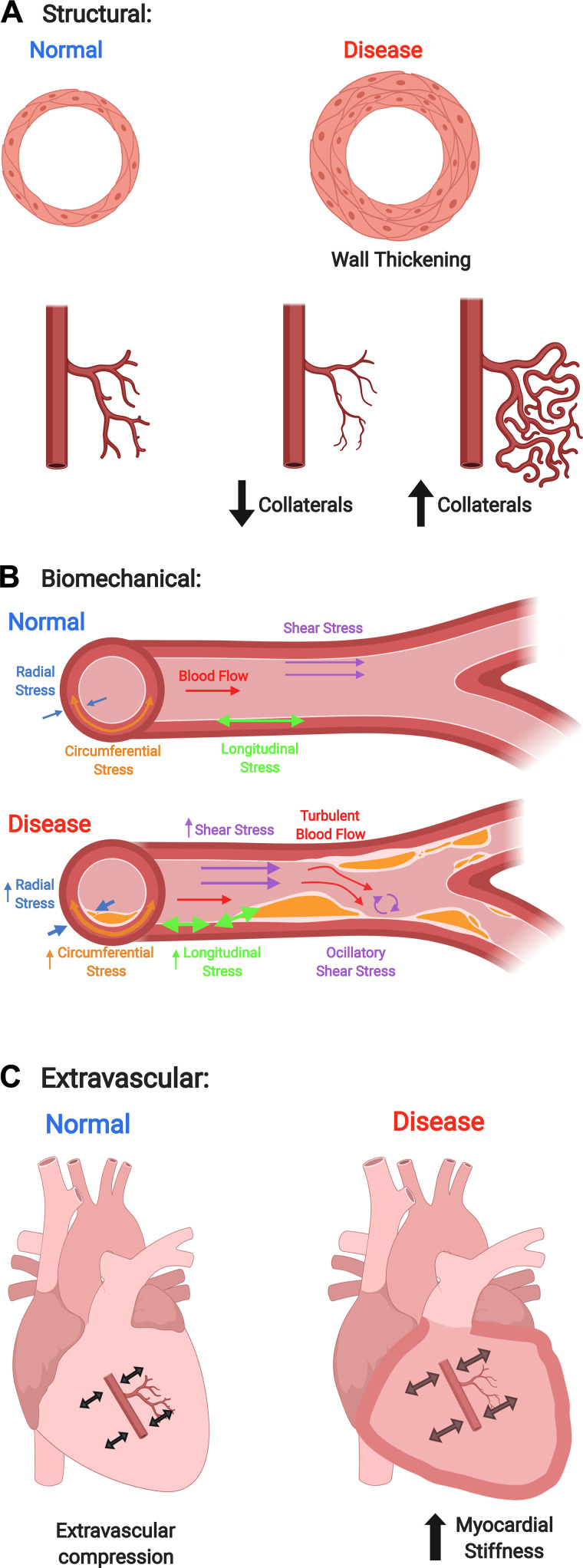
Figure 1.
Figure 1.
Coronary blood flow (CBF) is regulated by a myriad of physiological parameters. Conventionally, studies have focused on one of these parameters, however, under pathological conditions, typically more than one of these parameters goes awry. In this figure we depict how structural (A), biomechanical (B), and extravascular (C) parameters may change during normal and pathological conditions. Typically, functional changes are due to vasodilation or vasoconstriction to maintain CBF. Structural modifications may include changes in radius, wall thickness, and vessel length. Biomechanical factors include vessel material properties (i.e., stiffness), and forces acting on the vessels (e.g., shear, longitudinal, radial, and circumferential stresses). Extravascular alterations may include changes in myocardial stiffness and changes in viscosity. The figure was created using www.BioRender.com with permission.

References

    1. Muller-Delp JM. The coronary microcirculation in health and disease. ISRN Physiology 2013: 238979, 2013. doi: 10.1155/2013/238979. - DOI
    1. Muller JM, Davis MJ, Chilian WM. Integrated regulation of pressure and flow in the coronary microcirculation. Cardiovasc Res 32: 668–678, 1996. doi: 10.1016/S0008-6363(96)00111-3. - DOI - PubMed
    1. Goodwill AG, Dick GM, Kiel AM, Tune JD. Regulation of coronary blood flow. Compr Physiol 7: 321–382, 2017. doi: 10.1002/cphy.c160016. - DOI - PMC - PubMed
    1. Chilian WM, Eastham CL, Marcus ML. Microvascular distribution of coronary vascular resistance in beating left ventricle. Am J Physiol 251: H779–H788, 1986. doi: 10.1152/ajpheart.1986.251.4.H779. - DOI - PubMed
    1. Ross R. Atherosclerosis–an inflammatory disease. N Engl J Med 340: 115–126, 1999. doi: 10.1056/NEJM199901143400207. - DOI - PubMed

Publication types

LinkOut - more resources