


Once Daily Versus Overnight and Symptom Versus Physiological Monitoring to Detect Exacerbations of Chronic Obstructive Pulmonary Disease: Pilot Randomized Controlled Trial
- PMID: 33185560
- PMCID: PMC7695523
- DOI: 10.2196/17597
Once Daily Versus Overnight and Symptom Versus Physiological Monitoring to Detect Exacerbations of Chronic Obstructive Pulmonary Disease: Pilot Randomized Controlled Trial
Abstract
Background: Earlier detection of chronic obstructive pulmonary disease (COPD) exacerbations may facilitate more rapid treatment with reduced risk of hospitalization. Changes in pulse oximetry may permit early detection of exacerbations. We hypothesized that overnight pulse oximetry would be superior to once-daily monitoring for the early detection of exacerbations.
Objective: This study aims to evaluate whether measuring changes in heart rate and oxygen saturation overnight is superior to once-daily monitoring of both parameters and to assess symptom changes in facilitating earlier detection of COPD exacerbations.
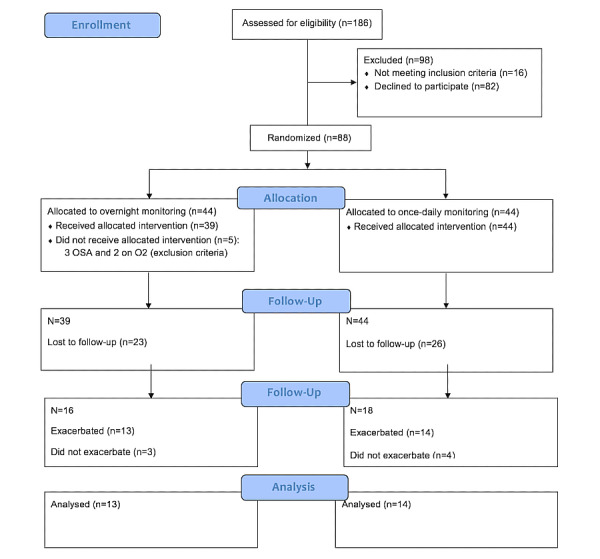
Methods: A total of 83 patients with COPD were randomized to once-daily or overnight pulse oximetry. Both groups completed the COPD assessment test questionnaire daily. The baseline mean and SD for each pulse oximetry variable were calculated from 14 days of stable monitoring. Changes in exacerbation were expressed as Z scores from this baseline.
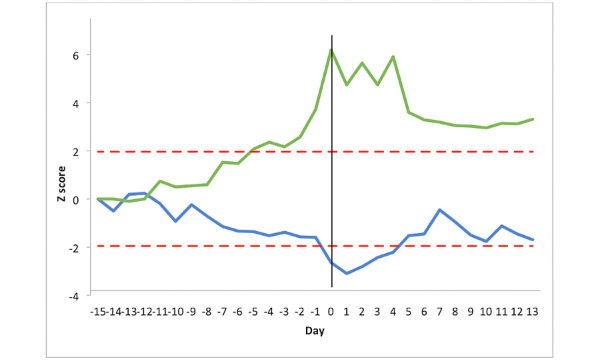
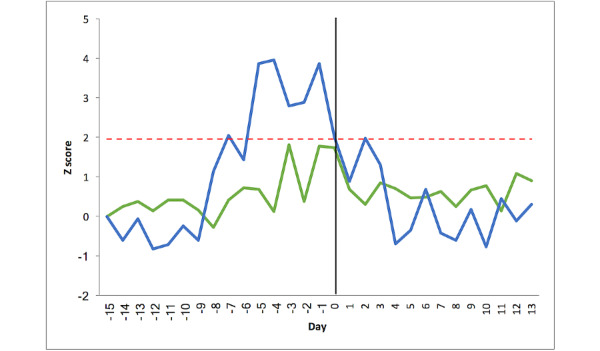
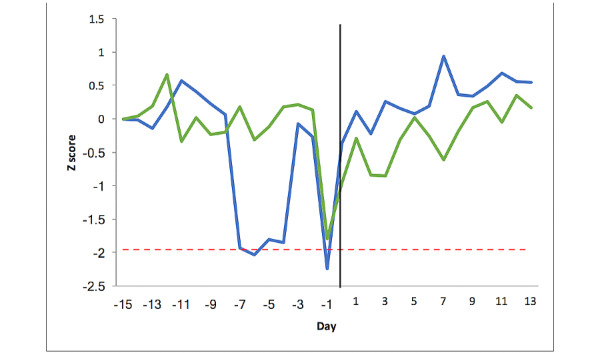
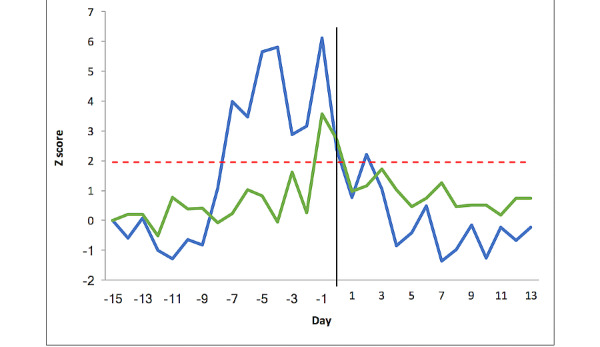
Results: The mean age of the patients was 70.6 (SD 8.1) years, 52% (43/83) were female, and the mean FEV1 was 53.0% (SD 18.5%) predicted. Of the 83 patients, 27 experienced an exacerbation. Symptoms were significantly elevated above baseline from 5 days before to 12 days after treatment initiation. Day-to-day variation in pulse oximetry during the stable state was significantly less in the overnight group than in the once-daily group. There were greater relative changes at exacerbation in heart rate than oxygen saturation. An overnight composite score of change in heart rate and oxygen saturation changed significantly from 7 days before initiation of treatment for exacerbation and had a positive predictive value for exacerbation of 91.2%. However, this was not statistically better than examining changes in symptoms alone.
Conclusions: Overnight pulse oximetry permits earlier detection of COPD exacerbations compared with once-daily monitoring. Monitoring physiological variables was not superior to monitoring symptoms, and the latter would be a simpler approach, except where there is a need for objective verification of exacerbations.
Trial registration: ClinicalTrials.gov NCT03003702; https://clinicaltrials.gov/ct2/show/NCT03003702.
Keywords: CAT; chronic obstructive pulmonary disease; exacerbations; heart rate; oxygen saturation; telehealth.
©Ahmed M Al Rajeh, Yousef Saad Aldabayan, Abdulelah Aldhahir, Elisha Pickett, Shumonta Quaderi, Jaber S Alqahtani, Swapna Mandal, Marc CI Lipman, John R Hurst. Originally published in JMIR mHealth and uHealth (http://mhealth.jmir.org), 13.11.2020.
Conflict of interest statement
Conflicts of Interest: None declared.
Figures
References
-
- Burden of COPD. World Health Organization. [2019-01-29]. https://www.who.int/respiratory/copd/burden/en/
-
- World Health Statistics. World Health Organization. 2008. [2019-01-18]. https://www.who.int/whosis/whostat/EN_WHS08_Full.pdf?ua=1 .
-
- Lee S, Huang M, Kang J, Lin C, Park MJ, Oh Y, Kwon N, Jones PW, Sajkov D, Investigators of the Predictive Ability of CAT in Acute Exacerbations of COPD (PACE) Study The COPD assessment test (CAT) assists prediction of COPD exacerbations in high-risk patients. Respir Med. 2014 Apr;108(4):600–8. doi: 10.1016/j.rmed.2013.12.014. https://linkinghub.elsevier.com/retrieve/pii/S0954-6111(13)00500-3 S0954-6111(13)00500-3 - DOI - PubMed
-
- Chronic Obstructive Pulmonary Disease (COPD) Facts Sheet. World Health Organization. 2017. Dec 01, [2019-01-29]. https://www.who.int/news-room/fact-sheets/detail/chronic-obstructive-pul...
Publication types
MeSH terms
Associated data
LinkOut - more resources
Full Text Sources
Medical
Miscellaneous
