Comparative Study
. 2021 Mar 9;38(3):1060-1074.
doi: 10.1093/molbev/msaa274.

Evolution of Embryo Implantation Was Enabled by the Origin of Decidual Stromal Cells in Eutherian Mammals

Affiliations
Comparative Study

Evolution of Embryo Implantation Was Enabled by the Origin of Decidual Stromal Cells in Eutherian Mammals

Arun R Chavan et al. Mol Biol Evol. .

Abstract

Mammalian pregnancy evolved in the therian stem lineage, that is, before the common ancestor of marsupials and eutherian (placental) mammals. Ancestral therian pregnancy likely involved a brief phase of attachment between the fetal and maternal tissues followed by parturition-similar to the situation in most marsupials including the opossum. In all eutherians, however, embryo attachment is followed by implantation, allowing for a stable fetal-maternal interface and an extended gestation. Embryo attachment induces an attachment reaction in the uterus that is homologous to an inflammatory response. Here, we elucidate the evolutionary mechanism by which the ancestral inflammatory response was transformed into embryo implantation in the eutherian lineage. We performed a comparative uterine transcriptomic and immunohistochemical study of three eutherians, armadillo (Dasypus novemcinctus), hyrax (Procavia capensis), and rabbit (Oryctolagus cuniculus); and one marsupial, opossum (Monodelphis domestica). Our results suggest that in the eutherian lineage, the ancestral inflammatory response was domesticated by suppressing one of its modules detrimental to pregnancy, namely, neutrophil recruitment by cytokine IL17A. Further, we propose that this suppression was mediated by decidual stromal cells, a novel cell type in eutherian mammals. We tested a prediction of this model in vitro and showed that decidual stromal cells can suppress the production of IL17A from helper T cells. Together, these results provide a mechanistic understanding of early stages in the evolution of eutherian pregnancy.

Keywords: homology; interleukin-17; marsupial; mucosal inflammation; placental; pregnancy.


Figures

Fig. 1.
Fig. 1.
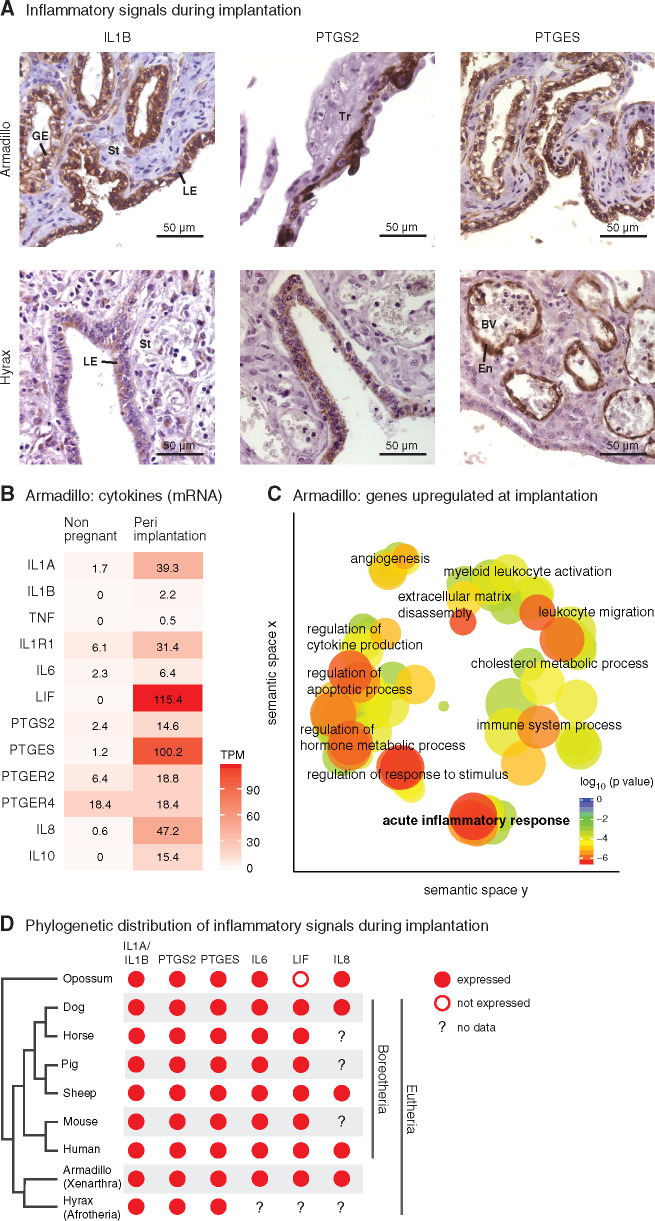
Inflammatory implantation is an ancestral eutherian character. (A) Immunohistochemistry for inflammation marker genes IL1B, PTGS2, and PTGES at the fetal–maternal interface in armadillo (peri-implantation stage) and hyrax (peri-implantation stage). Nuclei are blue due to hematoxylin counterstaining and the immunostaining signal is brown due to 3,3′-diaminobenzidine (DAB). GE, glandular epithelium; LE, luminal epithelium; St, stroma; Tr, trophoblast; BV, blood vessel; En, endothelium. (B) Abundance of mRNA transcripts (TPM = Transcripts per Million) of key inflammatory genes in armadillo uterus in nonpregnant and peri-implantation stage. Armadillo has two orthologs of IL6, ENSDNOG00000017107 and ENSDNOG00000023693, of which the former is shown here; the latter is not expressed. (C) Enriched GO categories among the genes that are upregulated at least 10-fold in armadillo uterus in transition from nonpregnant to peri-implantation stage. GO categories are clustered by semantic similarity. GO categories closer to each other are semantically similar; those represented by red circles are more significantly enriched than those in blue. (D) Comparison of expression of inflammatory genes during embryo attachment or implantation in therian mammals. Data for human: cytokines (reviewed by Van Sinderen et al. [2013]), PTGS2 (Marions and Danielsson 1999), and PTGES (Milne et al. 2001). Data for sheep, horse, pig, dog, and mouse (reviewed by Chavan et al. [2017]).
Fig. 2.
Fig. 2.
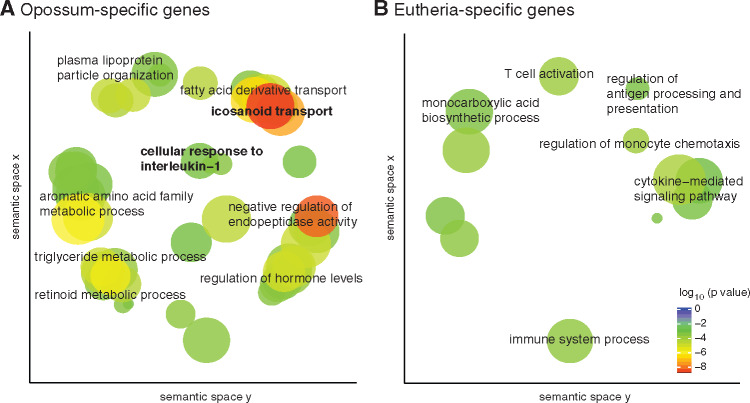
Transcriptomic differences between marsupial and eutherian attachment reaction. GO categories enriched in each set are shown in the figures, where semantically similar categories are clustered together in space. Genes were classified as (A) opossum-specific (B) eutherian-specific.
Fig. 3.
Fig. 3.
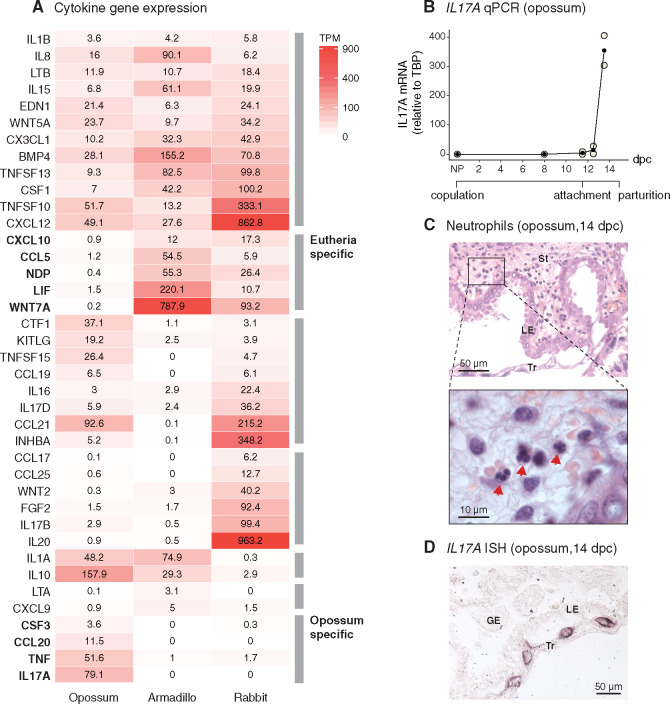
IL17A signaling is suppressed in eutherians. (A) Gene expression of cytokines in opossum (attachment stage, 13.5 dpc), armadillo (peri-implantation stage), and rabbit (implantation stage, 7.25 dpc) uterus. Intensity of red is proportional to the abundance of mRNA. Genes expressed below 3 TPM are considered unexpressed (Wagner et al. 2013). Rows are ordered by the gene expression patterns across species: expressed in all species; expressed only in Eutheria; expressed in opossum and rabbit, rabbit-specific; and expressed in opossum and armadillo, armadillo-specific, and opossum-specific. Cytokines not expressed in any of these species are not shown in the figure. (B) Expression of IL17A through the pregnancy of opossum, measured relative to TBP, by qPCR. Embryo attachment begins around 11.5 dpc, and pregnancy ends at 14.5 dpc (number of biological replicates: NP = 3, 8 dpc = 3, 11.5 dpc = 2, 12.5 dpc = 2, and 13.5 dpc = 2). (C) Neutrophil infiltration in H&E stained opossum uterus at 14 dpc, indicated by red arrows in the zoomed-in micrograph. (D) In situ hybridization for IL17A in opossum at 14 dpc. IL17A staining is detected in the trophoblast cells. LE, luminal epithelium; GE, glandular epithelium; St, stroma; Tr, trophoblast; TPM, Transcripts per Million.
Fig. 4.
Fig. 4.
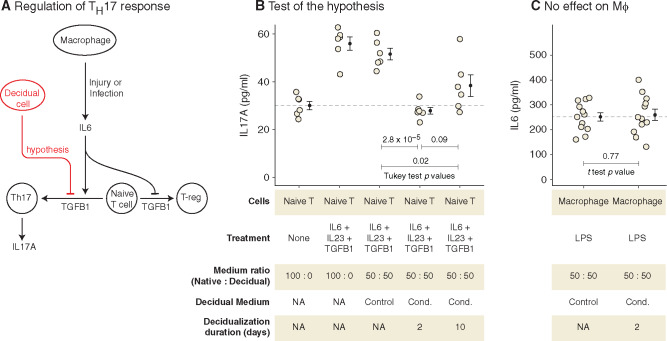
DSCs suppress IL17A production in TH17 cells. (A) Schematic showing how TH17 cells differentiate from naïve T cells, and the hypothesis for the role of DSC. (B) Test of the hypothesis using in vitro differentiation of human naïve T cells into TH17 cells. IL17A secretion (pg/ml) by TH17 cells is shown (mean and standard error of the mean). The first two samples are reference points, where TH17 cells were differentiated in their native medium, and the last three samples were differentiated in DSC control or conditioned medium. (See supplementary figure 2, Supplementary Material online, for mRNA levels of IL17A.) (C) DSC-conditioned medium has no effect on the activation of macrophages. IL6 secreted (pg/ml) by LPS-stimulated macrophages in the presence of control or DSC-conditioned medium is shown (mean and standard error of the mean). Cond, conditioned.
Fig. 5.
Fig. 5.
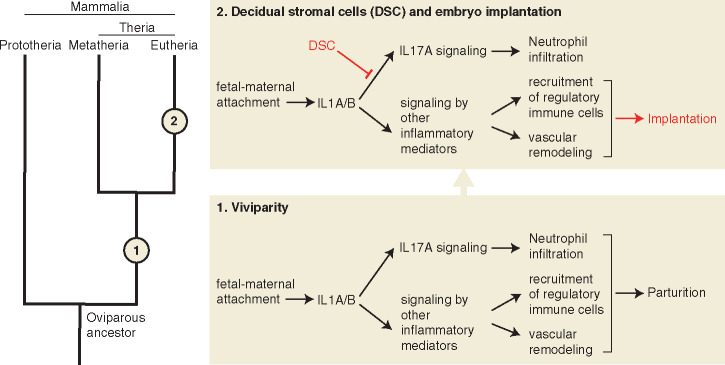
Model for the evolution of eutherian implantation from attachment-induced inflammation. Evolutionary events in the therian and eutherian stem lineages are represented by numbers 1 and 2, respectively.

References

    1. Abzhanov A. 2009. In situ hybridization analysis of embryonic beak tissue from Darwin’s finches. Cold Spring Harb Protoc. 2009(3):pdb.prot5175. - PubMed
    1. Anders S, Pyl PT, Huber W.. 2015. HTSeq—a Python framework to work with high-throughput sequencing data. Bioinformatics 31(2):166–169. - PMC - PubMed
    1. Ashary N, Tiwari A, Modi D.. 2018. Embryo implantation: war in times of love. Endocrinology 159(2):1188–1198. - PubMed
    1. Barash A, Dekel N, Fieldust S, Segal I, Schechtman E, Granot I.. 2003. Local injury to the endometrium doubles the incidence of successful pregnancies in patients undergoing in vitro fertilization. Fertil Steril. 79(6):1317–1322. - PubMed
    1. Barrett T, Wilhite SE, Ledoux P, Evangelista C, Kim IF, Tomashevsky M, Marshall KA, Phillippy KH, Sherman PM, Holko M, et al.2013. NCBI GEO: archive for functional genomics data sets—update. Nucleic Acids Res. 41(D1):D991–D995. - PMC - PubMed

Publication types