Review
. 2020 Nov 13;18(11):e3000953.
doi: 10.1371/journal.pbio.3000953. eCollection 2020 Nov.

Find and fuse: Unsolved mysteries in sperm-egg recognition

Affiliations
Review

Find and fuse: Unsolved mysteries in sperm-egg recognition

Enrica Bianchi et al. PLoS Biol. .

Abstract

Sexual reproduction is such a successful way of creating progeny with subtle genetic variations that the vast majority of eukaryotic species use it. In mammals, it involves the formation of highly specialised cells: the sperm in males and the egg in females, each carrying the genetic inheritance of an individual. The interaction of sperm and egg culminates with the fusion of their cell membranes, triggering the molecular events that result in the formation of a new genetically distinct organism. Although we have a good cellular description of fertilisation in mammals, many of the molecules involved remain unknown, and especially the identity and role of cell surface proteins that are responsible for sperm-egg recognition, binding, and fusion. Here, we will highlight and discuss these gaps in our knowledge and how the role of some recently discovered sperm cell surface and secreted proteins contribute to our understanding of this fundamental process.


Conflict of interest statement

The authors have declared that no competing interests exist

Figures
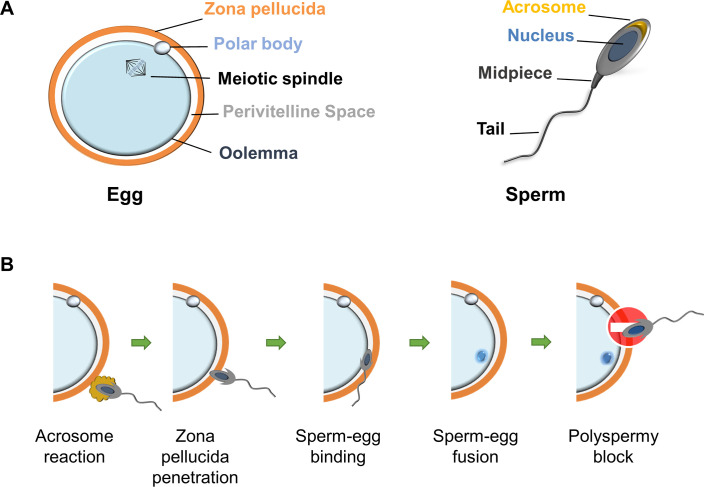
Fig 1
Fig 1. Schematic of mammalian gametes and the different stages of fertilisation.
(A) Prior to fertilisation, mammalian eggs are held at metaphase II of the second meiotic division with the chromosomes aligned on the metaphase plate; half of the maternal DNA has been extruded and held within the polar body during meiosis I. The oolemma overlaying the meiotic spindle is devoid of microvilli, and sperm do not adhere or fuse in this region. Note that the egg and sperm are not drawn at scale; the sperm head is 5–10 times smaller than the egg. (B) Fertilisation is separated into a series of distinct stages. The acrosome reaction releases enzymes and exposes sperm ligands (such as IZUMO1) that were previously sequestered within the sperm head, and only acrosome-reacted sperm can pass through the ZP and fertilise the egg. Binding and fusion are regarded as separate events because there is evidence that they can be genetically and experimentally distinguished. The changes in the egg induced by fertilisation reduce the ability of sperm to fuse with an already fertilised egg in a mechanism known as the polyspermy block. The modifications occur at both the egg membrane and the ZP (for extensive reviews on this subject, see [–6]). ZP, zona pellucida.
Fig 2
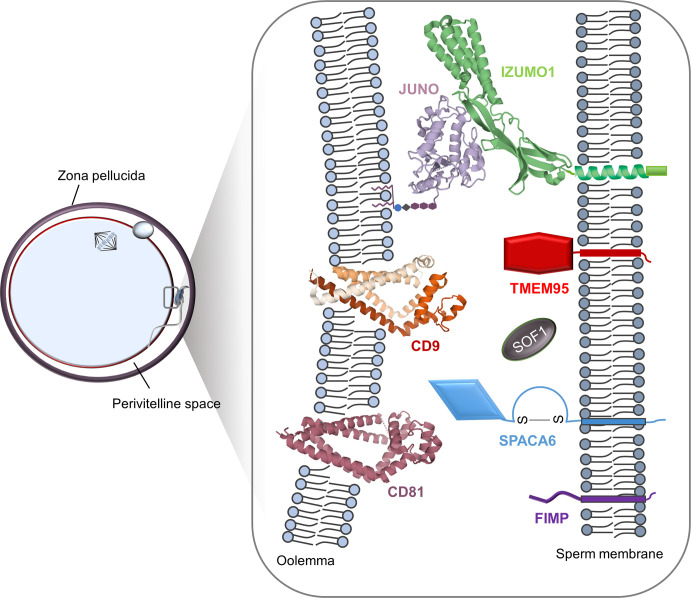
Fig 2. Cell surface proteins required for fertilisation in mammals.
The binding of the GPI-anchored egg protein JUNO to the ectodomain of the sperm protein IZUMO1 ensures the adhesion of gamete cell membranes and is essential for fertilisation. Three single-pass membrane proteins expressed by sperm—SPACA6, TMEM95, and FIMP—are necessary for fertilisation. Like IZUMO1, the extracellular region of SPACA6 contains an immunoglobulin-like domain, whereas no structural data are available for TMEM95 and FIMP. The fourth sperm protein essential for fertilisation, SOF1, is a putative secreted molecule with an unknown structure. Two tetraspanins, CD9 and CD81, are also required for fertilisation, and there is no evidence that they directly interact with any of the other proteins. CD, Cluster of Differentiation; FIMP, Fertilisation Influencing Membrane Protein; GPI, Glycosylphosphatidylinositol; SOF1, Sperm–Oocyte Fusion required 1; SPACA6, SPerm ACrosome membrane-Associated protein 6; TMEM95, TransMEMbrane protein 95.

References

    1. Hirohashi N, Yanagimachi R. Sperm acrosome reaction: its site and role in fertilization. Biol Reprod. 2018;99: 127–133. 10.1093/biolre/ioy045 - DOI - PubMed
    1. Ramalho-Santos J, Schatten G, Moreno RD. Control of membrane fusion during spermiogenesis and the acrosome reaction. Biol Reprod. 2002;67: 1043–1051. 10.1095/biolreprod67.4.1043 - DOI - PubMed
    1. Bianchi E, Wright GJ. Sperm Meets Egg: The Genetics of Mammalian Fertilization. Annu Rev Genet. 2016;50: 93–111. 10.1146/annurev-genet-121415-121834 - DOI - PubMed
    1. Evans JP. Preventing polyspermy in mammalian eggs-Contributions of the membrane block and other mechanisms. Mol Reprod Dev. 2020;87: 341–349. 10.1002/mrd.23331 - DOI - PubMed
    1. Gardner AJ, Evans JP. Mammalian membrane block to polyspermy: new insights into how mammalian eggs prevent fertilisation by multiple sperm. Reprod Fertil Dev. 2006;18: 53–61. 10.1071/rd05122 - DOI - PubMed

Publication types

Substances