Clinical Trial
. 2020 Dec:62:103112.
doi: 10.1016/j.ebiom.2020.103112. Epub 2020 Nov 11.

A clade of SARS-CoV-2 viruses associated with lower viral loads in patient upper airways

Affiliations
Clinical Trial

A clade of SARS-CoV-2 viruses associated with lower viral loads in patient upper airways

Ramon Lorenzo-Redondo et al. EBioMedicine. 2020 Dec.

Abstract

Background: The rapid spread of SARS-CoV-2, the causative agent of Coronavirus disease 2019 (COVID-19), has been accompanied by the emergence of distinct viral clades, though their clinical significance remains unclear. Here, we aimed to investigate the phylogenetic characteristics of SARS-CoV-2 infections in Chicago, Illinois, and assess their relationship to clinical parameters.

Methods: We performed whole-genome sequencing of SARS-CoV-2 isolates collected from COVID-19 patients in Chicago in mid-March, 2020. Using these and other publicly available sequences, we performed phylogenetic, phylogeographic, and phylodynamic analyses. Patient data was assessed for correlations between demographic or clinical characteristics and virologic features.

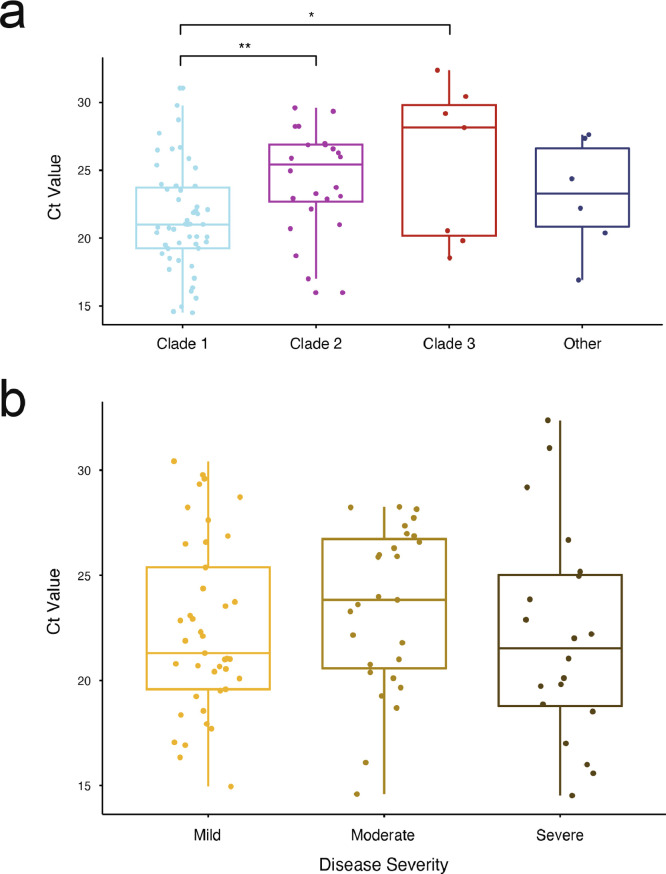
Findings: The 88 SARS-CoV-2 genome sequences in our study separated into three distinct phylogenetic clades. Clades 1 and 3 were most closely related to viral sequences from New York and Washington state, respectively, with relatively broad distributions across the US. Clade 2 was primarily found in the Chicago area with limited distribution elsewhere. At the time of diagnosis, patients infected with Clade 1 viruses had significantly higher average viral loads in their upper airways relative to patients infected with Clade 2 viruses, independent of disease severity.

Interpretation: These results show that multiple variants of SARS-CoV-2 were circulating in the Chicago area in mid-March 2020 that differed in their relative viral loads in patient upper airways. These data suggest that differences in virus genotype can impact viral load and may influence viral spread.

Funding: Dixon Family Translational Research Award, Northwestern University Clinical and Translational Sciences Institute (NUCATS), National Institute of Allergy and Infectious Diseases (NIAID), Lurie Comprehensive Cancer Center, Northwestern University Emerging and Re-emerging Pathogens Program.

Keywords: COVID-19; Phylogenetics; SARS-CoV-2; Viral genotype; Viral load; Whole genome sequencing.


Conflict of interest statement

Declaration of Competing Interests The authors declare no competing financial interests.

Figures
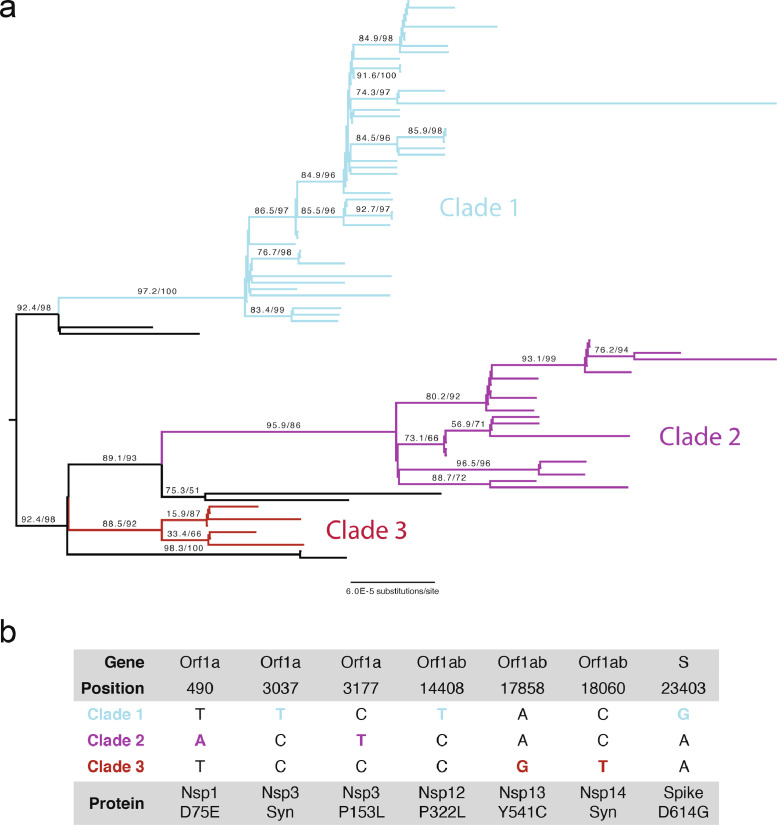
Fig 1
Fig. 1
Phylogenetic Analysis of SARS-CoV-2 Isolates in Chicago. a) ML phylogenetic tree of 88 SARS-CoV-2 specimen genomes from Northwestern Memorial Hospital and Lake Forest Hospital. All non-zero statistical support values for each branch are indicated. Black branches represent sequenced isolates that do not belong to any of the three major clades. Midpoint rooting was used for representation purposes. b) Clade-defining mutations at the US level. Positions are numbered according to the reference genome (NC_045512.2).
Fig 2
Fig. 2
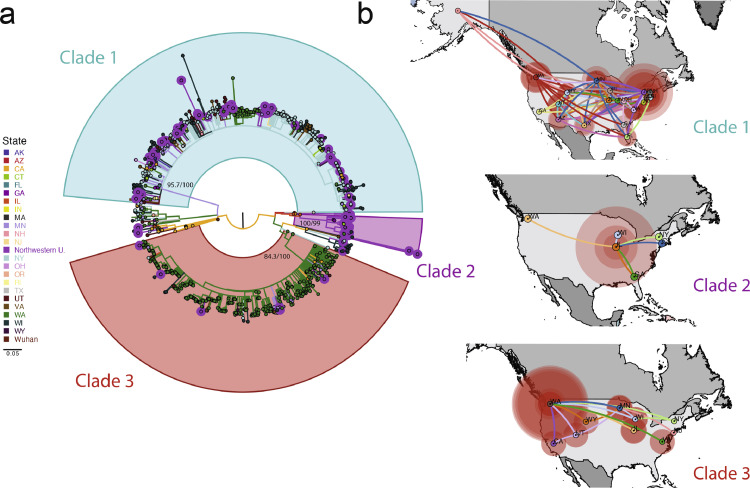
Phylogenetic and Phylogeographic Analysis of Chicago Isolates compared to the US Epidemic. a) ML phylogenetic reconstruction of full genome sequences from the United States. We included sequences from Northwestern and all sequences from the US available in GISAID as of April 4, 2020. Branches are colored by location and tips corresponding to Northwestern sequences are highlighted. Well-supported clades of the tree that include our defined Chicago clades are indicated; approximate likelihood-ratio test (aLRT) and bootstrap values of the main clade branches are indicated proximal to the branch points. b) Phylogeographic patterns of US isolates in three major clades represented in the Chicago collection under a discrete diffusion model. Westward movements are indicated by lines with an upward curvature, eastward movements are indicated by lines with a downward curvature, lines are colored according to the most probable geographical location of their descendent node, and circle sizes around a node are proportional to the number of lineages maintaining that location.
Fig 3
Fig. 3
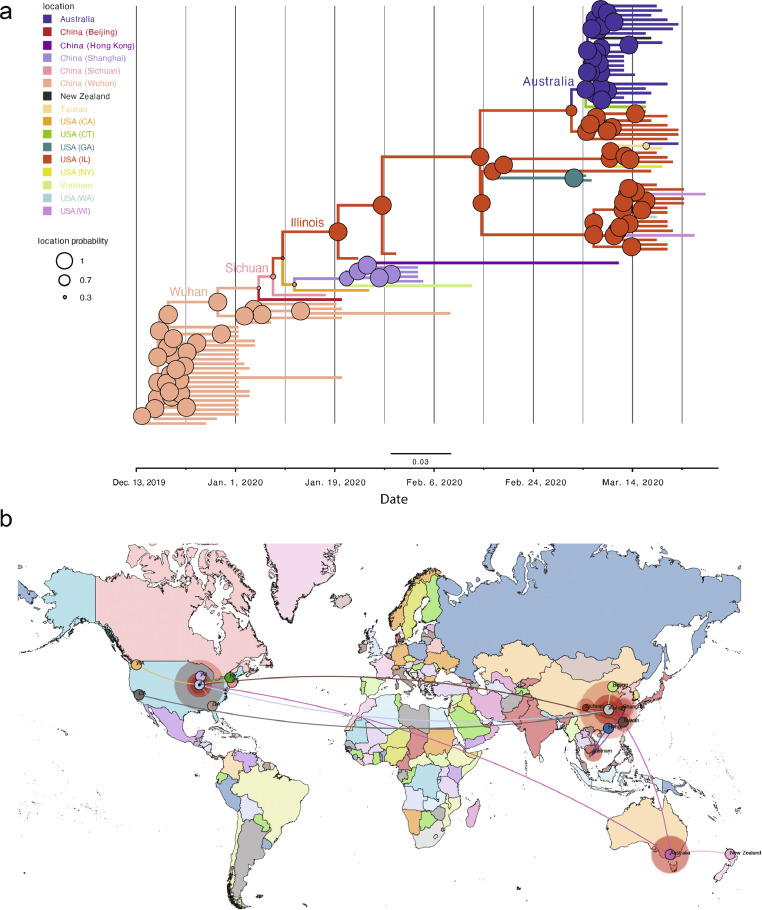
Phylogenetic and Phylogeographic Analysis of Chicago Isolates compared to the Global Pandemic. a) Phylodynamic tree of US and global Clade 2 related genome sequences. We used global sequences phylogenetically related to Clade 2 available in the GISAID database and performed the analysis encompassing simultaneous estimation of sequence and discrete (geographic) trait data. The depicted phylogenetic tree corresponds to the maximum clade credibility tree. Branch colors represent the most probable geographical location of their descendent node inferred through Bayesian reconstruction of the ancestral state. X-axis corresponds to the inferred date. b) Phylogeographic reconstruction of the origin of Clade 2 under a discrete diffusion model. Westward movements are indicated by lines with an upward curvature, eastward movements are indicated by lines with a downward curvature, lines are colored according to the most probable geographical location of their descendent node, and circle sizes around a node are proportional to the number of lineages maintaining that location.
Fig 4
Fig. 4
Associations between Viral Clade and Ct Value and Disease Severity. a) PCR Cycle threshold (Ct) values of patient samples grouped by major Clade assignment. b) Specimen Ct values by maximum disease severity. Mild (blue) = no hospital admission; Moderate (red) = hospital admission, but no ICU stay; Severe (green) = ICU admission. In both panels, horizontal lines in each box represent the median value and the lower and upper error bars are the interquartile ranges. Significance is indicated for the comparisons performed within each fitted model (* = q-value<0.05; ** = q-value <0.01).

Update of

References

    1. Wang C, Horby PW, Hayden FG, Gao GF. A novel coronavirus outbreak of global health concern. The Lancet. 2020;395(10223):470–473. - PMC - PubMed
    1. Zhu N, Zhang D, Wang W. A novel coronavirus from patients with pneumonia in China, 2019. N Engl J Med. 2020;382(8):727–733. - PMC - PubMed
    1. Li Q, Guan X, Wu P. Early transmission dynamics in wuhan, China, of novel coronavirus–infected pneumonia. New Eng J Med. 2020;382(13):1199–1207. - PMC - PubMed
    1. Ceraolo C, Giorgi FM. Genomic variance of the 2019-nCoV coronavirus. J Med Virol. 2020;92(5):522–528. - PMC - PubMed
    1. Lu R, Zhao X, Li J. Genomic characterisation and epidemiology of 2019 novel coronavirus: implications for virus origins and receptor binding. The Lancet. 2020;395(10224):565–574. - PMC - PubMed

Publication types