Review
. 2021 Jan;26(1):41-50.
doi: 10.1038/s41380-020-00949-3. Epub 2020 Nov 13.

Polysubstance use in the U.S. opioid crisis

Affiliations
Review

Polysubstance use in the U.S. opioid crisis

Wilson M Compton et al. Mol Psychiatry. 2021 Jan.

Abstract

Interventions to address the U.S. opioid crisis primarily target opioid use, misuse, and addiction, but because the opioid crisis includes multiple substances, the opioid specificity of interventions may limit their ability to address the broader problem of polysubstance use. Overlap of opioids with other substances ranges from shifts among the substances used across the lifespan to simultaneous co-use of substances that span similar and disparate pharmacological categories. Evidence suggests that nonmedical opioid users quite commonly use other drugs, and this polysubstance use contributes to increasing morbidity and mortality. Reasons for adding other substances to opioids include enhancement of the high (additive or synergistic reward), compensation for undesired effects of one drug by taking another, compensation for negative internal states, or a common predisposition that is related to all substance consumption. But consumption of multiple substances may itself have unique effects. To achieve the maximum benefit, addressing the overlap of opioids with multiple other substances is needed across the spectrum of prevention and treatment interventions, overdose reversal, public health surveillance, and research. By addressing the multiple patterns of consumption and the reasons that people mix opioids with other substances, interventions and research may be enhanced.


Conflict of interest statement

WMC reports ownership of stock in General Electric, 3M, and Pfizer Inc. unrelated to the submitted work. Other authors have no interests to declare.

Figures
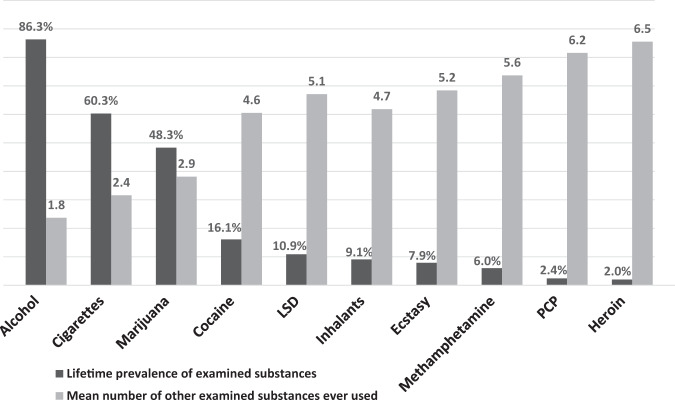
Fig. 1
Fig. 1. Overlap of substances used across the lifetime.
Weighted lifetime prevalence of substance use and mean number of other substances ever used by adults age 18 and older in the United States (n = 51,000; Source: 2018 U.S. National Survey on Drug Use and Health [adapted from Eric Wish, University of Maryland, Center for Substance Abuse Research]).
Fig. 2
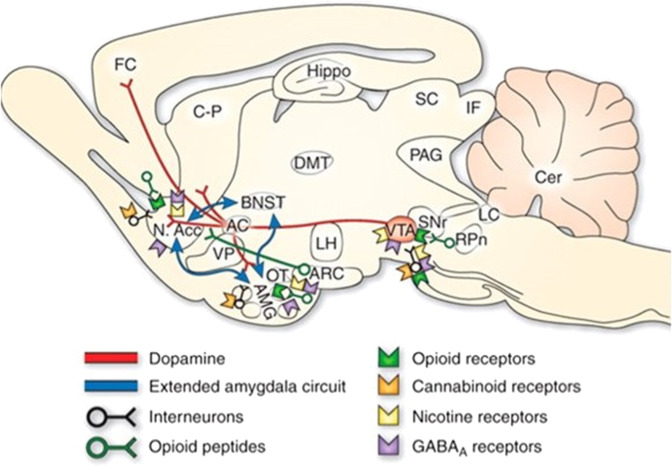
Fig. 2. Rat brain neurochemical neurocircuits in drug reward (From [101]).
Sagittal section through a representative rodent brain illustrating the pathways and receptor systems implicated in the acute reinforcing actions of drugs of abuse. Cocaine and amphetamines activate the release of dopamine in the nucleus accumbens and amygdala through direct actions on dopamine terminals. Opioids activate opioid receptors in the VTA, nucleus accumbens, and amygdala through direct or indirect actions via interneurons. Opioids facilitate the release of dopamine in the nucleus accumbens by an action either in the VTA or the nucleus accumbens, but also are hypothesized to activate elements independent of the dopamine system. Alcohol activates g-aminobutyric acid-A (GABAA) receptors or GABA release in the VTA, nucleus accumbens, and amygdala by either direct actions at the GABAA receptor or through indirect release of GABA. Alcohol is hypothesized to facilitate the release of opioid peptides in the VTA, nucleus accumbens, and central nucleus of the amygdala. Alcohol facilitates the release of dopamine in the nucleus accumbens through an action either in the VTA or the nucleus accumbens. Nicotine activates nicotinic acetylcholine receptors in the VTA, nucleus accumbens, and amygdala, either directly or indirectly, through actions on interneurons. Cannabinoids activate cannabinoid CB1 receptors in the VTA, nucleus accumbens, and amygdala. Cannabinoids facilitate the release of dopamine in the nucleus accumbens through an unknown mechanism either in the VTA or the nucleus accumbens. The blue arrows represent the interactions within the extended amygdala system hypothesized to have a key function in drug reinforcement. The medial forebrain bundle represents ascending and descending projections between the ventral forebrain (nucleus accumbens, olfactory tubercle, septal area) and the ventral midbrain (VTA) (not shown in figure for clarity). AC anterior commissure, AMG amygdala, ARC arcuate nucleus, BNST bed nucleus of the stria terminalis, Cer cerebellum, C-P caudate-putamen, DMT dorsomedial thalamus, FC frontal cortex, Hippo hippocampus, IF inferior colliculus, LC locus coeruleus, LH lateral hypothalamus, N Acc. nucleus accumbens, OT olfactory tract, PAG periaqueductal gray, RPn reticular pontine nucleus, SC superior colliculus, SNr substantia nigra pars reticulata, VP ventral pallidum, VTA ventral tegmental area.

References

    1. Hedegaard H, Miniño AM, Warner M. Drug overdose deaths in the United States, 1999–2018. NCHS Data Brief, No. 356. Hyattsville, MD: National Center for Health Statistics; 2020.
    1. Case A, Deaton A. Mortality and morbidity in the 21st century. Brookings Pap Econ Act. 2017;2017:397–476. - PMC - PubMed
    1. Dowell D, Arias E, Kochanek K, Anderson R, Guy GP, Losby J, et al. Contribution of opioid-involved poisoning to the change in life expectancy in the United States, 2000-2015. JAMA. 2017;318:1065–7. - PMC - PubMed
    1. Cranston K, Alpren C, John B, Dawson E, Roosevelt K, Burrage A, et al. Notes from the field: HIV diagnoses among persons who inject drugs—Northeastern Massachusetts, 2015-2018. Morb Mortal Wkly Rep. 2019;68:253–4. - PMC - PubMed
    1. Compton WM, Jones CM. Epidemiology of the U.S. opioid crisis: the importance of the vector. Ann NY Acad Sci. 2019;1451:130–43. - PMC - PubMed

MeSH terms

Substances