


More than just summed neuronal activity: how multiple cell types shape the BOLD response
- PMID: 33190598
- PMCID: PMC7116385
- DOI: 10.1098/rstb.2019.0630
More than just summed neuronal activity: how multiple cell types shape the BOLD response
Abstract
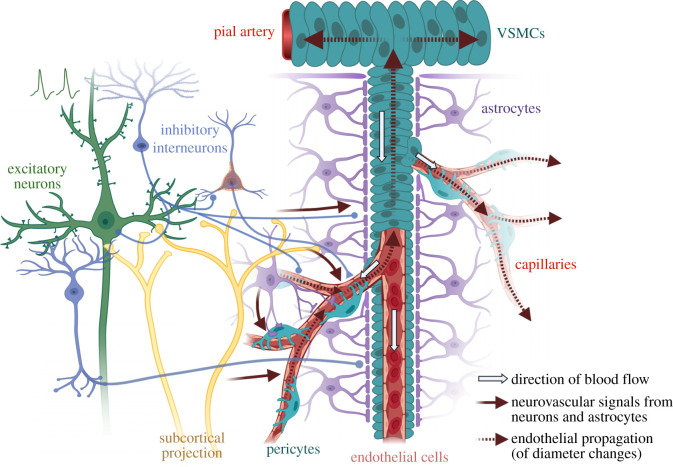
Functional neuroimaging techniques are widely applied to investigations of human cognition and disease. The most commonly used among these is blood oxygen level-dependent (BOLD) functional magnetic resonance imaging. The BOLD signal occurs because neural activity induces an increase in local blood supply to support the increased metabolism that occurs during activity. This supply usually outmatches demand, resulting in an increase in oxygenated blood in an active brain region, and a corresponding decrease in deoxygenated blood, which generates the BOLD signal. Hence, the BOLD response is shaped by an integration of local oxygen use, through metabolism, and supply, in the blood. To understand what information is carried in BOLD signals, we must understand how several cell types in the brain-local excitatory neurons, inhibitory neurons, astrocytes and vascular cells (pericytes, vascular smooth muscle and endothelial cells), and their modulation by ascending projection neurons-contribute to both metabolism and haemodynamic changes. Here, we review the contributions of each cell type to the regulation of cerebral blood flow and metabolism, and discuss situations where a simplified interpretation of the BOLD response as reporting local excitatory activity may misrepresent important biological phenomena, for example with regards to arousal states, ageing and neurological disease. This article is part of the theme issue 'Key relationships between non-invasive functional neuroimaging and the underlying neuronal activity'.
Keywords: BOLD fMRI; astrocyte; endothelial propagation; interneuron; neurometabolic coupling; neurovascular coupling.
Conflict of interest statement
We declare we have no competing interests.
Figures
References
-
- Sokoloff L. 1960. The metabolism of the central nervous system in vivo. In Handbook of physiology, I, neurophysiology, vol. 3 (eds Field J, Magoun HW, Hall VE.), pp. 1843–1864. Washington, DC: American Physiological Society.
Publication types
MeSH terms
Grants and funding
LinkOut - more resources
Full Text Sources
Medical
