Mortality and other adverse outcomes in patients with type 2 diabetes mellitus admitted for COVID-19 in association with glucose-lowering drugs: a nationwide cohort study
- PMID: 33190637
- PMCID: PMC7666969
- DOI: 10.1186/s12916-020-01832-2
Mortality and other adverse outcomes in patients with type 2 diabetes mellitus admitted for COVID-19 in association with glucose-lowering drugs: a nationwide cohort study
Abstract
Background: Limited evidence exists on the role of glucose-lowering drugs in patients with COVID-19. Our main objective was to examine the association between in-hospital death and each routine at-home glucose-lowering drug both individually and in combination with metformin in patients with type 2 diabetes mellitus admitted for COVID-19. We also evaluated their association with the composite outcome of the need for ICU admission, invasive and non-invasive mechanical ventilation, or in-hospital death as well as on the development of in-hospital complications and a long-time hospital stay.
Methods: We selected all patients with type 2 diabetes mellitus in the Spanish Society of Internal Medicine's registry of COVID-19 patients (SEMI-COVID-19 Registry). It is an ongoing, observational, multicenter, nationwide cohort of patients admitted for COVID-19 in Spain from March 1, 2020. Each glucose-lowering drug user was matched with a user of other glucose-lowering drugs in a 1:1 manner by propensity scores. In order to assess the adequacy of propensity score matching, we used the standardized mean difference found in patient characteristics after matching. There was considered to be a significant imbalance in the group if a standardized mean difference > 10% was found. To evaluate the association between treatment and study outcomes, both conditional logit and mixed effect logistic regressions were used when the sample size was ≥ 100.
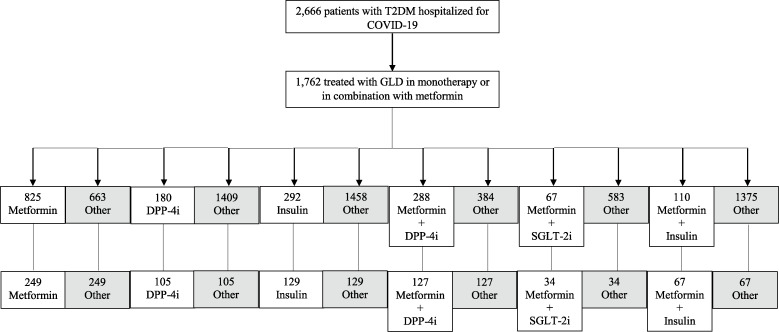
Results: A total of 2666 patients were found in the SEMI-COVID-19 Registry, 1297 on glucose-lowering drugs in monotherapy and 465 in combination with metformin. After propensity matching, 249 patients on metformin, 105 on dipeptidyl peptidase-4 inhibitors, 129 on insulin, 127 on metformin/dipeptidyl peptidase-4 inhibitors, 34 on metformin/sodium-glucose cotransporter 2 inhibitor, and 67 on metformin/insulin were selected. No at-home glucose-lowering drugs showed a significant association with in-hospital death; the composite outcome of the need of intensive care unit admission, mechanical ventilation, or in-hospital death; in-hospital complications; or long-time hospital stays.
Conclusions: In patients with type 2 diabetes mellitus admitted for COVID-19, at-home glucose-lowering drugs showed no significant association with mortality and adverse outcomes. Given the close relationship between diabetes and COVID-19 and the limited evidence on the role of glucose-lowering drugs, prospective studies are needed.
Keywords: Coronavirus disease 2019; Glucose-lowering drug; Type 2 diabetes mellitus.
Conflict of interest statement
The authors declare that they have no competing interests.
Figures