. 2020 Nov 15;8(1):158.
doi: 10.1186/s40168-020-00935-5.

Transductomics: sequencing-based detection and analysis of transduced DNA in pure cultures and microbial communities

Affiliations

Transductomics: sequencing-based detection and analysis of transduced DNA in pure cultures and microbial communities

Manuel Kleiner et al. Microbiome. .

Abstract

Background: Horizontal gene transfer (HGT) plays a central role in microbial evolution. Our understanding of the mechanisms, frequency, and taxonomic range of HGT in polymicrobial environments is limited, as we currently rely on historical HGT events inferred from genome sequencing and studies involving cultured microorganisms. We lack approaches to observe ongoing HGT in microbial communities.

Results: To address this knowledge gap, we developed a DNA sequencing-based "transductomics" approach that detects and characterizes microbial DNA transferred via transduction. We validated our approach using model systems representing a range of transduction modes and show that we can detect numerous classes of transducing DNA. Additionally, we show that we can use this methodology to obtain insights into DNA transduction among all major taxonomic groups of the intestinal microbiome.

Conclusions: The transductomics approach that we present here allows for the detection and characterization of genes that are potentially transferred between microbes in complex microbial communities at the time of measurement and thus provides insights into real-time ongoing horizontal gene transfer. This work extends the genomic toolkit for the broader study of mobile DNA within microbial communities and could be used to understand how phenotypes spread within microbiomes. Video Abstract.


Conflict of interest statement

The authors declare no competing interests.

Figures
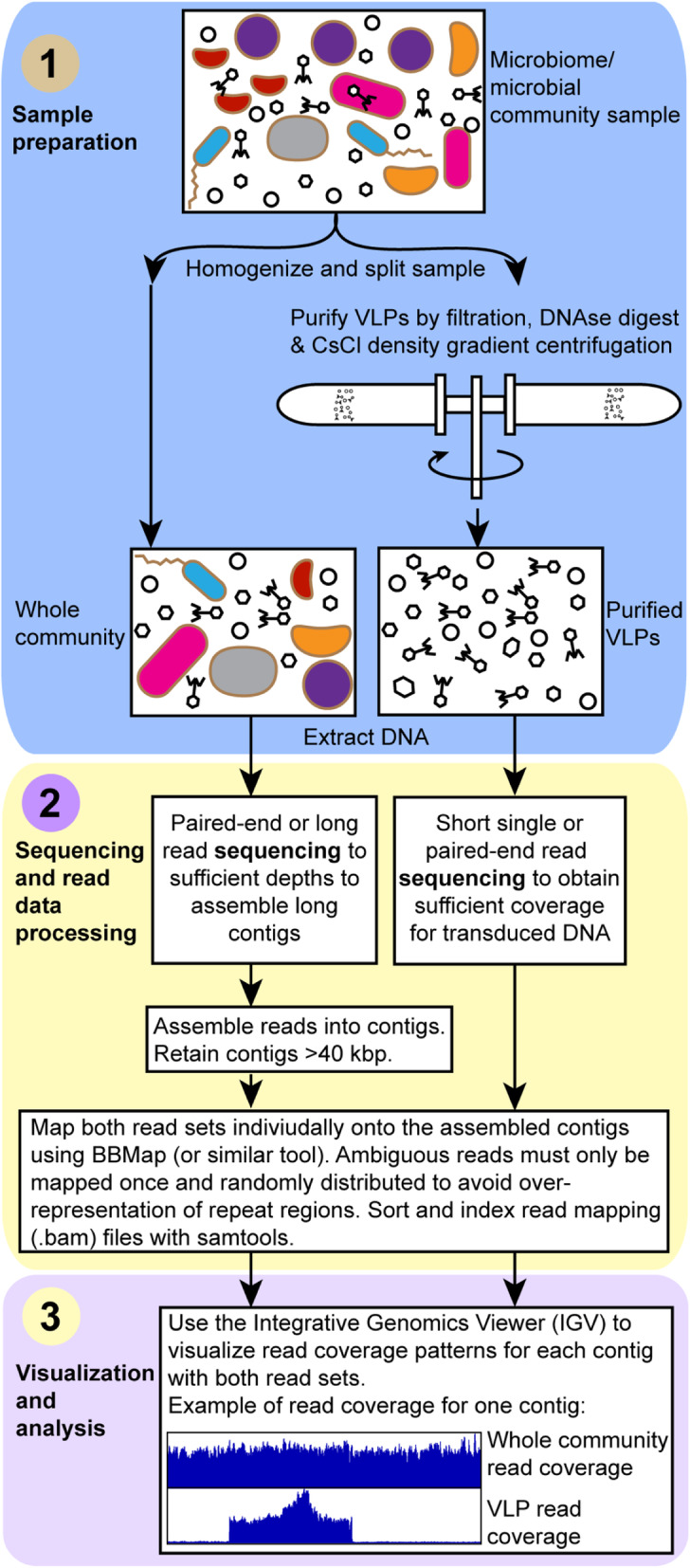
Fig. 1
Fig. 1
The “transductomics” workflow. In the sample preparation step, the sample is gently homogenized and split into two subsamples. One subsample is directly used for whole community DNA extraction, the other subsample is subjected to ultra-purification of virus-like particles (VLPs) using a combination of filtration, DNAse digestion, and CsCl density gradient centrifugation as previously described [24] followed by DNA extraction from the purified VLPs. Both DNA samples are sequenced to different depths and potentially with different sequencing approaches, although in many cases the same sequencing approach could be applied to both samples. For the whole community DNA sample, the sequencing must focus on ultimately achieving assembly of long metagenomic contigs. For the VLP DNA sample, the sequencing must focus on maximal read coverage, and no assembly is needed for these reads. The whole community sequencing reads are assembled using a suitable assembler. Contigs smaller than 40 kbp are discarded. Both the whole community and VLP sequencing reads are mapped onto the contigs > 40 kbp using BBMap [25] ensuring that ambiguously mapped reads are only used once and randomly assigned. To find transduced regions, the contig read coverage patterns for both whole community and VLP reads are visualized using the Integrative Genomics Viewer [26]
Fig. 2
Fig. 2
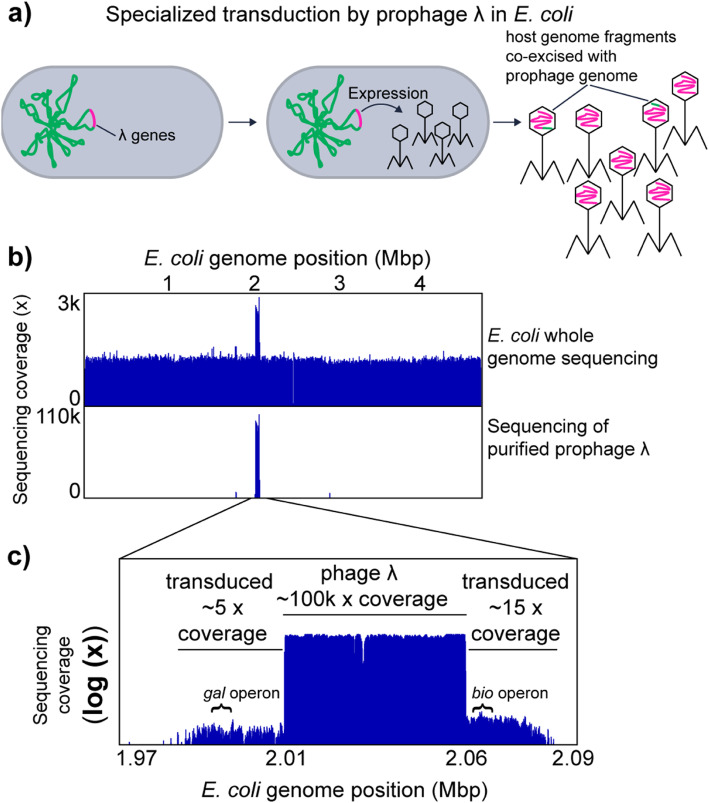
Specialized transduction by E. coli prophage λ. a Illustration of specialized transduction. The prophage λ genome is integrated into the host chromosome. Upon induction of the prophage, the prophage genome is excised and replicated. The phage structural genes are expressed, phage particles are produced and the replicated phage genome is packaged into phage heads. Ultimately, the phages are released to the environment by lysis of the host cell. Imprecise excision of the prophage λ genome happens at low frequency and leads packaging of the host chromosome into phage heads. These parts of the host chromosome can be transferred to new host genomes in the process called specialized transduction. b Genome coverage pattern associated with prophage λ induction and specialized transducing prophage λ. The upper box shows coverage patterns for whole genome sequencing reads and purified phage particle reads mapped to the E. coli genome. c In the lower box, an enlargement of the purified phage read coverage for the prophage λ region is shown (log scale). The positions of the gal and bio operons, which are known to be transduced by prophage λ, are indicated [27]
Fig. 3
Fig. 3
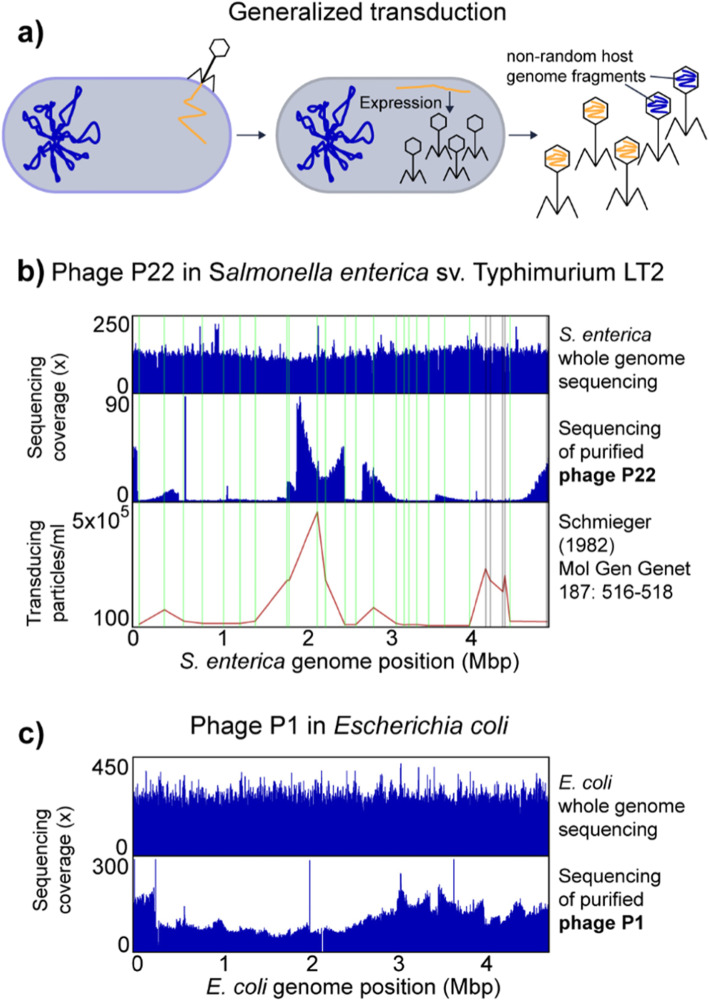
Generalized transduction by S. enterica phage P22 and E. coli phage P1. a Illustration of generalized transduction. Upon phage infection, the phage genome is replicated in the host cell by rolling circle replication resulting in genome concatemers and phage particles are produced. The phage genome is packaged into the phage head by a so-called head-full packaging mechanism, which relies on the recognition of a packaging (pac) site. The bacterial host chromosomes contain sites that resemble the pac site and thus lead to packaging of non-random pieces of the host chromosome into phage heads. The packaging happens in a processive fashion, i.e., after one phage head has been filled the packaging machinery continues to fill the next phage head with the remaining DNA molecule. The likelihood that the packaging machinery dissociates from the molecule increases the further away from the pac site it gets, thus leading to a decreased packaging efficiency over distance. b Salmonella enterica genome coverage pattern associated with generalized transduction by phage P22. Whole genome sequencing reads and purified phage particle reads were mapped to the S. enterica genome. In the lower part transduction, frequencies for 28 chromosomal markers along the chromosome are shown as determined by Schmieger [30]. Vertical lines indicate the positions of the chromosomal markers in green where the transduction frequency matches the read coverage, in grey where read coverage does not correspond to reported transduction frequency. c Escherichia coli genome coverage pattern associated with generalized transduction by E. coli phage P1
Fig. 4
Fig. 4
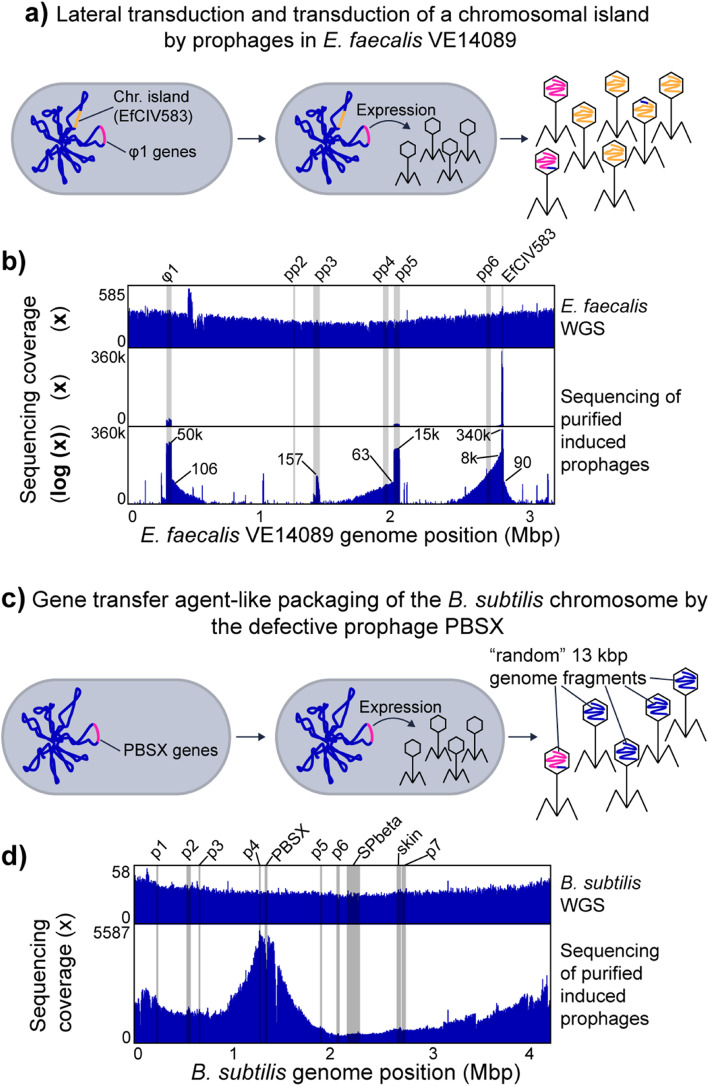
Other types of transduction. a Lateral transduction (see description for prophage λ) and transduction of a chromosomal island by prophages in E. faecalis VE14089. The chromosome of E. faecalis contains multiple prophages including φ1 and the chromosomal island EfCIV583. Upon induction, φ1 and EfCIV583 are excised from the chromosome and replicated. EfCIV583 hijacks the structural proteins of φ1 when they are produced and a large number of phage particles that carry the EfCIV583 genome are produced. b E. faecalis VE14089 genome coverage patterns associated with prophage induction and EfCIV583 transduction. Whole genome sequencing (WGS) reads and purified VLPs were mapped to the E. faecalis genome. The lowest part of the box shows VLP read coverage on a log scale. The small numbers in this plot give × fold coverage for specific genome positions corresponding to prophages or the chromosomal island EfCIV583 and the surrounding areas that are likely transduced. The positions of known prophage-like elements and EfCIV583 in the E. faecalis genome are highlighted by grey bars. c Gene transfer agent-like packaging of the B. subtilis chromosome by the defective prophage PBSX. The B. subtilis chromosome contains a variety of prophages and prophage-like elements including the defective prophage PBSX [37]. Upon expression of the PBSX genes, phage-like particles are produced, which contain random 13 kbp pieces of the host chromosome [38]. d B. subtilis genome coverage patterns associated with prophage induction. Whole genome sequencing (WGS) reads and purified prophage particle reads were mapped to the B. subtilis genome. The positions of known prophages and prophage-like elements in the B. subtilis genome [37] are highlighted by grey bars
Fig. 5
Fig. 5
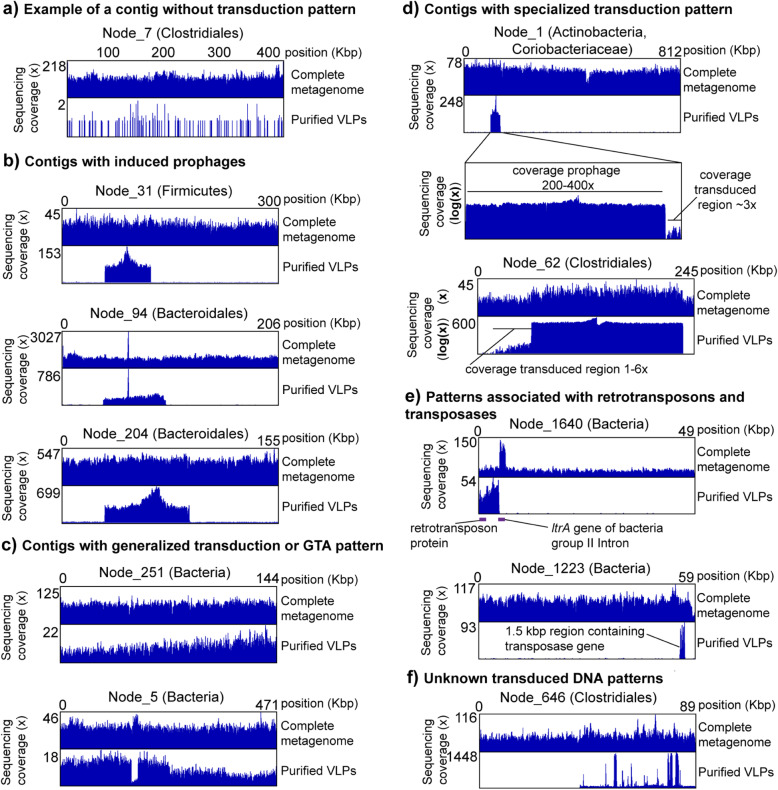
Example of transduction patterns in the mouse intestinal microbiome. The taxonomic classification for each contig specified in parentheses after each contig name is the lowest taxonomic level successfully classified by CAT [43] (Suppl. Table S2). The complete metagenome reads and the purified VLP reads were mapped to the same exact set of contigs assembled from the complete metagenome reads. The read coverage pattern of the complete metagenome reads provides evidence for the correct assembly of the contigs and allows to distinguish potential transduction-derived VLP read coverage patterns from VLP coverage patterns due to contamination with microbial DNA. With the exception of a, all shown contigs have the same or a lower abundance rank for VLP read coverage as compared to complete metagenome read coverage indicating that their overall read coverage was enriched in the VLP samples. Read coverage due to VLP sample contamination with cellular DNA is expected to result in a higher abundance rank for VLP read coverage, as compared to complete metagenome read coverage

References

    1. Zhaxybayeva O, Doolittle WF. Lateral gene transfer. Curr Biol. 2011;21:R242–R246. doi: 10.1016/j.cub.2011.01.045. - DOI - PubMed
    1. Soucy SM, Huang J, Gogarten JP. Horizontal gene transfer: building the web of life. Nat Rev Genet. 2015;16:472–482. doi: 10.1038/nrg3962. - DOI - PubMed
    1. Smillie CS, et al. Ecology drives a global network of gene exchange connecting the human microbiome. Nature. 2011;480:241–244. doi: 10.1038/nature10571. - DOI - PubMed
    1. A. Oladeinde, et al., Horizontal gene transfer and acquired antibiotic resistance in Salmonella enterica Serovar Heidelberg following in vitro incubation in broiler ceca. Appl. Environ. Microbiol. 85 (2019). - PMC - PubMed
    1. Borgeaud S, Metzger LC, Scrignari T, Blokesch M. The type VI secretion system of vibrio cholerae fosters horizontal gene transfer. Science. 2015;347:63–67. doi: 10.1126/science.1260064. - DOI - PubMed

Publication types