


Educational attainment inequalities in depressive symptoms in more than 100,000 individuals in Europe
- PMID: 33190666
- PMCID: PMC7737177
- DOI: 10.1192/j.eurpsy.2020.100
Educational attainment inequalities in depressive symptoms in more than 100,000 individuals in Europe
Abstract
Background: Increasing educational attainment (EA) could decrease the occurrence of depression. We investigated the relationship between EA and depressive symptoms in older individuals across four European regions.
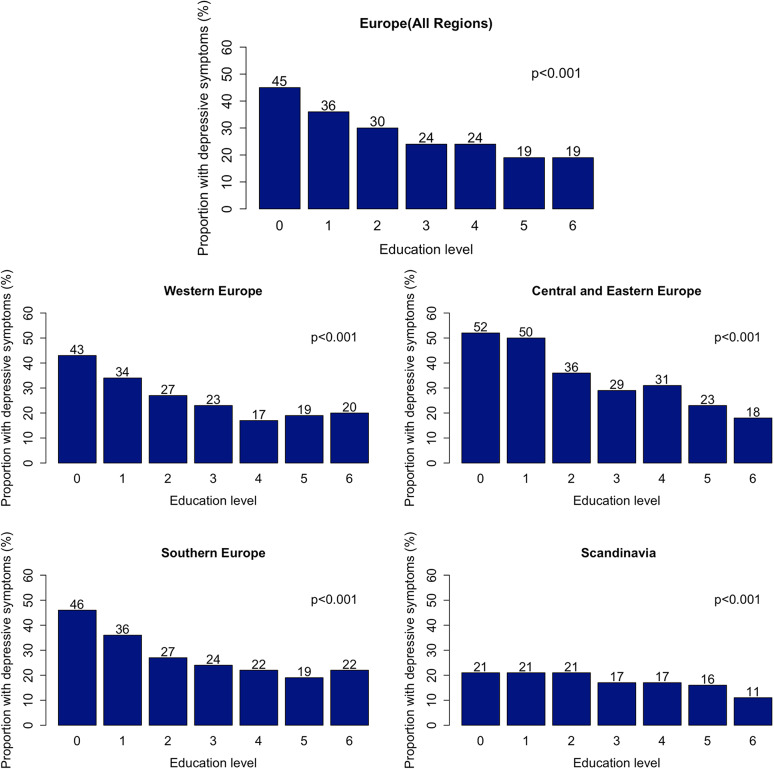
Methods: We studied 108,315 Europeans (54% women, median age 63 years old) from the Survey on Health, Ageing and Retirement in Europe assessing EA (seven educational levels based on International Standard Classification of Education [ISCED] classification) and depressive symptoms (≥4 points on EURO-D scale). Logistic regression estimated the association between EA and depressive symptoms, adjusting for sociodemographic and health-related factors, testing for sex/age/region and education interactions.
Results: Higher EA was associated with lower odds of depressive symptoms, independent of sociodemographic and health-related factors. A threshold of the lowest odds of depressive symptoms was detected at the first stage of tertiary education (OR 0.60; 95% confidence interval [CI] 0.55-0.65; p < 0.001; relative to no education). Central and Eastern Europe showed the strongest association (OR for high vs. low education 0.37; 95% CI 0.33-0.40; p < 0.001) and Scandinavia the weakest (OR for high vs. low education 0.69; 95% CI 0.60-0.80; p < 0.001). The association was strongest among younger individuals. There was a sex and education interaction only within Central and Eastern Europe.
Conclusions: Level of EA is reflected in later-life depressive symptoms, suggesting that supporting individuals in achieving EA, and considering those with lower EA at increased risk for depression, could lead to decreased burden of depression across the life course. Further educational support in Central and Eastern Europe may decrease the higher burden of depressive symptoms in women.
Keywords: Depression; Europe; education; epidemiology.
Conflict of interest statement
Adam Chlapecka, Anna Kagstrom, and Pavla Cermakova declare no conflict of interest.
Figures
References
-
- Organization WH. The global burden of disease: 2004 update. Switzerland: World Health Organization, 2008.
-
- Horackova K, Kopecek M, Machu V, Kagstrom A, Aarsland D, Motlova LB, et al. Prevalence of late-life depression and gap in mental health service use across European regions. Eur Psychiatry. 2019;57:19–25. - PubMed
-
- Cermakova P, Pikhart H, Ruiz M, Kubinova R, Bobak M. Socioeconomic position in childhood and depressive symptoms in later adulthood in the Czech Republic. J Affect Disord. 2020;272:17–23. - PubMed
-
- Depression WH. Other common mental disorders: global health estimates. Geneva: World Health Organization, 2017;p. 1–24.
Publication types
MeSH terms
Grants and funding
LinkOut - more resources
Full Text Sources
Medical
