


Measuring the Patient Experience of Mental Health Care: A Systematic and Critical Review of Patient-Reported Experience Measures
- PMID: 33192054
- PMCID: PMC7653683
- DOI: 10.2147/PPA.S255264
Measuring the Patient Experience of Mental Health Care: A Systematic and Critical Review of Patient-Reported Experience Measures
Abstract
Background: There is growing concern about measuring patient experience with mental health care. There are currently numerous patient-reported experience measures (PREMs) available for mental health care, but there is little guidance for selecting the most suitable instruments. The objective of this systematic review was to provide an overview of the psychometric properties and the content of available PREMs.
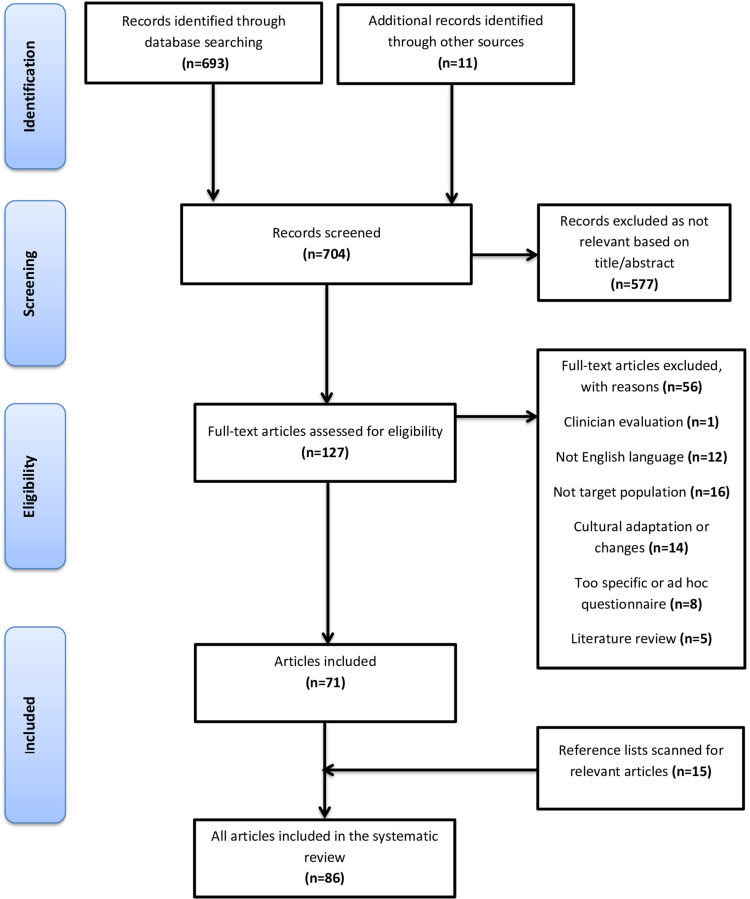
Methods: A comprehensive review following the preferred reporting items for systematic reviews and meta-analysis (PRISMA) guidelines was conducted using the MEDLINE database with no date restrictions. The content of PREMs was analyzed using an inductive qualitative approach, and the methodological quality was assessed according to Pesudovs quality criteria.
Results: A total of 86 articles examining 75 PREMs and totaling 1932 items were included. Only four PREMs used statistical methods from item response theory (IRT). The 1932 items covered seven key mental health care domains: interpersonal relationships (22.6%), followed by respect and dignity (19.3%), access and care coordination (14.9%), drug therapy (14.1%), information (9.6%), psychological care (6.8%) and care environment (6.1%). Additionally, a few items focused on patient satisfaction (6.7%) rather than patient experience. No instrument covered the latent trait continuum of patient experience, as defined by the inductive qualitative approach, and the psychometric properties of the instruments were heterogeneous.
Conclusion: This work is a critical step in the creation of an item library to measure mental health care patient-reported experience that will be used in France to develop, validate, and standardize item banks and computerized adaptive testing (CAT) based on IRT. It will also provide internationally replicable measures that will allow direct comparisons of mental health care systems.
Trial registration: NCT02491866.
Keywords: bipolar disorder; health services research; major depression; patient experience; patient satisfaction; patient-reported experience measures; schizophrenia; systematic review.
© 2020 Fernandes et al.
Conflict of interest statement
Bruno Aouizerate reports personal fees from Janssen-Cilag, Lilly, Sanofi, and Lundbeck, outside the submitted work. Pierre-Michel Llorca reports personal fees from lundbeck, otsuka, Sanofi, Recordatti, and Gedeon Richter, and personal fees and non-financial support from Janssen, outside the submitted work. The authors report no other possible conflicts of interest in this work.
Figures
References
-
- Patel V, Saxena S, Lund C, et al. The Lancet Commission on global mental health and sustainable development. Lancet Lond Engl. 2018;392(10157):1553‑98. - PubMed
-
- Institute of Medicine. Improving the Quality of Health Care for Mental and Substance-Use Conditions. Washington, DC: National Academies Press; 2006. - PubMed
Publication types
Associated data
LinkOut - more resources
Full Text Sources
Medical
Miscellaneous
