


The Distribution of Alpha-1 Antitrypsin Genotypes Between Patients with COPD/Emphysema, Asthma and Bronchiectasis
- PMID: 33192056
- PMCID: PMC7654539
- DOI: 10.2147/COPD.S271810
The Distribution of Alpha-1 Antitrypsin Genotypes Between Patients with COPD/Emphysema, Asthma and Bronchiectasis
Abstract
Purpose: Alpha-1-antitrypsin deficiency (AATD) is a rare hereditary condition characterized by low circulating levels of alpha-1antitrypsin (AAT). While the association between AATD and COPD/emphysema is undisputed, the association between AATD and asthma or bronchiectasis is still a matter of debate.
Aims and objectives: Our study aimed to investigate the distribution of AAT genotypes between patients with COPD/emphysema, asthma and bronchiectasis. To back up the diagnostic labels, we described symptoms associated with the diagnosis.
Methods: Between September 2003 and March 2020, 29,465 testing kits (AlphaKit®) were analyzed in the AAT laboratory, University of Marburg, Germany. The diagnosis of AATD has been made based on the measurements of AAT serum levels, followed by genotyping, phenotyping or whole gene sequencing depending on the availability and/or the need for more detailed interpretation of the results. The respiratory symptoms were recorded as well.
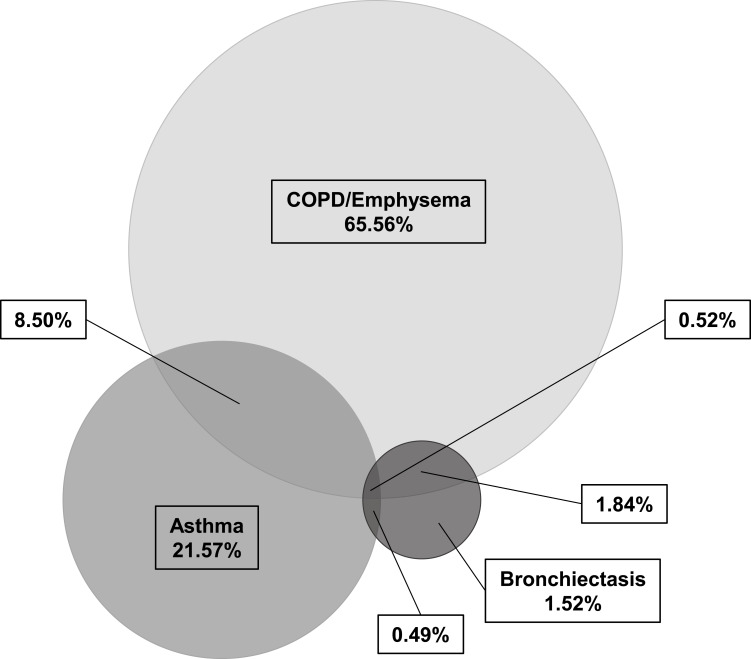
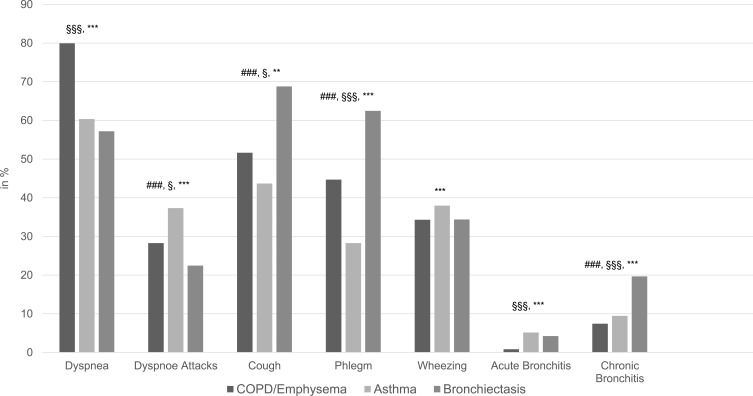
Results: Regarding the distribution of the wild type allele M and the most frequent mutations S (E264V) and Z (E342K), no significant differences could be found between COPD/emphysema [Pi*MM (58.24%); Pi*SZ (2.49%); Pi*ZZ (9.12%)] and bronchiectasis [Pi*MM (59.30%) Pi*SZ (2.81%); Pi*ZZ (7.02%)]. When COPD/emphysema and bronchiectasis were recorded in the same patient, the rate of Pi* ZZ (14.78%) mutations was even higher. Asthma patients exhibited significantly less deficient genotypes [Pi*MM (54.81%); Pi*SZ (2%); Pi*ZZ (2.77%)] than two other groups. Associated respiratory symptoms confirmed the diagnosis.
Conclusion: COPD/emphysema and bronchiectasis, but not asthma patients, exhibit higher frequency of AATD genotypes. Our data suggest that AATD testing should be offered to patients with COPD/emphysema and bronchiectasis.
Keywords: SERPINA1; alpha-1-antitrypsin deficiency; asthma; bronchiectasis; diagnosis.
© 2020 Veith et al.
Conflict of interest statement
Martina Veith reports grants from Grifols. Prof. Dr. Robert Bals reports grants from BMBF, during the conduct of the study; grants from Schwiete Stiftung, Novartis, and Mukoviszidose e.V. and personal fees from AstraZeneca and CSL Behring, outside the submitted work. Prof. Dr. Claus Franz Vogelmeier reports grants, personal fees from AstraZeneca, Boehringer Ingelheim, Grifols, GlaxoSmithKline, and Novartis; personal fees from CSL Behring, Chiesi, Menarini, Nuvaira, MedUpdate, outside the submitted work. Dr Timm Greulich reports grants from Grifols, during the conduct of the study; personal fees from AstraZeneca, serves as a lecturer and part of the advisory board for Berlin Chemie, Boehringer Ingelheim, Chiesi, CSL Behring, Grifols, GSK, Novartis, received grants from German Centre for Lung Research, outside the submitted work. The authors report no other conflicts of interest in this work.
Figures


References
-
- Janciauskiene SM, Bals R, Koczulla R, Vogelmeier C, Kohnlein T, Welte T. The discovery of alpha1-antitrypsin and its role in health and disease. Respir Med. 2011;105(8):1129–1139. - PubMed
-
- European RS, American Thoracic Society. American thoracic society/European respiratory society statement: standards for the diagnosis and management of individuals with alpha-1 antitrypsin deficiency. Am J Respir Crit Care Med. 2003;168(7):818–900. - PubMed
-
- Stoller JK, Brantly M. The challenge of detecting alpha-1 antitrypsin deficiency. Copd. 2013;10(Suppl 1):26–34. - PubMed
MeSH terms
Substances
LinkOut - more resources
Full Text Sources
Medical
Research Materials
Miscellaneous
