


Accuracy of the Diagnostic Tests of Sacroiliac Joint Dysfunction
- PMID: 33192189
- PMCID: PMC7646135
- DOI: 10.1016/j.jcm.2019.12.002
Accuracy of the Diagnostic Tests of Sacroiliac Joint Dysfunction
Abstract
Objective: The purpose of this study was to assess the reliability and validity of motion palpation and pain provocation compared with sacroiliac joint (SIJ) block as the gold-standard assessment method of patients with sacroiliac joint dysfunction (SIJD).
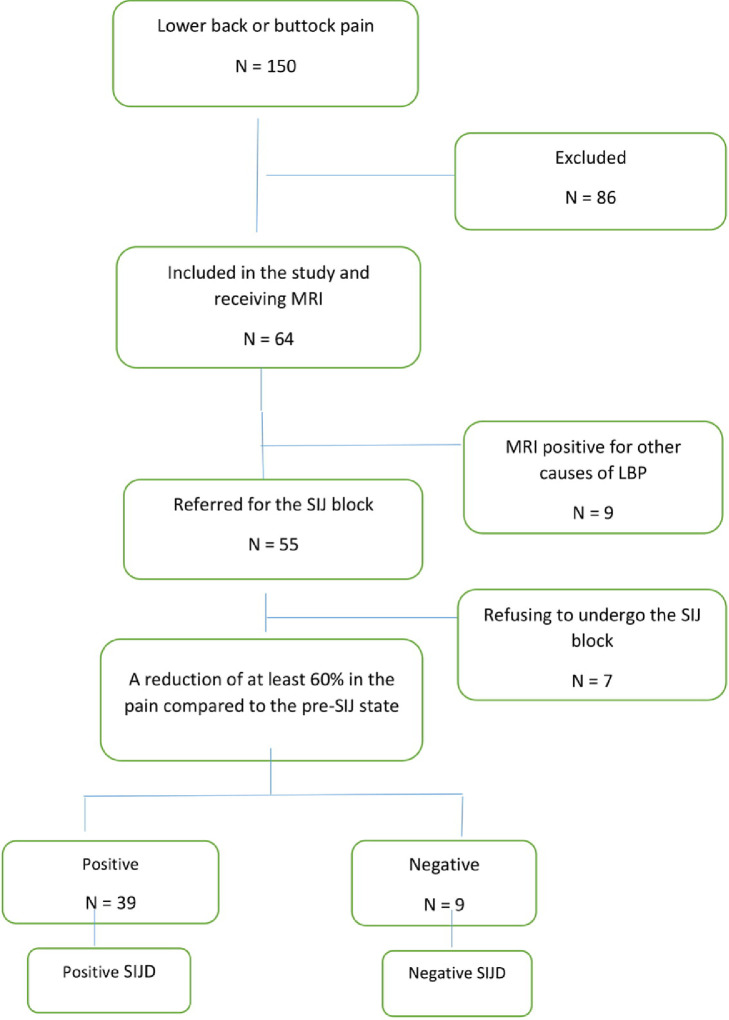
Methods: A cross-sectional study was conducted in the Department of Sports and Exercise Medicine at Rasool Akram Hospital. Forty-eight patients suspected of having SIJD were selected from a total of 150 patients on the basis of a combination of symptoms, physical tests, and magnetic resonance imaging findings. The patients suspected of having SIJD received the SIJ block, to which the accuracy of all the physical tests was compared. Sensitivity, specificity, and positive and negative predictive values were calculated for each test. The receiver operating characteristic curve and the area under the receiver operating characteristic curve were measured.
Results: The Flexion, Abduction and External Rotation (FABER) test had the highest specificity and positive predictive values of the physical tests. Furthermore, the combination of the FABER test and the thigh thrust test improved overall diagnostic ability more so than any of the other test combinations.
Conclusion: A combination of the motion and provocation tests increased specificity and positive predictive values, and the FABER test had the highest of these single values. The palpation tests did not change after the SIJ block, suggesting that their accuracy cannot be determined using this method.
Keywords: Diagnostic Tests; Predictive Value of Tests; Sensitivity and Specificity.
© 2020 by National University of Health Sciences.
Figures
References
-
- Krismer M, van Tulder M. Low back pain (non-specific) Best Pract Res Clin Rheumatol. 2007;21(1):77–91. - PubMed
-
- Ehrlich GE, Chaltaev NG. World Health Organization, Department of Noncommunicable Disease Management; 1999. Low back pain initiative.
-
- Chi B. Sacroiliitis. In: Warfield CA, Fausett HJ, editors. Manual of Pain Management. 2nd ed. Lippincott Williams and Wilkins; Philadelphia, PA: 2002. pp. 95–98.
-
- Katz V, Schofferman J, Reynolds J. The sacroiliac joint: a potential cause of pain after lumbar fusion to the sacrum. J Spinal Disord Tech. 2003;16(1):96–99. - PubMed
-
- Ombregt L. Clinical examination of the sacroiliac joint. In: Ombregt L, editor. A System of Orthopaedic Medicine. 3rd ed. London, UK: Churchill Livingstone; 2013. pp. 595–600.
LinkOut - more resources
Full Text Sources
Medical
