


Unmet Supportive Care Needs Among Women With Breast and Gynecological Cancer: Relevance of Attachment Anxiety and Psychological Distress
- PMID: 33192814
- PMCID: PMC7609386
- DOI: 10.3389/fpsyg.2020.558190
Unmet Supportive Care Needs Among Women With Breast and Gynecological Cancer: Relevance of Attachment Anxiety and Psychological Distress
Abstract
Objective: Attachment anxiety and avoidance are known risk factors for the development of unmet needs and poor well-being among patients with chronic diseases. Few studies have addressed this in individuals with cancer. We aimed to explore the relationship between supportive care needs, attachment styles and distress in women with breast and gynecological cancer.
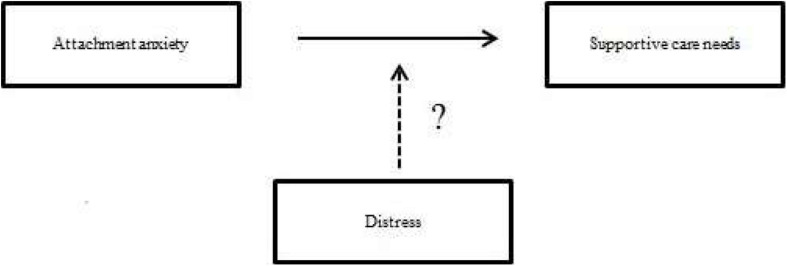
Methods: Using a cross-sectional paper-pencil (n = 157) and online survey (n = 614), a total of 771 patients with breast or gynecological cancer completed a set of validated questionnaires. From September 2013 to January 2014, consecutive inpatients and outpatients of the university hospital Tuebingen were included in the study. Further, participants were recruited through social media, patient internet platforms, self-help group leaders and patient networks. We used the Supportive Care Needs Survey (SCNS-SF-34) with the need dimensions: health system, patient care, psychological, physical, and sexual needs, as well as the Experiences in Close Relationships-Revised Questionnaire, and the Distress Thermometer. A multiple linear regression model was used to analyze the influence of attachment styles (anxiety and avoidance) on the SCNS-SF-34 dimensions. A moderation analysis was used to explore the influence of the interaction between attachment anxiety and distress for all SCNS-SF-34 dimensions.
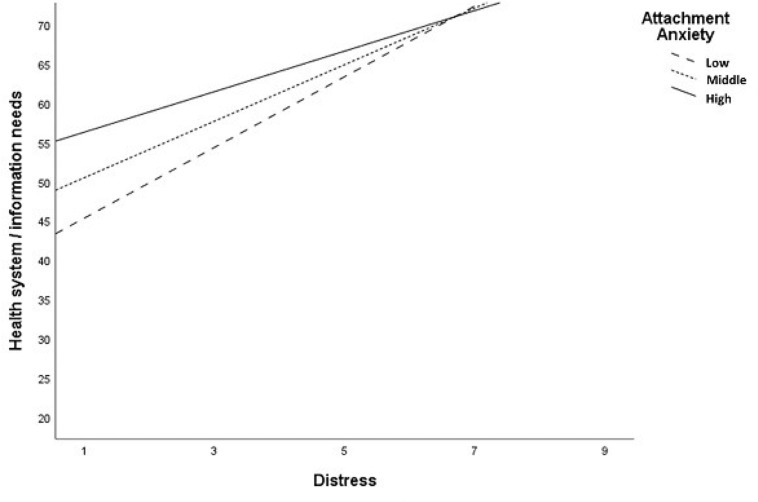
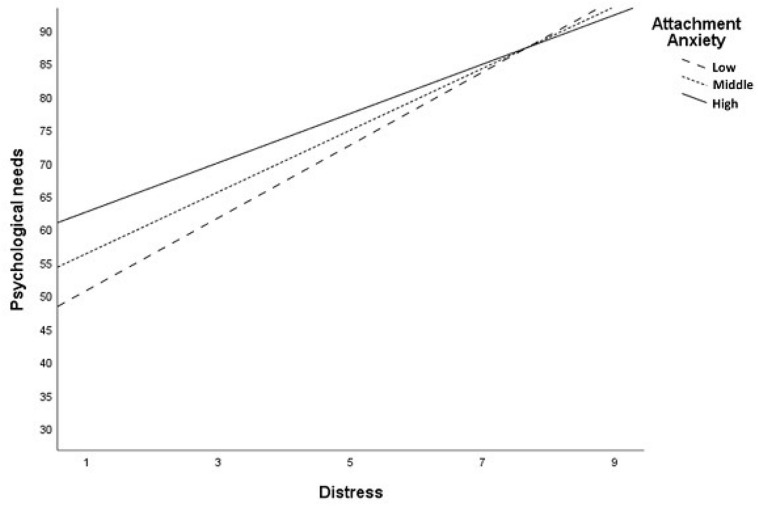
Results: Attachment anxiety was a significant determinant and led to higher unmet supportive care needs in all dimensions, whereas attachment avoidance was not significant. Distress did moderate the relationship between attachment anxiety and psychological and health system needs and led to a higher unmet needs development. For the other SCNS-SF-34 dimensions, distress was not confirmed as a moderator.
Conclusion: Our findings highlight attachment anxiety as a risk factor for the development of unmet supportive care needs and potentially impaired psychological adjustment to cancer. Further studies are needed to elucidate the interactions between attachment styles, distress and supportive care needs among cancer patients.
Keywords: attachment anxiety; attachment styles; distress; psychooncology; supportive care needs; unmet needs.
Copyright © 2020 Graf, Junne, Ehrenthal, Schäffeler, Schwille-Kiuntke, Stengel, Mehnert-Theuerkauf, Marwedel, Brucker, Zipfel and Teufel.
Figures
References
-
- Ainsworth M. D. S., Blehar M. C., Waters E., Wall S. (2014). Patterns of Attachment: A Psychological Study of the Strange Situation. London: Psychology Press.
-
- Arambasic J., Sherman K. A., Elder E., Australia B. C. N. (2019). Attachment styles, self-compassion, and psychological adjustment in long-term breast cancer survivors. Psychol.Oncol. 28 1134–1141. - PubMed
-
- Bowlby J. (1969). Attachment and loss. New York, NY: Basic Books.
LinkOut - more resources
Full Text Sources
