Review
. 2020 Oct 21:11:544563.
doi: 10.3389/fimmu.2020.544563. eCollection 2020.

Recent Advances in Immune Cell Therapy for Glioblastoma

Affiliations
Review

Recent Advances in Immune Cell Therapy for Glioblastoma

Xianhui Kang et al. Front Immunol. .

Abstract

Glioblastoma (GBM) is the most malignant form of astrocytoma with short survival and a high recurrence rate and remains a global problem. Currently, surgery, chemotherapy, radiotherapy, and other comprehensive treatments are the main treatment modalities, but patients still have a poor prognosis mainly due to the infiltrative growth of GBM and the protective effect of the blood-brain barrier on tumor cells. Therefore, immunotherapy is expected to be a good option for GBM. In the immune system, different cells play varying roles in the treatment of GBM, so understanding the roles played by various immune cells in treating GBM and considering how to combine these effects to maximize the efficacy of these cells is important for the selection of comprehensive and optimal treatment plans and improving GBM prognosis. Therefore, this study reviews the latest research progress on the role of various types of immune cells in the treatment of GBM.

Keywords: advances; glioblastoma; immune cell; immunotherapy; mechanism.


Figures

Figure 1
Figure 1
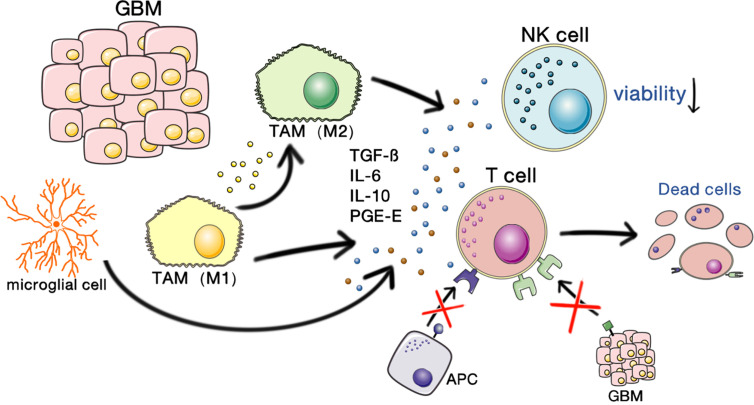
Immunosuppressive microenvironment of GBM. GBM-associated macrophages and microglia secrete inhibitory cytokines, which decrease NK cell activity and T cell–mediated apoptosis and inhibit the binding and killing effects of T cells on antigen-presenting cells and GBM cells. This allows the tumor to escape the immune-killing effects of NK cells and T cells.
Figure 2
Figure 2
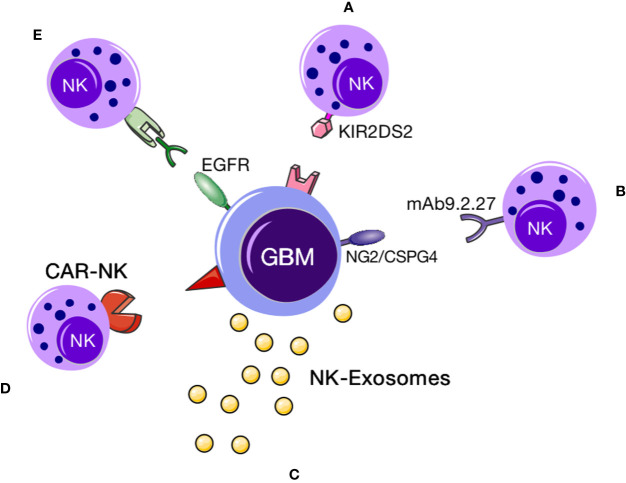
NK cell immunotherapy. NK cell–based immunotherapy for GBM. This figure demonstrates that a variety of NK cell therapies for GBM. (A) KIR2DS2 immunotype NK cells could target and destroy GBM cells (10); (B) exosomes secreted by NK cells could specifically localize to GBM cells, upon which the cytokines within the exosomes could induce apoptotic signaling in tumor cells to promote cell death; (C) CAR-NK immunotherapy comprising NK cells expressing a GBM-specific CAR can target the tumor; (D) specific proteins (such as CD16) can bind NK cells and EGFR on the surface of GBM cells to facilitate NK cell activity. (E) using specific proteins (such as CD16) to bind NK cells and then specifically bind to EGFR on the surface of glioblastoma cells to exert a cytotoxic effect.

References

    1. Alexander BM, Cloughesy TF. Adult Glioblastoma. J Clin Oncol (2017) 35(21):2402–9. 10.1200/JCO.2017.73.0119 - DOI - PubMed
    1. Chaichana KL, Parker SL, Olivi A, Quiñones-Hinojosa A. Long-term seizure outcomes in adult patients undergoing primary resection of malignant brain astrocytomas. Clinical article. J Neurosurg (2009) 111(2):282–92. 10.3171/2009.2.JNS081132 - DOI - PubMed
    1. Lim M, Xia YX, Bettegowda C, Weller M. Current state of immunotherapy for glioblastoma. Nat Rev Clin Oncol (2018) 15(7):422–42. 10.1038/s41571-018-0003-5 - DOI - PubMed
    1. Jackson CM, Choi J, Lim M. Mechanisms of immunotherapy resistance: lessons from glioblastoma. Nat Immunol (2019) 20(9):1100–9. 10.1038/s41590-019-0433-y - DOI - PubMed
    1. Brown NF, Carter TJ, Ottaviani D, Mulholland P. Harnessing the immune system in glioblastoma. Br J Cancer (2018) 119(10):1171–81. 10.1038/s41416-018-0258-8 - DOI - PMC - PubMed

Publication types