Review
. 2020 Oct 27:11:579220.
doi: 10.3389/fimmu.2020.579220. eCollection 2020.

I mmunosenescence and Inflammaging: Risk Factors of Severe COVID-19 in Older People

Affiliations
Review

I mmunosenescence and Inflammaging: Risk Factors of Severe COVID-19 in Older People

Anna Julia Pietrobon et al. Front Immunol. .

Abstract

Old individuals are more susceptible to various infections due to immunological changes that occur during the aging process. These changes named collectively as "immunosenescence" include decreases in both the innate and adaptive immune responses in addition to the exacerbated production of inflammatory cytokines. This scenario of immunological dysfunction and its relationship with disease development in older people has been widely studied, especially in infections that can be fatal, such as influenza and, more recently, COVID-19. In the current scenario of SARS-CoV-2 infection, many mechanisms of disease pathogenesis in old individuals have been proposed. To better understand the dynamics of COVID-19 in this group, aspects related to immunological senescence must be well elucidated. In this article, we discuss the main mechanisms involved in immunosenescence and their possible correlations with the susceptibility of individuals of advanced age to SARS-CoV-2 infection and the more severe conditions of the disease.

Keywords: COVID-19; SARS-CoV-2; aging; coronavirus; immunosenescence; inflammaging.


Figures

Figure 1
Figure 1
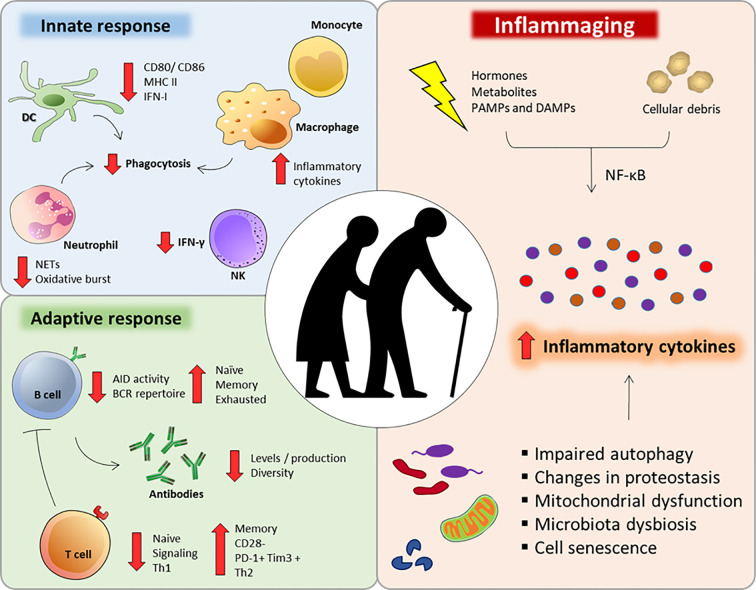
Major immunological alterations observed during immunosenescense. Aging interferes in a number of innate and adaptive immune cells aspects that can impair or compromise their function and response. Additionally, several factors can dysregulate intracellular homeostasis during aging, intensifying the secretion of inflammatory cytokines and chemokines (inflammaging).
Figure 2
Figure 2
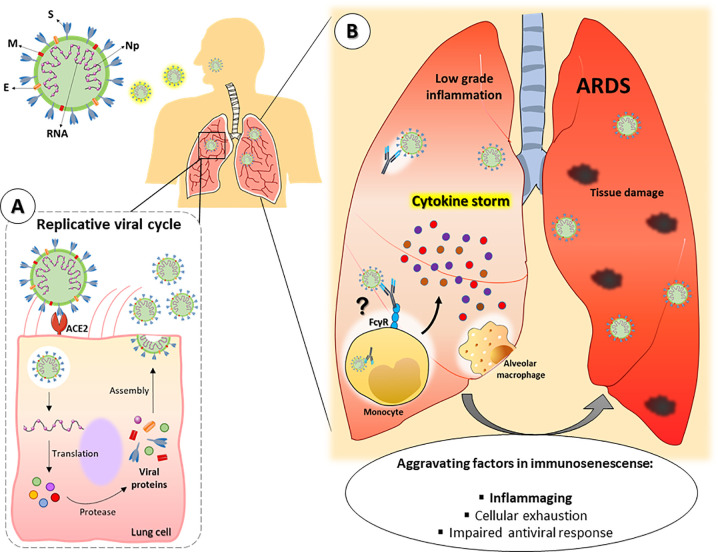
Hypothetical framework of SARS-CoV-2 pulmonary infection in old individuals. SARS-CoV-2 consists of single RNA strand and the following proteins: Spike (S), membrane (M), envelope (E) and nucleocapsid (Np). (A) After entering the organism, the virus infects lung cells by binding to the receptor angiotensin-converting enzyme 2 (ACE-2) and establishes its replicative cycle releasing new viral particles. (B) Older people have a constitutive low-grade proinflammatory state that, along with other peculiarities of the immunosenescence, can favor the cytokine storm syndrome, leading to a faster progression to ARDS and severe manifestations of COVID-19. In addition, tissue resident or lung-infiltrating immune cells (e.g., neutrophils, monocytes and alveolar macrophages) can contribute to disease severity either by dysfunctional responses associated to immunosenescence or by facilitating viral internalization through ADE. ARDS = Acute respiratory distress syndrome. ADE = Antibody-dependent enhancement.

References

    1. Morens DM, Fauci AS. The 1918 influenza pandemic: insights for the 21st century. J Infect Dis (2007) 195(7):1018–28. 10.1086/511989 - DOI - PubMed
    1. de Wit E, van Doremalen N, Falzarano D, Munster VJ. SARS and MERS: recent insights into emerging coronaviruses. Nat Rev Microbiol (2016) 14(8):523–34. 10.1038/nrmicro.2016.81 - DOI - PMC - PubMed
    1. Zhou P, Yang XL, Wang XG, Hu B, Zhang L, Zhang W, et al. A pneumonia outbreak associated with a new coronavirus of probable bat origin. Nature (2020) 579(7798):270–3. 10.1038/s41586-020-2012-7 - DOI - PMC - PubMed
    1. Wu C, Chen X, Cai Y, Xia J, Zhou X, Xu S, et al. Risk Factors Associated With Acute Respiratory Distress Syndrome andDeath in Patients With Coronavirus Disease 2019 Pneumonia in Wuhan, China. JAMA Intern Med (2020) 180(7):934–43. 10.1001/jamainternmed.2020.0994 - DOI - PMC - PubMed
    1. World Health Organization World Health Organization. Coronavirus disease 2019 (COVID-19) WeeklyEpidemiological Update - 6. (2020). Available at: https://www.who.int/docs/default-source/coronaviruse/situation-reports/2...(Accessed October 10, 2020).

Publication types