. 2020 Oct 28:11:587615.
doi: 10.3389/fimmu.2020.587615. eCollection 2020.

Immunoinformatic Analysis of SARS-CoV-2 Nucleocapsid Protein and Identification of COVID-19 Vaccine Targets

Affiliations

Immunoinformatic Analysis of SARS-CoV-2 Nucleocapsid Protein and Identification of COVID-19 Vaccine Targets

Sergio C Oliveira et al. Front Immunol. .

Abstract

COVID-19 is a worldwide emergency; therefore, there is a critical need for foundational knowledge about B and T cell responses to SARS-CoV-2 essential for vaccine development. However, little information is available defining which determinants of SARS-CoV-2 other than the spike glycoprotein are recognized by the host immune system. In this study, we focus on the SARS-CoV-2 nucleocapsid protein as a suitable candidate target for vaccine formulations. Major B and T cell epitopes of the SARS-CoV-2 N protein are predicted and resulting sequences compared with the homolog immunological domains of other coronaviruses that infect human beings. The most dominant of B cell epitope is located between 176-206 amino acids in the SRGGSQASSRSSSRSRNSSRNSTPGSSRGTS sequence. Further, we identify sequences which are predicted to bind multiple common MHC I and MHC II alleles. Most notably there is a region of potential T cell cross-reactivity within the SARS-CoV-2 N protein position 102-110 amino acids that traverses multiple human alpha and betacoronaviruses. Vaccination strategies designed to target these conserved epitope regions could generate immune responses that are cross-reactive across human coronaviruses, with potential to protect or modulate disease. Finally, these predictions can facilitate effective vaccine design against this high priority virus.

Keywords: B cells; Coronavirus Disease 2019; T cells; epitopes; nucleocapsid; severe acute respiratory syndrome coronavirus 2; vaccine.


Figures

Figure 1
Figure 1
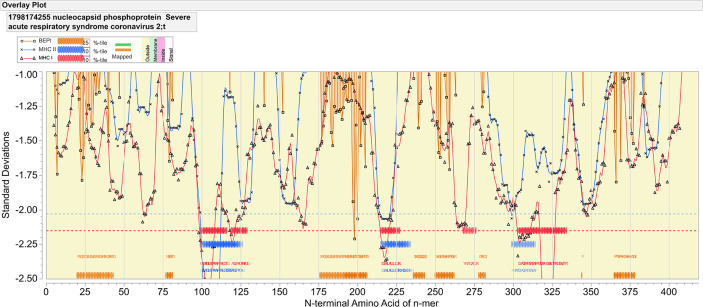
Epitope mapping of nucleocapsid protein of SARS-CoV-2. The X axis indicates the index position of sequential peptides with single amino acid displacement. The Y axis indicates predicted binding affinity in standard deviation units for the protein. The red line shows the permuted average predicted MHC-IA and B (62 alleles) binding affinity by index position of sequential 9-mer peptides with single amino acid displacement. The blue line shows the permuted average predicted MHC-II DRB allele (24 most common human alleles) binding affinity of sequential 15-mer peptides. Orange lines show the predicted probability of B-cell receptor binding for an amino acid centered in each sequential 9-mer peptide. Low numbers for MHC data represent high binding affinity, whereas low numbers equate to high B cell receptor contact probability. Ribbons (red: MHC-I, blue: MHC-II) indicate the 10% highest predicted MHC affinity binding. Orange ribbons indicate the top 25% predicted probability B-cell binding. Horizontal dotted lines demarcate the top 5% of binding affinity for the protein (red MHC I, blue MHC II).
Figure 2
Figure 2
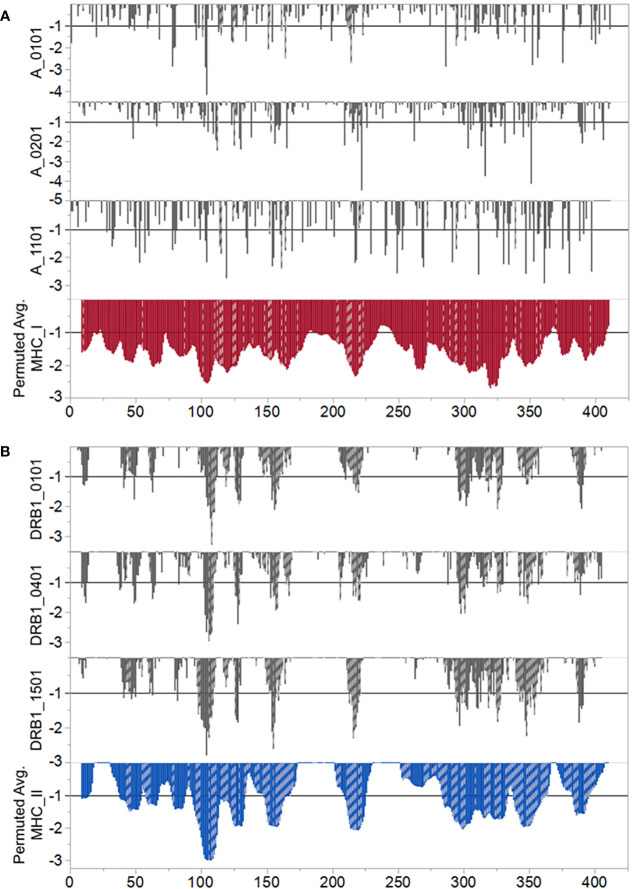
Predicted differential binding of example alleles. (A) MHC I and (B) MHC II. In both panels the Y axis indicates predicted binding affinity of sequential peptides. The X axis indicates the index position of each 9 mer (MHC (I) or 15-mer (MHC II) represented by a vertical bar. Bars which are cross hatched are those peptides predicted to be excised for binding and presentation by either cathepsin S or cathepsin L. For MHC I the cathepsin predictions are those which excise a 9 mer. For MHC II a predicted excision of a 12–18 mer is shown. The lower tier of each panel shows the population permuted average predicted binding affinity as described for Figure 1 . The top three tiers contrast the responses of selected example alleles. For MHC I we show predicted responses of A_0101, A0201, and A1101. For MHC II we show predicted responses of DRB1_0101, DRB1_0401, and DRB1_1501. Other alleles evaluated show a similar diversity of predicted response.
Figure 3
Figure 3
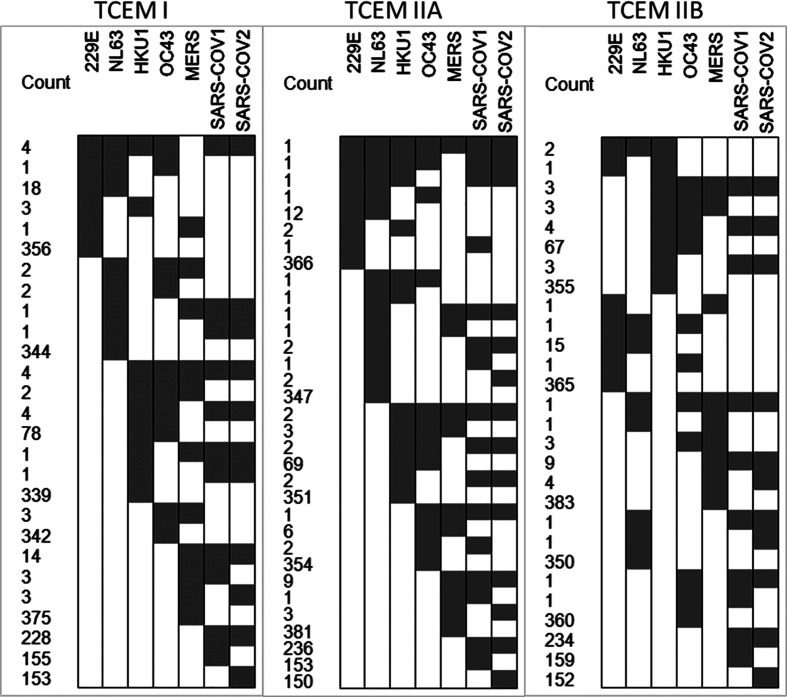
T cell exposed motifs conserved across coronaviruses. The cell plots show in gray where there are T cell exposed motifs shared between SARS-CoV-2 and other human coronaviruses, as shown in the X axis. The number of shared motifs indicated in the Y axis counts. The most highly conserved motifs are also shown in Supplementary Table 1 .
Figure 4
Figure 4
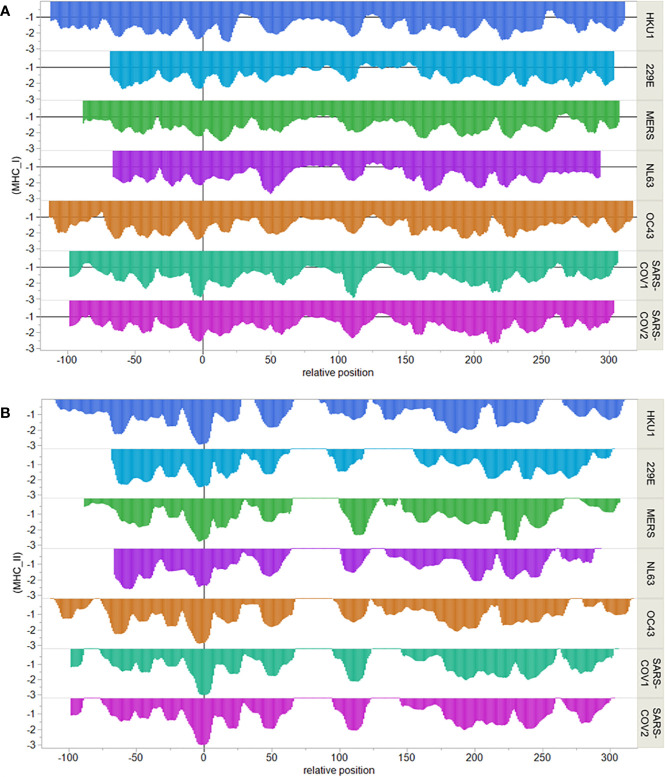
Comparative MHC binding patterns in human coronavirus nucleocapsid protein. X axis shows sequential peptides aligned relative to the most conserved MHC I pentamer. Peptides are 9-mers for MHC I and 15-mers for MHC II and are indicated at their index positions. Y axis shows permuted predicted binding in standard deviation units below the mean for the protein. (A) shows MHC I alleles. (B) shows MHC II DRB alleles.
Figure 5
Figure 5
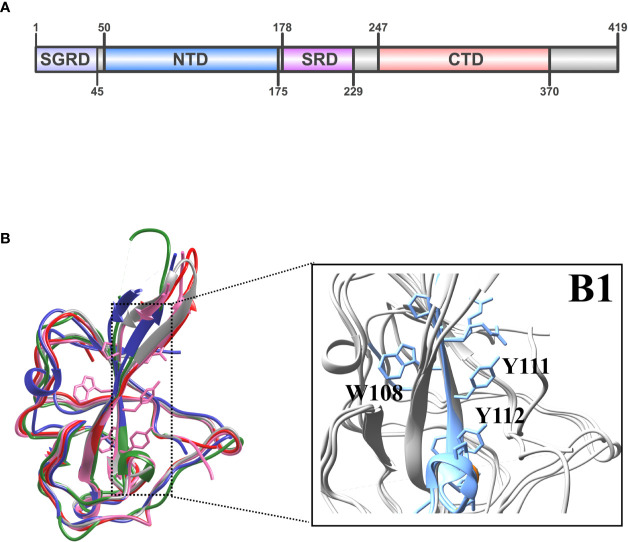
(A) Domain organization of coronaviral N proteins. The four domains labeled are as follows: SGRD, serine–glycine–arginine-rich domain; NTD, N-terminal domain; SRD, serine-rich domain; and CTD, C-terminal domain. (B) Superimposition of the HCoV-Sars-2 NTD in pink (pdb ID: 6M3M) with NTDs from Sars-CoV-1 in red (pdb ID: 2OFZ), HCoV-OC43 in green (pdb ID: 4J3K), HCoV-NL63 in blue (pdb ID: 5NK4), MERS in gray (pdb ID: 4UDI). (B1) The beta-strand (β3) region for the major conserved epitope is highlighted in blue with the two conserved tyrosines for RNA binding.

References

    1. Wang C, Horby PW, Hayden FG, Gao GF. A novel coronavirus outbreak of global health concern. Lancet (2020) 395(10223):470–3. 10.1016/S0140-6736(20)30185-9 - DOI - PMC - PubMed
    1. Dahlke C, Heidepriem J, Kobbe R, Santer R, Koch T, Fathi A, et al. Distinct early IgA profile may determine severity of COVID-19 symptoms: an immunological case series. medRxiv (2020). 10.1101/2020.04.14.20059733 - DOI
    1. Chen Y, Liu Q, Guo D. Emerging coronaviruses: Genome structure, replication, and pathogenesis. J Med Virol (2020) 92(4):418–23. 10.1002/jmv.25681 - DOI - PMC - PubMed
    1. Tilocca B, Soggiu A, Sanguinetti M, Musella V, Britti D, Bonizzi L, et al. Comparative computational analysis of SARS-CoV-2 nucleocapsid protein epitopes in taxonomically related coronaviruses. Microbes Infect (2020) 22(4-5):188–94. 10.1016/j.micinf.2020.04.002 - DOI - PMC - PubMed
    1. Tay MZ, Poh CM, Renia L, MacAry PA, Ng LFP. The trinity of COVID-19: immunity, inflammation and intervention. Nat Rev Immunol (2020) 20(6):363–74. 10.1038/s41577-020-0311-8 - DOI - PMC - PubMed

Publication types

MeSH terms