Review
. 2020 Sep 18:11:578712.
doi: 10.3389/fgene.2020.578712. eCollection 2020.

Chromatin Landscape During Skeletal Muscle Differentiation

Affiliations
Review

Chromatin Landscape During Skeletal Muscle Differentiation

Oscar Hernández-Hernández et al. Front Genet. .

Abstract

Cellular commitment and differentiation involve highly coordinated mechanisms by which tissue-specific genes are activated while others are repressed. These mechanisms rely on the activity of specific transcription factors, chromatin remodeling enzymes, and higher-order chromatin organization in order to modulate transcriptional regulation on multiple cellular contexts. Tissue-specific transcription factors are key mediators of cell fate specification with the ability to reprogram cell types into different lineages. A classic example of a master transcription factor is the muscle specific factor MyoD, which belongs to the family of myogenic regulatory factors (MRFs). MRFs regulate cell fate determination and terminal differentiation of the myogenic precursors in a multistep process that eventually culminate with formation of muscle fibers. This developmental progression involves the activation and proliferation of muscle stem cells, commitment, and cell cycle exit and fusion of mononucleated myoblast to generate myotubes and myofibers. Although the epigenetics of muscle regeneration has been extensively addressed and discussed over the recent years, the influence of higher-order chromatin organization in skeletal muscle regeneration is still a field of development. In this review, we will focus on the epigenetic mechanisms modulating muscle gene expression and on the incipient work that addresses three-dimensional genome architecture and its influence in cell fate determination and differentiation to achieve skeletal myogenesis. We will visit known alterations of genome organization mediated by chromosomal fusions giving rise to novel regulatory landscapes, enhancing oncogenic activation in muscle, such as alveolar rhabdomyosarcomas (ARMS).

Keywords: MyoD; muscle regeneration; myogenesis; myogenic regulatory factors; satellite cells.


Figures

Figure 1
Figure 1
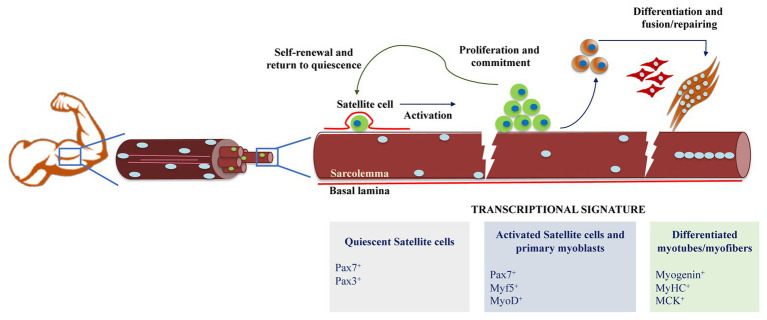
Schematic representation of skeletal muscle differentiation. Muscle regeneration is possible thanks to the functionality of adult muscle stem cells and the satellite cells. In homeostatic conditions, satellite cells are in a quiescent state, and after different stimulus caused by damage, they proliferate to generate myogenic precursors and to repopulate the satellite cell niche. Myoblasts express markers of muscle identity and fuse to each other to generate myotubes and myofibers, to eventually repair the damaged muscle fiber.
Figure 2
Figure 2
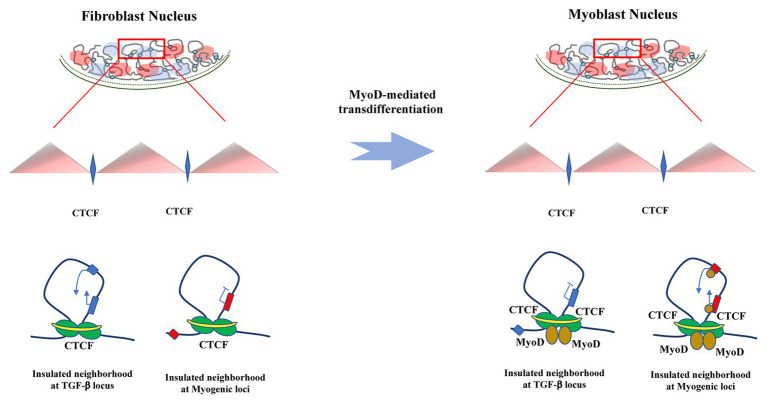
MyoD dependent trans-differentiation drives changes in chromatin interaction. Schematic representation of chromatin changes that MyoD drives during somatic reprogramming toward trans-differentiation. While MyoD erases the cell of origin transcriptional program by altering insulated neighborhoods that allow – among many others – TGF-β promoter-enhancer contacts in fibroblasts, it also activates skeletal myogenesis through reconfiguration of chromatin interactions that involves cis-regulatory and structural genomic elements and temporally precedes transcriptional regulation of muscle genes.

References

    1. Asakura A., Lyons G. E., Tapscott S. J. (1995). The regulation of MyoD gene expression: conserved elements mediate expression in embryonic axial muscle. Dev. Biol. 171, 386–398. 10.1006/dbio.1995.1290, PMID: - DOI - PubMed
    1. Austenaa L. M. I., Barozzi I., Simonatto M., Masella S., Chiara G. D., Ghisletti S., et al. (2015). Transcription of mammalian cis-regulatory elements is restrained by actively enforced early termination. Mol. Cell 60, 460–474. 10.1016/j.molcel.2015.09.018, PMID: - DOI - PubMed
    1. Barr F. G. (2001). Gene fusions involving PAX and FOX family members in alveolar rhabdomyosarcoma. Oncogene 20, 5736–5746. 10.1038/sj.onc.1204599, PMID: - DOI - PubMed
    1. Battistelli C., Busanello A., Maione R. (2014). Functional interplay between MyoD and CTCF in regulating long-range chromatin interactions during differentiation. J. Cell Sci. 127, 3757–3767. 10.1242/jcs.149427, PMID: - DOI - PubMed
    1. Bennicelli J. L., Edwards R. H., Barr F. G. (1996). Mechanism for transcriptional gain of function resulting from chromosomal translocation in alveolar rhabdomyosarcoma. Proc. Natl. Acad. Sci. U. S. A. 93, 5455–5459. 10.1073/pnas.93.11.5455, PMID: - DOI - PMC - PubMed

LinkOut - more resources