Review
. 2020 Oct 26:10:589508.
doi: 10.3389/fonc.2020.589508. eCollection 2020.

Targeting Glutaminolysis: New Perspectives to Understand Cancer Development and Novel Strategies for Potential Target Therapies

Affiliations
Review

Targeting Glutaminolysis: New Perspectives to Understand Cancer Development and Novel Strategies for Potential Target Therapies

Zhefang Wang et al. Front Oncol. .

Abstract

Metabolism rewiring is an important hallmark of cancers. Being one of the most abundant free amino acids in the human blood, glutamine supports bioenergetics and biosynthesis, tumor growth, and the production of antioxidants through glutaminolysis in cancers. In glutamine dependent cancer cells, more than half of the tricarboxylic/critic acid (TCA) metabolites are derived from glutamine. Glutaminolysis controls the process of converting glutamine into TCA cycle metabolites through the regulation of multiple enzymes, among which the glutaminase shows the importance as the very first step in this process. Targeting glutaminolysis via glutaminase inhibition emerges as a promising strategy to disrupt cancer metabolism and tumor progression. Here, we review the regulation of glutaminase and the role of glutaminase in cancer metabolism and metastasis. Furthermore, we highlight the glutaminase inhibitor based metabolic therapy strategy and their potential applications in clinical scenarios.

Keywords: cancer metabolism; combination therapy; glutaminase inhibitor; glutaminolysis; metastasis.


Figures

Figure 1
Figure 1
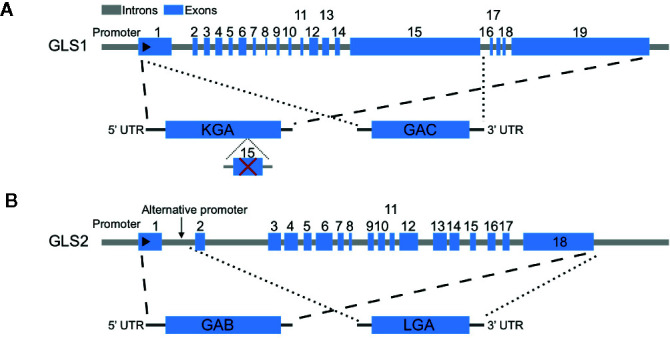
Genomic structures of human GLS1 and GLS2 and alternative transcripts. (A) Two alternative transcripts arise from GLS1, KGA, and glutaminase C (GAC). KGA is the longer isoform with all exons except exon 15, while GAC is the shorter isoform with exons 1–15. (B) Two alternative transcripts arise from GLS2, GAB, and LGA. GAB is the longer isoform with all exons, while LGA is the shorter isoform lack of exon 1.
Figure 2
Figure 2
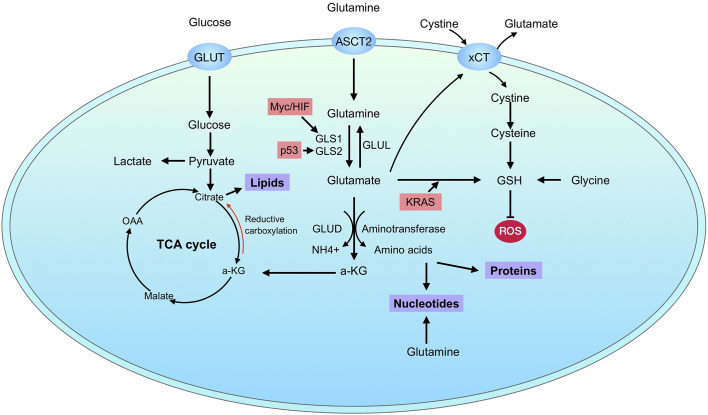
Glutamine metabolism in cancer. Cancer cells uptake glucose and glutamine through GLUT and ASCT2, respectively. After transporting into cells, glutamine is catalyzed to glutamate by glutaminases, which have two isoforms: GLS1 and GLS2. Glutamate is further converted to α-KG through GLUD or aminotransferases. The resulting metabolites can supply for bioenergetics through tricarboxylic/critic acid (TCA) cycle and support biosynthesis of proteins, nucleotides and lipids. In addition, glutamine metabolism also contributes directly to GSH synthesis. The regulation of glutaminase is marked in pink.
Figure 3
Figure 3
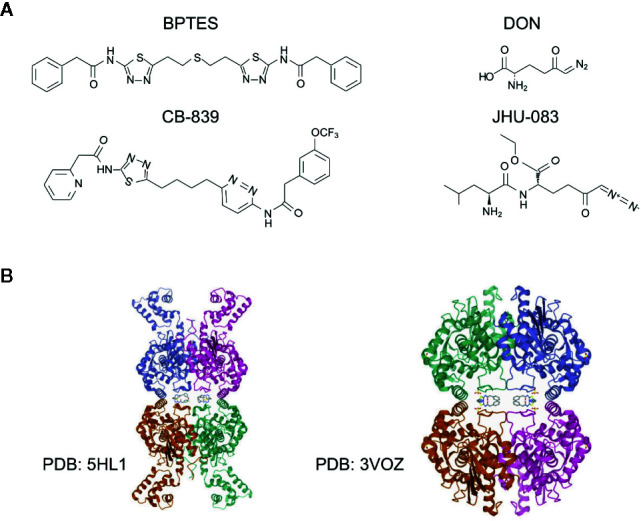
Structures of glutaminase inhibitors. (A) The structures of selected glutaminase inhibitors, including BPTES, CB-839, DON and JHU-083. (B) The structure and allosteric binding pocket of GLS1 (rcsb.org). Left, structure of GLS1 in complex with BPTES, PDB entry 3VOZ; right, structure of GLS1 in complex with CB-839, PDB entry 5HL1. The inhibitors are at the center of the structures.
Figure 4
Figure 4
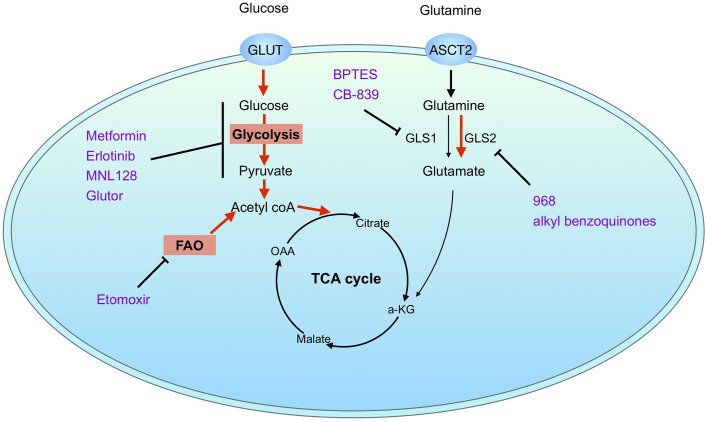
Mechanisms of glutaminase inhibition resistance. Resistance to pharmacological glutaminase inhibition may be explained by differential expression of glutaminase isoenzymes or activation of alternative metabolic pathways. Combination therapy with inhibitors targeting alternative metabolic pathways, such as glycolysis and fatty acid oxidation, helps to overcome glutaminase inhibition resistance. Possible mechanisms of glutaminase inhibition resistance are marked in red. Inhibitors are marked in purple.

References

    1. Hanahan D, Weinberg RA. Hallmarks of cancer: the next generation. Cell (2011) 144:646–74. 10.1016/j.cell.2011.02.013 - DOI - PubMed
    1. Pavlova NN, Thompson CB. The Emerging Hallmarks of Cancer Metabolism. Cell Metab (2016) 23:27–47. 10.1016/j.cmet.2015.12.006 - DOI - PMC - PubMed
    1. Patra KC, Wang Q, Bhaskar PT, Miller L, Wang Z, Wheaton W, et al. Hexokinase 2 is required for tumor initiation and maintenance and its systemic deletion is therapeutic in mouse models of cancer. Cancer Cell (2013) 24:213–28. 10.1016/j.ccr.2013.06.014 - DOI - PMC - PubMed
    1. Shroff EH, Eberlin LS, Dang VM, Gouw AM, Gabay M, Adam SJ, et al. MYC oncogene overexpression drives renal cell carcinoma in a mouse model through glutamine metabolism. Proc Natl Acad Sci USA (2015) 112:6539–44. 10.1073/pnas.1507228112 - DOI - PMC - PubMed
    1. Warburg O. On respiratory impairment in cancer cells. Science (1956) 124:269–70. 10.1126/science.124.3215.267 - DOI - PubMed

LinkOut - more resources