Review
. 2020 Oct 20:8:564809.
doi: 10.3389/fchem.2020.564809. eCollection 2020.

Review of the Correlation of LAT1 With Diseases: Mechanism and Treatment

Affiliations
Review

Review of the Correlation of LAT1 With Diseases: Mechanism and Treatment

Jingshun Zhang et al. Front Chem. .

Abstract

LAT1 is a member of the system L transporter family. The main role of the LAT1 is to transport specific amino acids through cell membranes to provide nutrients to cells and participate in several metabolic pathways. It also contributes to the transport of hormones and some drugs, which are essential for the development and treatment of some diseases. In recent years, many studies have shown that LAT1 is related to cancer, obesity, diabetes, and other diseases. However, the specific mechanism underlying the influence of LAT1 on such conditions remains unclear. Through the increasing number of studies on LAT1, we have obtained a preliminary understanding on the function of LAT1 in diseases. These studies also provide a theoretical basis for finding treatments for LAT1-related diseases, such as cancer. This review summarizes the function and mechanism of LAT1 in different diseases and the treatment of LAT1-related diseases. It also provides support for the development of novel and reliable disease treatments.

Keywords: LAT1; MYC; cancer; immune diseases; insulin resistance; mTOR.


Figures

Figure 1
Figure 1
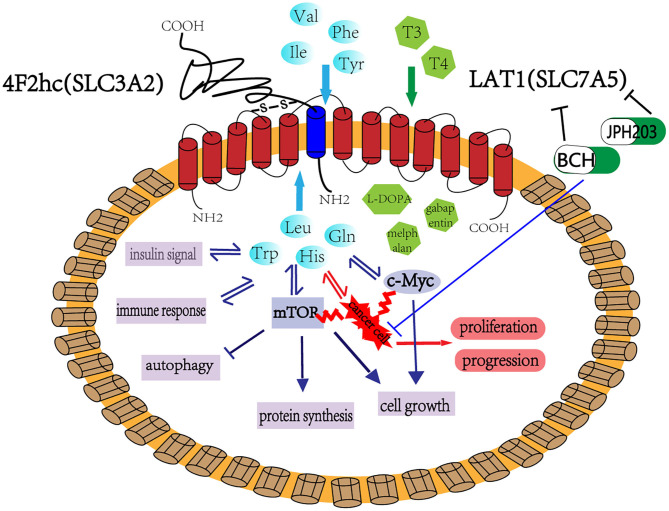
LAT1 binds with 4F2hc (SLC3A2), which are located on the plasma membrane. This complex is responsible for transporting amino acids, hormones, and some drugs. LAT1 regulates cell growth and metabolism through the mTOR and MYC pathway and participates in insulin signaling, immune response, and cell autophagy. LAT1 also plays an important role in tumor occurrence and development. BCH and JPH203 are the two main inhibitors of LAT1, which can inhibit the growth of tumor cells and has considerable application prospect in tumor treatment.

References

    1. Adeva M. M., Calvino J., Souto G., Donapetry C. (2012). Insulin resistance and the metabolism of branched-chain amino acids in humans. Amino Acids 43, 171–181. 10.1007/s00726-011-1088-7 - DOI - PubMed
    1. Aifantis I., Raetz E., Buonamici S. (2008). Molecular pathogenesis of T-cell leukaemia and lymphoma. Nat. Rev. Immunol. 8, 380–390. 10.1038/nri2304 - DOI - PubMed
    1. Al-Otaish H., Al-Ayadhi L., Bjorklund G., Chirumbolo S., Urbina M. A., El-Ansary A. (2018). Relationship between absolute and relative ratios of glutamate, glutamine and GABA and severity of autism spectrum disorder. Metab. Brain Dis. 33, 843–854. 10.1007/s11011-018-0186-6 - DOI - PubMed
    1. Araki K., Turner A. P., Shaffer V. O., Gangappa S., Keller S. A., Bachmann M. F., et al. (2009). mTOR regulates memory CD8 T-cell differentiation. Nature 460, 108–112. 10.1038/nature08155 - DOI - PMC - PubMed
    1. Arnsburg K., Kirstein-Miles J. (2014). Interrelation between protein synthesis, proteostasis and life span. Curr. Genomics 15, 66–75. 10.2174/1389202915666140210210542 - DOI - PMC - PubMed