Review
. 2020 Oct 27:7:595796.
doi: 10.3389/fvets.2020.595796. eCollection 2020.

Current Insights Into the Pathology of Canine Intervertebral Disc Extrusion-Induced Spinal Cord Injury

Collaborators, Affiliations
Review

Current Insights Into the Pathology of Canine Intervertebral Disc Extrusion-Induced Spinal Cord Injury

Ingo Spitzbarth et al. Front Vet Sci. .

Abstract

Spinal cord injury (SCI) in dogs is commonly attributed to intervertebral disc extrusion (IVDE). Over the last years substantial progress was made in the elucidation of factors contributing to the pathogenesis of this common canine disease. A detailed understanding of the underlying histopathological and molecular alterations in the lesioned spinal cord represents a prerequisite to translate knowledge on the time course of secondary injury processes into the clinical setting. This review summarizes the current state of knowledge of the underlying pathology of canine IVDE-related SCI. Pathological alterations in the spinal cord of dogs affected by IVDE-related SCI include early and persisting axonal damage and glial responses, dominated by phagocytic microglia/macrophages. These processes are paralleled by a pro-inflammatory microenvironment with dysregulation of cytokines and matrix metalloproteinases within the spinal cord. These data mirror findings from a clinical and therapeutic perspective and can be used to identify biomarkers that are able to more precisely predict the clinical outcome. The pathogenesis of progressive myelomalacia, a devastating complication of SCI in dogs, is not understood in detail so far; however, a fulminant and exaggerating secondary injury response with massive reactive oxygen species formation seems to be involved in this unique neuropathological entity. There are substantial gaps in the knowledge of pathological changes in IVDE with respect to more advanced and chronic lesions and the potential involvement of demyelination. Moreover, the role of microglia/macrophage polarization in IVDE-related SCI still remains to be investigated. A close collaboration of clinical neurologists and veterinary pathologists will help to facilitate an integrative approach to a more detailed understanding of the molecular pathogenesis of canine IVDE and thus to identify therapeutic targets.

Keywords: IVDE; axonal damage; cytokine; extrusion; immunohistochemistry; macrophage; macrophage polarization; spinal cord injury.


Figures

Figure 1
Figure 1
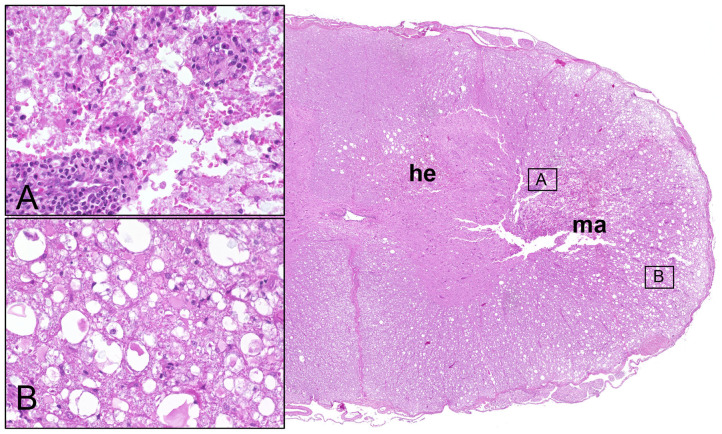
Male Dachshund with type I intervertebral disc herniation (acute extrusion). Overview (right side) of HE stained spinal cord transversal section with hemorrhage (he) accentuated within the gray matter and white matter malacia (ma). Inset upper left (A): moderate perivascular cuffing of mononuclear leukocytes and focal disintegration of neuroparenchyma (necrosis, malacia). Inset lower left (B): moderate to severe white matter vacuolation within the ventrolateral funiculus, characterized by multiple dilated myelin sheaths that contain hypereosinophilic swollen axons (spheroids). 20x magnification in insets.
Figure 2
Figure 2
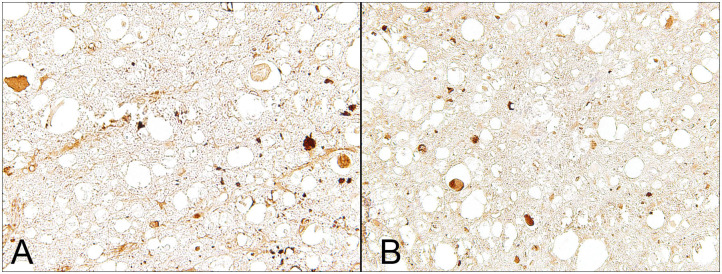
Male Dachshund with type I intervertebral disc herniation (acute extrusion). Immunohistochemical detection of axonal damage. (A) Beta-APP accumulates within swollen axons indicating disruption of the fast axonal transport machinery. (B) Non-phosphorylated neurofilament (nNF), another marker for axonal damage, is detected within numerous swollen axons but is also expressed by axons with a normal appearing diameter. 40x magnification.
Figure 3
Figure 3
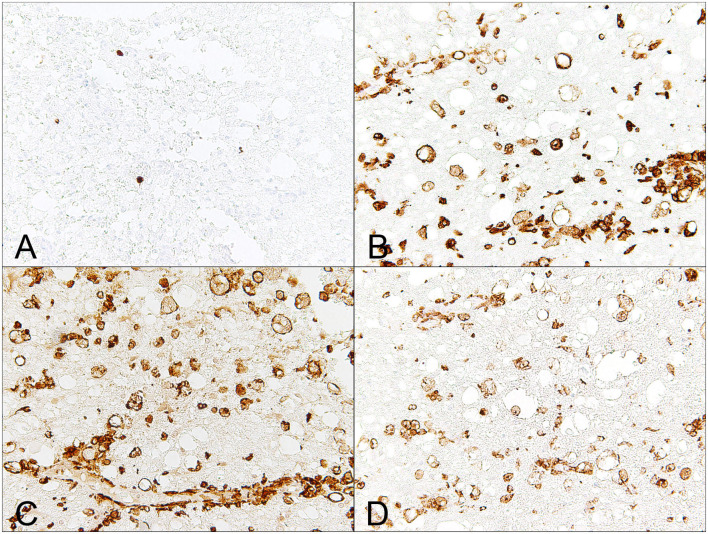
Male Dachshund with type I intervertebral disc herniation (acute extrusion). Immunohistochemical detection of macrophages, which are a dominating immune cell population involved in secondary injury mechanisms. (A) Mac387, a clone that detects myleoid/histiocyte antigen, only detects relatively few, monocyte-like blood born macrophages. (B) There is severe up-regulation of MHC class II on phagocytic gitter cells. (C) Similarly, Iba-1, a pan-macrophage marker, labels numerous phagocytic microglia/macrophages within the affected white matter. (D) CD204, a marker that has been proposed to mainly detect M2-polarized macrophages, labels several microglia/macrophages within the white matter and within dilated, optically empty myelin sheaths (myelinophagia). 40x magnification.
Figure 4
Figure 4
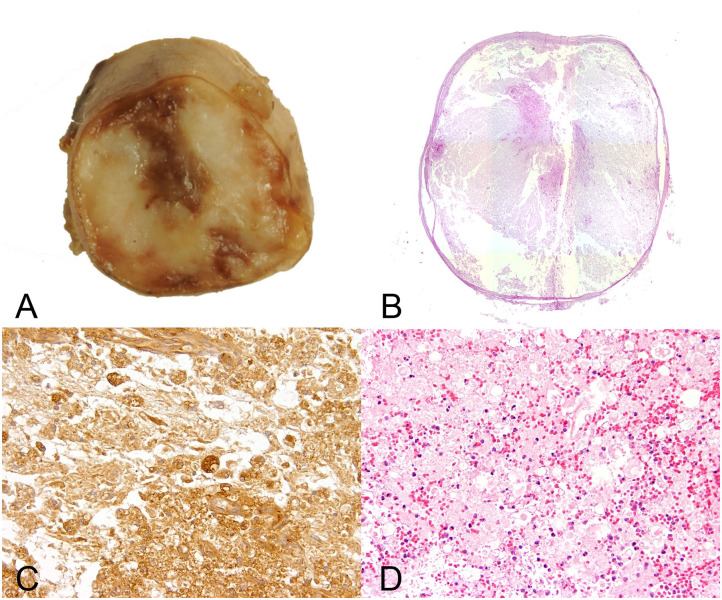
Male 6 years old Yorkshire Terrier with progressive myelomalacia (PMM) following acute intervertebral disc extrusion. In PMM the shown lesions are not restricted to the initial site of spinal cord injury but extend several centimeters into cranial and caudal direction (ascending and descending malacia). (A) Gross picture of a transversal section of the formalin fixed spinal cord with complete disintegration of spinal cord neuroparenchyma and hemorrhage. (B) The HE stained overview of the transversal section shows polio- and leukomyelomalacia with complete loss of cellular details and loss of distinction between white and gray matter. (C) Multiple foamy microglia/macrophages labeled by the lectin of Bandeiraea simplicifolia 1 have infiltrated the lesion and remove cellular debris. 40x magnification. (D) There is severe extravasation of erythrocytes within the white and gray matter (hemorrhage), associated with infiltration of viable and degenerate neutrophils adjacent to areas of white matter damage with spheroids and myelin vacuolation. 10x magnification.

References

    1. Olby N. The pathogenesis and treatment of acute spinal cord injuries in dogs. Vet Clin North Am Small Anim Pract. (2010) 40:791–807. 10.1016/j.cvsm.2010.05.007 - DOI - PubMed
    1. Bray JP, Burbidge HM. The canine intervertebral disk. Part two: degenerative changes—nonchondrodystrophoid versus chondrodystrophoid disks. J Am Anim Hosp Assoc. (1998) 34:135–44. 10.5326/15473317-34-2-135 - DOI - PubMed
    1. Webb AA, Ngan S, Fowler JD. Spinal cord injury I: a synopsis of the basic science. Can Vet J. (2010) 51:485–92. - PMC - PubMed
    1. Coates JR. Intervertebral disk disease. Vet Clin North Am Small Anim Pract. (2000) 30:77–110. 10.1016/S0195-5616(00)50004-7 - DOI - PubMed
    1. Fluehmann G, Doherr MG, Jaggy A. Canine neurological diseases in a referral hospital population between 1989 and 2000 in Switzerland. J Small Anim Pract. (2006) 47:582–7. 10.1111/j.1748-5827.2006.00106.x - DOI - PubMed