


Cardiac Optogenetics in Atrial Fibrillation: Current Challenges and Future Opportunities
- PMID: 33195698
- PMCID: PMC7641281
- DOI: 10.1155/2020/8814092
Cardiac Optogenetics in Atrial Fibrillation: Current Challenges and Future Opportunities
Abstract
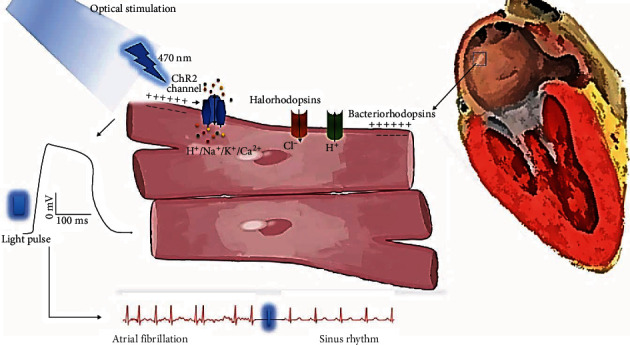
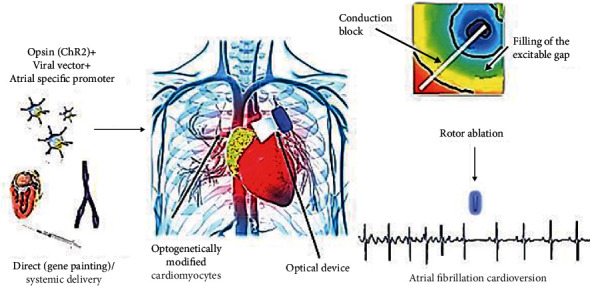
Although rarely life-threatening on short term, atrial fibrillation leads to increased mortality and decreased quality of life through its complications, including heart failure and stroke. Recent studies highlight the benefits of maintaining sinus rhythm. However, pharmacological long-term rhythm control strategies may be shadowed by associated proarrhythmic effects. At the same time, electrical cardioversion is limited to hospitals, while catheter ablation therapy, although effective, is invasive and is dedicated to specific patients, usually with low amounts of atrial fibrosis (preferably Utah I-II). Cardiac optogenetics allows influencing the heart's electrical activity by applying specific wavelength light pulses to previously engineered cardiomyocytes into expressing microbial derived light-sensitive proteins called opsins. The resulting ion influx may give rise to either hyperpolarizing or depolarizing currents, thus offering a therapeutic potential in cardiac electrophysiology, including pacing, resynchronization, and arrhythmia termination. Optogenetic atrial fibrillation cardioversion might be achieved by inducing a conduction block or filling of the excitable gap. The authors agree that transmural opsin expression and appropriate illumination with an exposure time longer than the arrhythmia cycle length are necessary to achieve successful arrhythmia termination. However, the efficiency and safety of biological cardioversion in humans remain to be seen, as well as side effects such as immune reactions and loss of opsin expression. The possibility of delivering pain-free shocks with out-of-hospital biological cardioversion is tempting; however, there are several issues that need to be addressed first: applicability and safety in humans, long-term behaviour, anticoagulation requirements, and fibrosis interactions.
Copyright © 2020 Mariana Floria et al.
Conflict of interest statement
The authors declare that there is no conflict of interest regarding the publication of this paper.
Figures
References
Publication types
MeSH terms
LinkOut - more resources
Full Text Sources
Medical
Miscellaneous
