. 2020 Dec 16;48(22):12453-12482.
doi: 10.1093/nar/gkaa1000.

Epigenome engineering: new technologies for precision medicine

Affiliations

Epigenome engineering: new technologies for precision medicine

Agustin Sgro et al. Nucleic Acids Res. .

Abstract

Chromatin adopts different configurations that are regulated by reversible covalent modifications, referred to as epigenetic marks. Epigenetic inhibitors have been approved for clinical use to restore epigenetic aberrations that result in silencing of tumor-suppressor genes, oncogene addictions, and enhancement of immune responses. However, these drugs suffer from major limitations, such as a lack of locus selectivity and potential toxicities. Technological advances have opened a new era of precision molecular medicine to reprogram cellular physiology. The locus-specificity of CRISPR/dCas9/12a to manipulate the epigenome is rapidly becoming a highly promising strategy for personalized medicine. This review focuses on new state-of-the-art epigenome editing approaches to modify the epigenome of neoplasms and other disease models towards a more 'normal-like state', having characteristics of normal tissue counterparts. We highlight biomolecular engineering methodologies to assemble, regulate, and deliver multiple epigenetic effectors that maximize the longevity of the therapeutic effect, and we discuss limitations of the platforms such as targeting efficiency and intracellular delivery for future clinical applications.


Figures

Figure 1.
Figure 1.
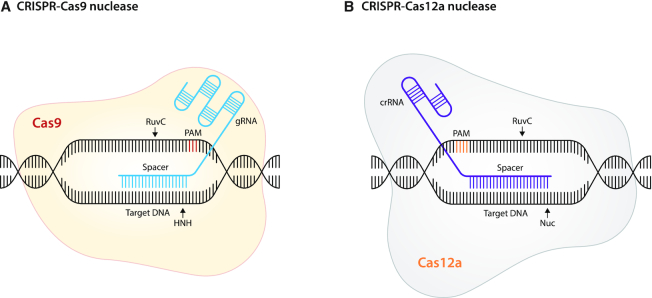
Schematic representation of the main CRISPR–Cas proteins adopted for epigenetic editing. (A) Cas9 proteins are RNA-guided DNA-targeting endonucleases. In epigenome engineering, the two Cas9 nuclease domains, RuvC and HNH, are mutated. Mutation of the catalytic residues of RuvC (D10A) and HNH (H840A) and (N580A) for Streptococcus pyogenes and Staphylococcus aureus, respectively, render Cas9 proteins defective, i.e., SpdCas9 and SadCas9. dCas9 proteins can still interact with the backbone of the guide RNA (gRNA). DNA binding results from complementary pairing of the spacer portion of the gRNA (20 nucleotides) to a targeted genomic region positioned next to a 5′ protospacer adjacent motif (PAM). (B) Cas12a endonucleases can be catalytically deactivated by point mutations. (D832A) in the RuvC domain and (E925A) in a putative nuclease (Nuc) domain render Lachnospiraceae bacterium Cas12a-defective; i.e., LbdCas12a, also known as LbdCpf1. DNA recognition and binding relies on the complementarity between the CRISPR RNA (crRNA) spacer (24 nucleotides), positioned next to a 3′ PAM, and the DNA target sequence.
Figure 2.
Figure 2.
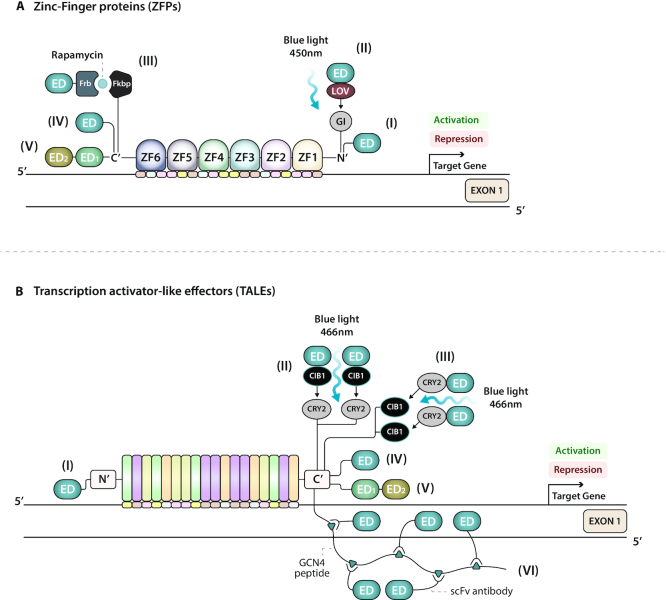
Programmable DNA-targeting platforms for epigenetic editing. (A) ZFPs are artificial protein modules that bind to the major groove of DNA. Each zinc finger domain recognizes a 3-nucleotide sequence. Fusions of six ZFPs can recognize an 18-base-pair sequence. (I) A single effector domain (ED) directly fused to the N-terminus of ZFP. (II) A light-inducible system based on blue light that controls heterodimerization of the GIGANTEA (GI) protein fused to ZFP and another plant protein LOV to translocate ED to the gene of interest. (III) A chemically inducible system based on rapamycin. A fusion of ZFP to the human protein Fkbp interacts, in the presence of rapamycin, with a domain derived from human protein Frb linked to ED. This system has also been fused with CRISPR/dCas proteins (see Figure 4A-III). (IV) A single ED directly fused to the C-terminus of ZFP. (V) A bipartite ED system directly linked to the C-terminus of ZFP. (B) TALEs are highly conserved tandem repeats or monomers of 34 amino acids in length that only differ in the amino acid residues at the 12th and the 13th position. The amino acids at these two sites in each monomer target a single nucleotide in one DNA strand according to a specific code (NI = adenine, HD = cytosine, NN = guanine, and NG = thymine). Fusions of customizable modules can target an 18-base-pair sequence. (I) A single ED directly fused to the N-terminus of TALE. (II) Optogenetic modulation of gene transcription by the Light-Inducible Transcriptional Effectors (LITE) system. Blue light triggers the interaction between TALE fused to the plant light-sensitive cryptochrome 2 (CRY2) protein and its interacting partner CIB1 linked to ED. (III) A spatiotemporal light-inducible system based on an inverted heterodimerizing fusion protein approach. This system has also been fused with CRISPR/dCas9 (see Figure 4A-I). (IV) A single ED directly fused to the C-terminus of TALE. (V) A bipartite ED system directly linked to the C-terminus of TALE. (VI) The SunTag system C-terminally fused to TALE. This technology involves a protruding GCN4 peptide that contains several antibody-binding sites (triangles) that can recruit multiple single-chain antibodies (scFv) fused to EDs for amplification of epigenetic editing activity. The system has also been devised with CRISPR/dCas proteins (see Figures 3A-V and 4A-IV).
Figure 3.
Figure 3.
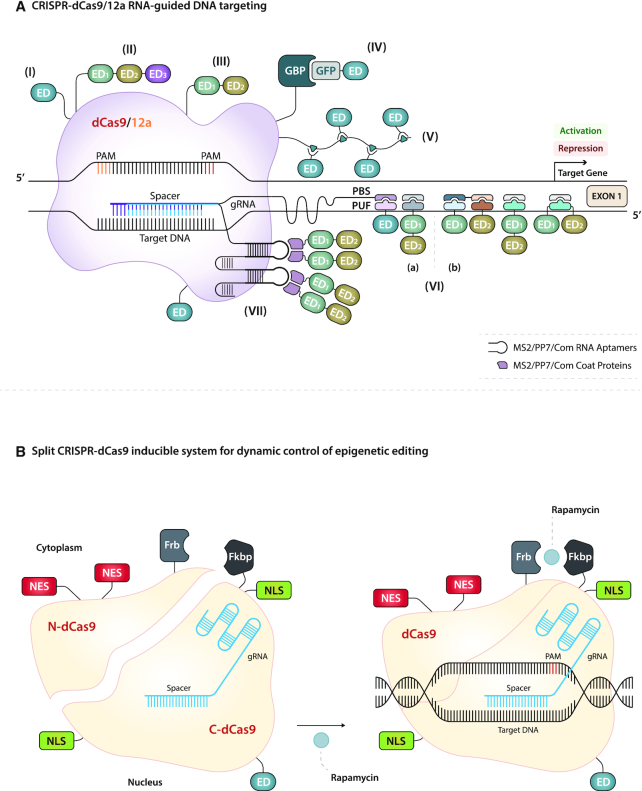
CRISPR-dCas9 and 12a proteins for epigenome engineering. (A) dCas9 and 12a are guided to the DNA by a customizable guide RNA (gRNA) and CRISPR RNA (crRNA), respectively. The spacer is the interchangeable portion of the gRNA and crRNA that is complementary to the targeted DNA sequence, which is 20 nucleotides (blue) and 24 nucleotides (violet) in length for dCas9 and dCas12a, respectively. In order to recognize and bind the genomic sequence, dCas proteins also require a protospacer adjacent motif (PAM) immediately 3′ (red) and 5′ (orange) of the target DNA, for dCas9 and dCas12a, respectively. (I) A single ED directly fused to either the N- or the C-terminus of dCas. (II and III) A tripartite and a bipartite ED system directly linked to either the N- or the C-terminus of dCas. (IV) A modular recruitment system based on green fluorescent protein (GFP)-coupled ED via GFP-binding protein (GBP) fused to dCas proteins. (V) The SunTag system fused to dCas proteins for augmentation of epigenetic editing. (VI) The Casilio recruitment platform comprises an appended gRNA fused with one to five copies of Pumilio/FBF (PUF) binding sites (PBS) to recruit multiple distinct EDs, fused to a PUF domain. (a) Simultaneous gene activation and gene repression via EDs, independently recruited, by separate dCas9 proteins targeting different promoters within the same cell. (b) Enhanced gene activation via synergistic activities of distinct EDs recruited, in different combinations, via the same dCas9 protein. (VII) The Synergistic Activation Mediator (SAM) and gRNA 2.0 technology is based on a gRNA modified with MS2, PP7, or Com RNA aptamers from bacteriophages, which recruit EDs fused to aptamer coat proteins to enhance the epigenetic editing activity of dCas proteins already fused to EDs. (B) Schematic representation of the split dCas9 strategy for chemical induction of epigenetic editing. The two split fragments, N-dCas9 and C-dCas9 fused to ED, are joined to the rapamycin-binding domains Frb and Fkbp, respectively. Spatial sequestration inside the cell is maintained by an equal ratio of nuclear export sequences (NES) and nuclear localization sequences (NLS) separately fused to the two segments. The addition of rapamycin activates rapid and reversible dCas9 dimerization, thereby allowing dynamic control of transcriptional modulation.
Figure 4.
Figure 4.
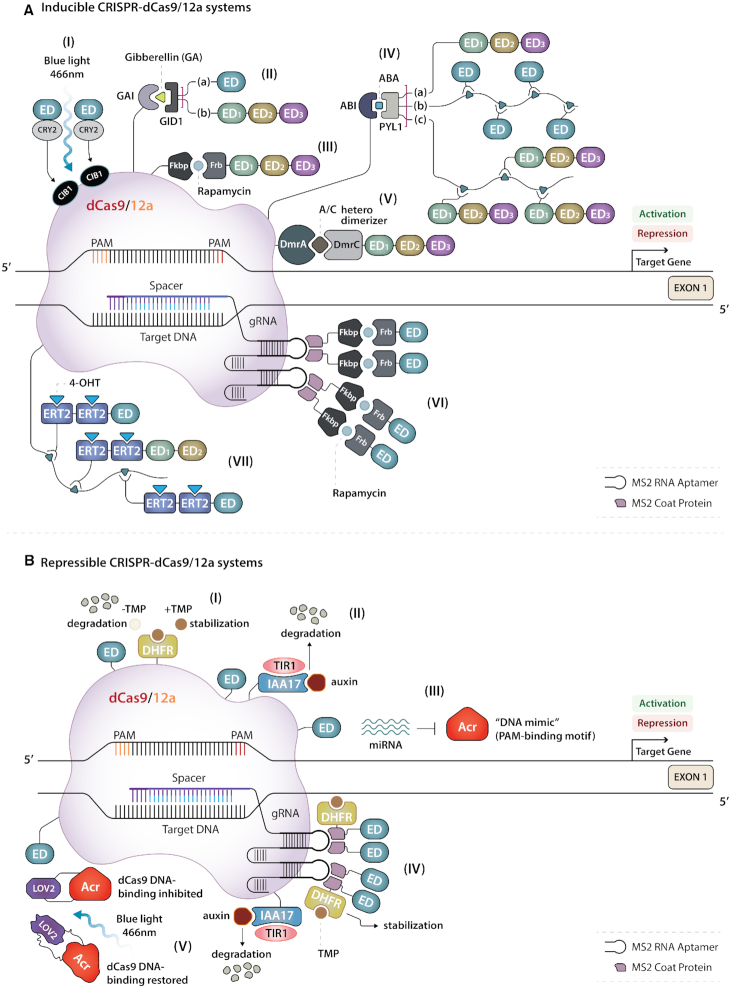
Inducible and repressible systems for precise and dynamic control of CRISPR-dCas9- and 12a-mediated epigenetic editing. (A) (I) The light-activated CRISPR-dCas9 effector (LACE) system induces spatiotemporal gene regulation based on exposure to blue light. (II) The chemical gibberellin (GA) induces dimerization of dCas fused to the GA-insensitive (GAI) plant protein and its binding partner gibberellin-insensitive dwarf1 (GID1) linked to either (a) single EDs or (b) tripartite ED systems. (III) The Fkbp-Frb technology recruits tripartite ED systems in the presence of rapamycin. (IV) The chemical abscisic acid (ABA)-inducible system. ABA triggers dimerization of dCas fused to the ABA-insensitive 1 (ABI) plant protein and its PYL1 interacting domain directly linked to (a) tripartite ED systems or to the SunTag system, which recruits (b) single EDs or (c) tripartite ED systems. (V) A drug-dependent system based on DmrA and DmrC domains fused to dCas and EDs, respectively, which interact only in the presence of the rapamycin analog A/C heterodimerizer. (VI) The Fkbp/Frb inducible recruitment for epigenome editing (FIRE) system combines the gRNA MS2 technology with the rapamycin-dependent dimerization approach. (VII) The hybrid drug inducible technology (HIT) based on the SunTag system. scFv antibodies are engineered with two copies of a mutated human estrogen receptor (ERT2) followed by single and multiple EDs. 4-Hydroxytamoxifen (4-OHT) induces nuclear translocation of these constructs that are otherwise retained in the cytoplasm. (B) (I) A drug-tunable system for conditional stabilization of dCas linked to ED (dCas9-ED) and N-terminally fused to a dihydrofolate reductase (DHFR)-derived destabilization domain. The addition of trimethoprim (TMP) temporally stabilizes the fusion construct. (II) Auxin-Inducible Degron technology (AID) involves tagging dCas-ED with the auxin plant hormone-sensitive domain IAA17 and co-expression of the auxiliary protein TIR1. The addition of auxin targets the chimeric dCas-ED protein for rapid proteasomal degradation. (III) Anti-CRISPR (Acr) proteins, e.g., AcrIIA4, interfere, and compete with dCas9-ED DNA recognition. The microRNA (miRNA)-responsive ‘Acr switch’ system is designed to cell-specifically regulate epigenetic editing. High levels of a specific miRNA can block Acr expression, thereby releasing dCas9-ED. (IV) A combinatorial strategy that couples the DHFR-TMP system, based on the MS2 ED-recruitment approach, with the AID technology. TMP results in stability, which can be abrogated by the addition of auxin to the system. (V) Optogenetic control based on the CASANOVA system. Acr fused to the plant photosensor LOV2 constitutively interferes with dCas9-ED DNA targeting. Blue light unfolds and impairs Acr-LOV2 fusion, thereby releasing dCas9-ED.

References

    1. Reik W. Stability and flexibility of epigenetic gene regulation in mammalian development. Nature. 2007; 447:425–432. - PubMed
    1. Kouzarides T. Chromatin modifications and their function. Cell. 2007; 128:693–705. - PubMed
    1. Margueron R., Reinberg D.. Chromatin structure and the inheritance of epigenetic information. Nat. Rev. Genet. 2010; 11:285–296. - PMC - PubMed
    1. Esteller M. Epigenetics in cancer. N. Engl. J. Med. 2008; 358:1148–1159. - PubMed
    1. Bennett R.L., Licht J.D.. Targeting epigenetics in cancer. Annu. Rev. Pharmacol. Toxicol. 2018; 58:187–207. - PMC - PubMed

Publication types