


Estimating the proportion of people with chronic hepatitis B virus infection eligible for hepatitis B antiviral treatment worldwide: a systematic review and meta-analysis
- PMID: 33197397
- PMCID: PMC7801814
- DOI: 10.1016/S2468-1253(20)30307-1
Estimating the proportion of people with chronic hepatitis B virus infection eligible for hepatitis B antiviral treatment worldwide: a systematic review and meta-analysis
Erratum in
-
Correction to Lancet Gastroenterol Hepatol 2021; 6: 106-19.Lancet Gastroenterol Hepatol. 2021 Feb;6(2):e1. doi: 10.1016/S2468-1253(20)30399-X. Lancet Gastroenterol Hepatol. 2021. PMID: 33444537 Free PMC article. No abstract available.
Abstract
Background: In 2016, of the estimated 257 million people living with chronic hepatitis B virus (HBV) infection worldwide, only a small proportion was diagnosed and treated. The insufficiency of information on the proportion of people infected with HBV who are eligible for treatment limits the interpretation of global treatment coverage. We aimed to estimate the proportion of people with chronic HBV infection who were eligible for antiviral treatment worldwide, based on the WHO 2015 guidelines.
Methods: In this systematic review and meta-analysis, we searched Medline, EMBASE, and the Cochrane databases from Jan 1, 2007, to Jan 31, 2018, for studies describing HBsAg-positive people in the population or health-care facilities. We extracted information from published studies using a standardised form to estimate the frequency of cirrhosis, abnormal alanine aminotransferase (ALT), HBV DNA exceeding 2000 IU/mL or 20 000 IU/mL, presence of HBeAg, and eligibility for treatment as per WHO and other guidelines as reported in the studies. We pooled proportions through meta-analysis with random effects. The study was registered with PROSPERO, CRD42020132345.
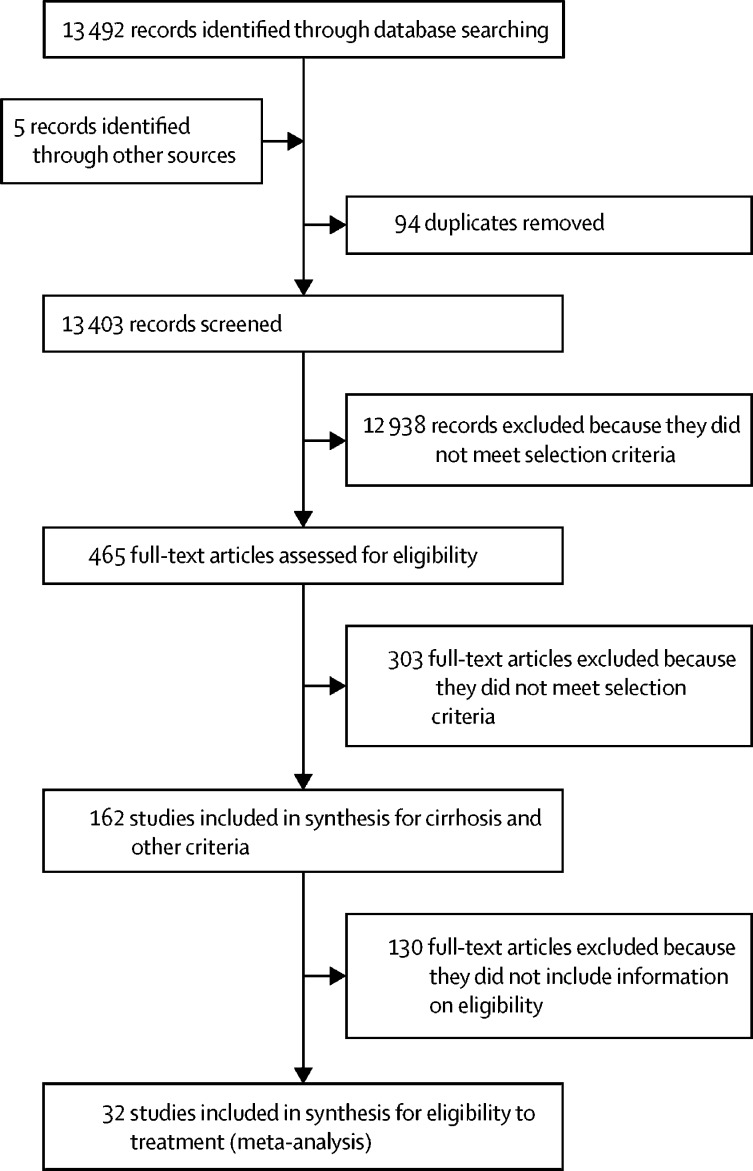
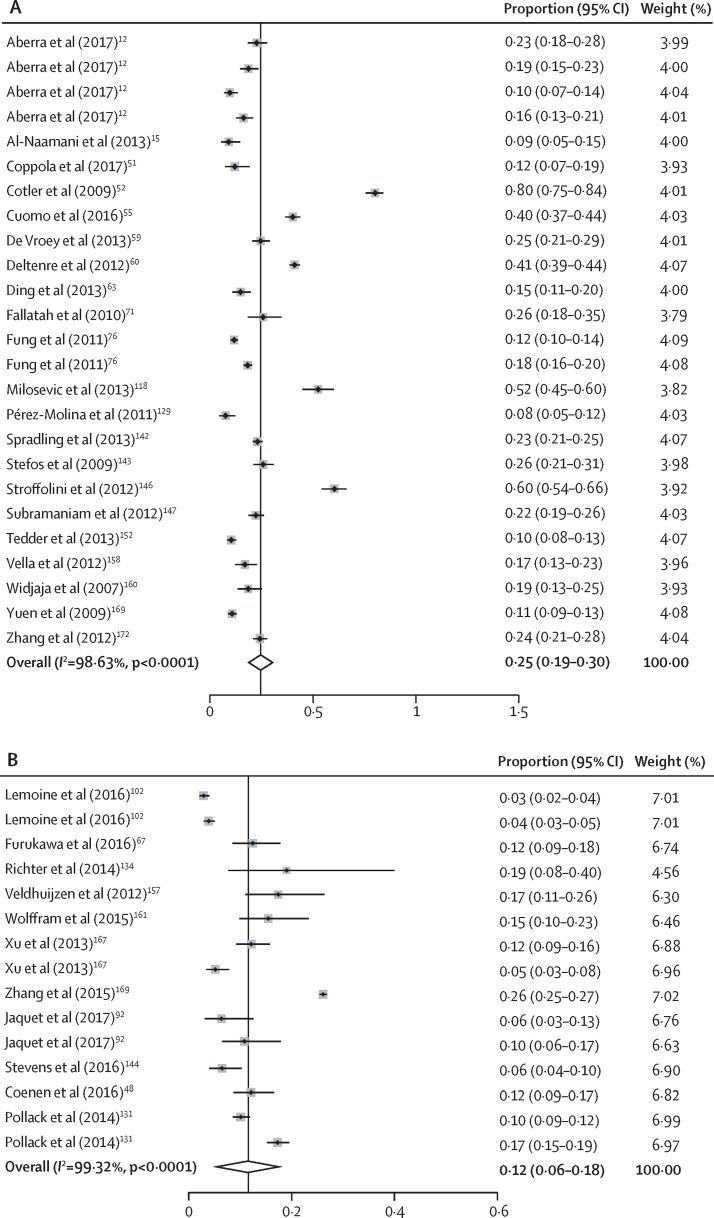
Findings: Of the 13 497 studies, 162 were eligible and included in our analysis. These studies included 145 789 participants. The pooled estimate of the proportion of cirrhosis was 9% (95% CI 8-10), ranging from 6% (4-8) in community settings to 10% (9-11) in clinic settings. Examining the proportion of participants who had characteristics used to determine eligibility in the WHO guidelines, 1750 (10·1%) of 17 394 had HBV DNA exceeding 20 000 IU/mL, and 20 425 (30·8%) of 66 235 had ALT above the upper limit of normal. 32 studies reported eligibility for treatment according to WHO or any other guidelines, with a pooled estimate of eligibility at 19% (95% CI 18-20), ranging from 12% (6-18) for studies in community settings to 25% (19-30) in clinic settings.
Interpretation: Many studies described people with HBV infection, but few reported information in a way that allowed assessment of eligibility for treatment. Although about one in ten of the 257 million people with HBV infection (26 million) might be in urgent need of treatment because of cirrhosis, a larger proportion (12-25%) is eligible for treatment in accordance with different guidelines. Future studies describing people with HBV infection should report on treatment eligibility, according to broadly agreed definitions.
Funding: WHO and US Centers for Disease Control and Prevention.
© 2020 World Health Organization; licensee Elsevier. This is an Open Access article published under the CC BY 3.0 IGO license which permits unrestricted use, distribution, and reproduction in any medium, provided the original work is properly cited. In any use of this article, there should be no suggestion that WHO endorses any specific organisation, products or services. The use of the WHO logo is not permitted. This notice should be preserved along with the article's original URL.
Figures
Comment in
-
Chronic hepatitis B: identifying who needs to be treated and improving linkage to care.Lancet Gastroenterol Hepatol. 2021 Feb;6(2):83-85. doi: 10.1016/S2468-1253(20)30332-0. Epub 2020 Nov 14. Lancet Gastroenterol Hepatol. 2021. PMID: 33197398 No abstract available.
-
Treatment eligibility in hepatitis B: a call for better linkage to optimal care.Lancet Gastroenterol Hepatol. 2021 Mar;6(3):160. doi: 10.1016/S2468-1253(20)30391-5. Lancet Gastroenterol Hepatol. 2021. PMID: 33581753 No abstract available.
References
-
- WHO . World Health Organization; Geneva: 2017. Global hepatitis report.https://www.who.int/hepatitis/publications/global-hepatitis-report2017/en/
-
- Chen CJ, Iloeje UH, Yang HI. Long-term outcomes in hepatitis B: the REVEAL-HBV study. Clin Liver Dis. 2007;11:797–816. - PubMed
-
- Han Y, Zeng A, Liao H, Liu Y, Chen Y, Ding H. The efficacy and safety comparison between tenofovir and entecavir in treatment of chronic hepatitis B and HBV related cirrhosis: a systematic review and Meta-analysis. Int Immunopharmacol. 2017;42:168–175. - PubMed
-
- WHO . World Health Organization; Geneva: 2015. Guidelines for the prevention, care and treatment of persons with chronic hepatitis B infection.https://www.who.int/hiv/pub/hepatitis/hepatitis-b-guidelines/en/ - PubMed
Publication types
MeSH terms
Substances
Grants and funding
LinkOut - more resources
Full Text Sources
Other Literature Sources
Medical
