


Sigh in Patients With Acute Hypoxemic Respiratory Failure and ARDS: The PROTECTION Pilot Randomized Clinical Trial
- PMID: 33197403
- PMCID: PMC7664474
- DOI: 10.1016/j.chest.2020.10.079
Sigh in Patients With Acute Hypoxemic Respiratory Failure and ARDS: The PROTECTION Pilot Randomized Clinical Trial
Abstract
Background: Sigh is a cyclic brief recruitment maneuver: previous physiologic studies showed that its use could be an interesting addition to pressure support ventilation to improve lung elastance, decrease regional heterogeneity, and increase release of surfactant.
Research question: Is the clinical application of sigh during pressure support ventilation (PSV) feasible?
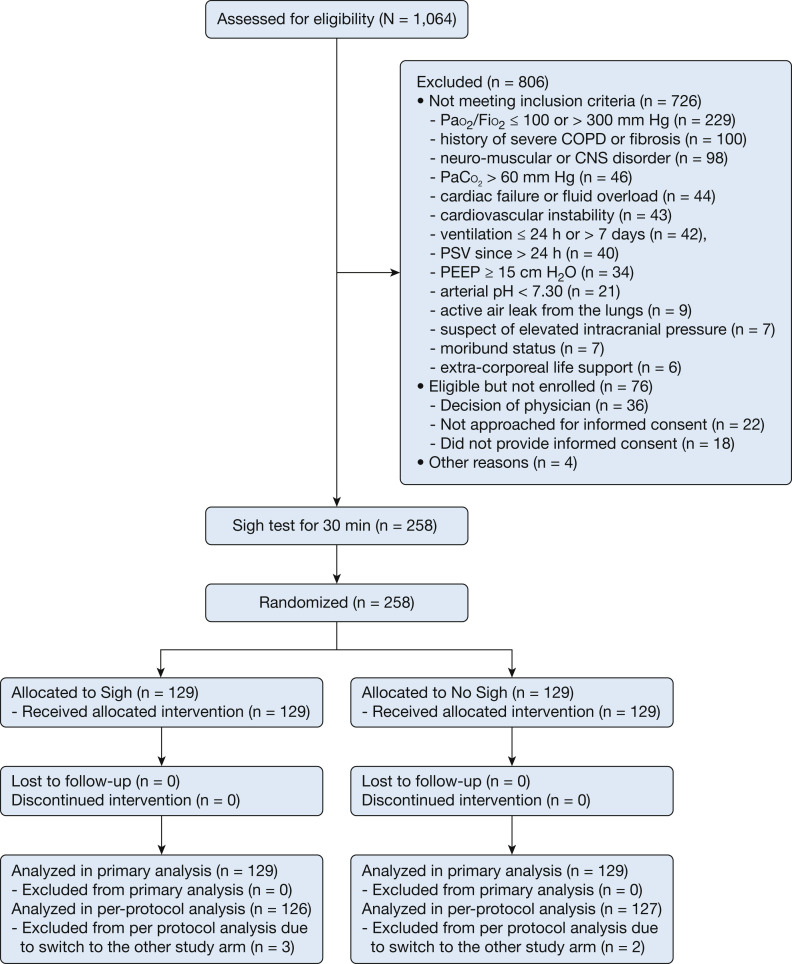
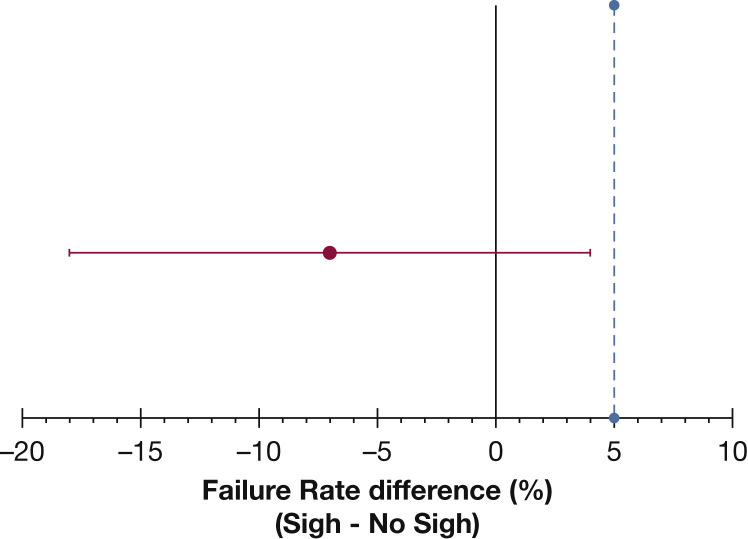
Study design and methods: We conducted a multicenter noninferiority randomized clinical trial on adult intubated patients with acute hypoxemic respiratory failure or ARDS undergoing PSV. Patients were randomized to the no-sigh group and treated by PSV alone, or to the sigh group, treated by PSV plus sigh (increase in airway pressure to 30 cm H2O for 3 s once per minute) until day 28 or death or successful spontaneous breathing trial. The primary end point of the study was feasibility, assessed as noninferiority (5% tolerance) in the proportion of patients failing assisted ventilation. Secondary outcomes included safety, physiologic parameters in the first week from randomization, 28-day mortality, and ventilator-free days.
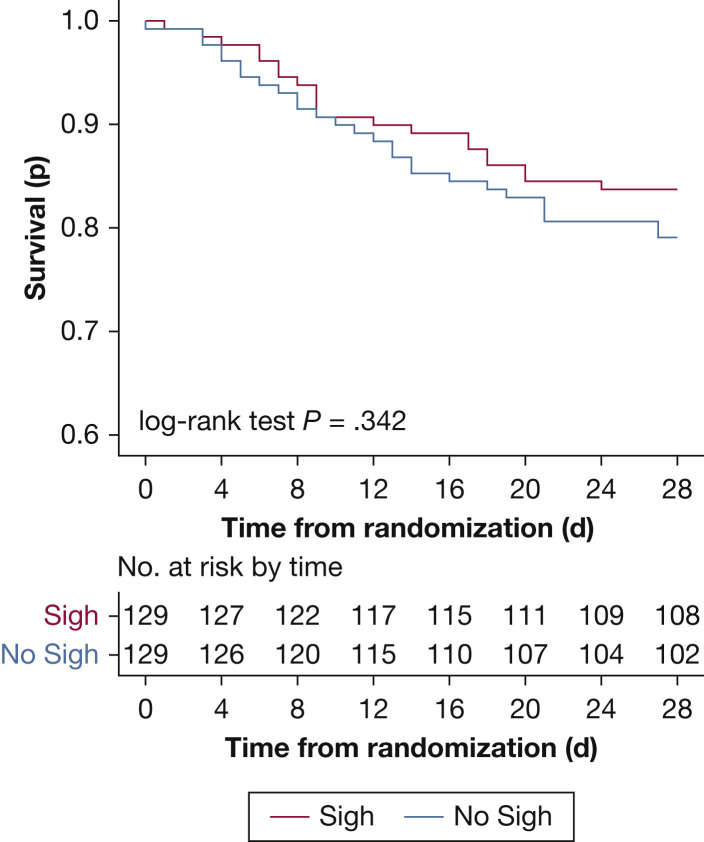
Results: Two-hundred and fifty-eight patients (31% women; median age, 65 [54-75] years) were enrolled. In the sigh group, 23% of patients failed to remain on assisted ventilation vs 30% in the no-sigh group (absolute difference, -7%; 95% CI, -18% to 4%; P = .015 for noninferiority). Adverse events occurred in 12% vs 13% in the sigh vs no-sigh group (P = .852). Oxygenation was improved whereas tidal volume, respiratory rate, and corrected minute ventilation were lower over the first 7 days from randomization in the sigh vs no-sigh group. There was no significant difference in terms of mortality (16% vs 21%; P = .337) and ventilator-free days (22 [7-26] vs 22 [3-25] days; P = .300) for the sigh vs no-sigh group.
Interpretation: Among hypoxemic intubated ICU patients, application of sigh was feasible and without increased risk.
Trial registry: ClinicalTrials.gov; No.: NCT03201263; URL: www.clinicaltrials.gov.
Keywords: ARDS; feasibility; pressure support; sigh; ventilation.
Copyright © 2020 The Authors. Published by Elsevier Inc. All rights reserved.
Figures
References
-
- Acute Respiratory Distress Syndrome Network. Brower R.G., Matthay M.A., Morris A., et al. Ventilation with lower tidal volumes as compared with traditional tidal volumes for acute lung injury and the acute respiratory distress syndrome. N Engl J Med. 2000;342(18):1301–1308. - PubMed
-
- Bellani G., Laffey J.G., Pham T., et al. Epidemiology, patterns of care, and mortality for patients with acute respiratory distress syndrome in intensive care units in 50 countries. JAMA. 2016;315(8):788–800. - PubMed
-
- Patroniti N., Foti G., Cortinovis B., et al. Sigh improves gas exchange and lung volume in patients with acute respiratory distress syndrome undergoing pressure support ventilation. Anesthesiology. 2002;96(4):788–794. - PubMed
-
- Mauri T., Eronia N., Abbruzzese C., et al. Effects of sigh on regional lung strain and ventilation heterogeneity in acute respiratory failure patients undergoing assisted mechanical ventilation. Crit Care Med. 2015;43(9):1823–1831. - PubMed
Publication types
MeSH terms
Associated data
LinkOut - more resources
Full Text Sources
Medical
