


Diaphragmatic thickening fraction as a potential predictor of response to continuous positive airway pressure ventilation in Covid-19 pneumonia: A single-center pilot study
- PMID: 33197604
- PMCID: PMC7664482
- DOI: 10.1016/j.resp.2020.103585
Diaphragmatic thickening fraction as a potential predictor of response to continuous positive airway pressure ventilation in Covid-19 pneumonia: A single-center pilot study
Abstract
Background: In a variable number of Covid-19 patients with acute respiratory failure, non-invasive breathing support strategies cannot provide adequate oxygenation, thus making invasive mechanical ventilation necessary. Factors predicting this unfavorable outcome are unknown, but we hypothesized that diaphragmatic weakness may contribute.
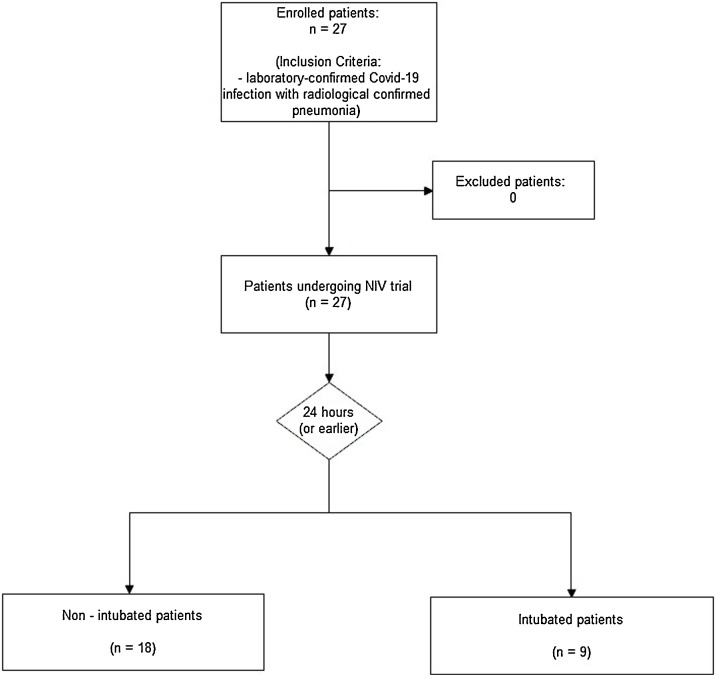
Methods: We prospectively analyzed the data of 27 consecutive patients admitted to the general Intensive Care Unit (ICU) from March 19, 2020, to April 20, 2020 and submitted to continuous positive airway pressure (CPAP) before considering invasive ventilation. Diaphragmatic thickening fraction (DTF) inferred by ultrasound was determined before applying CPAP.
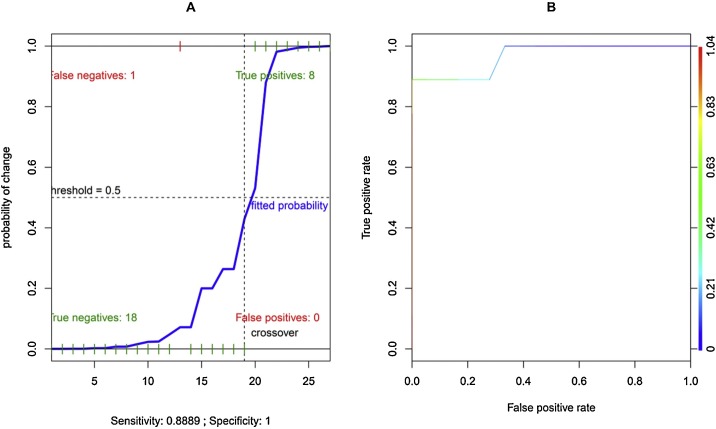
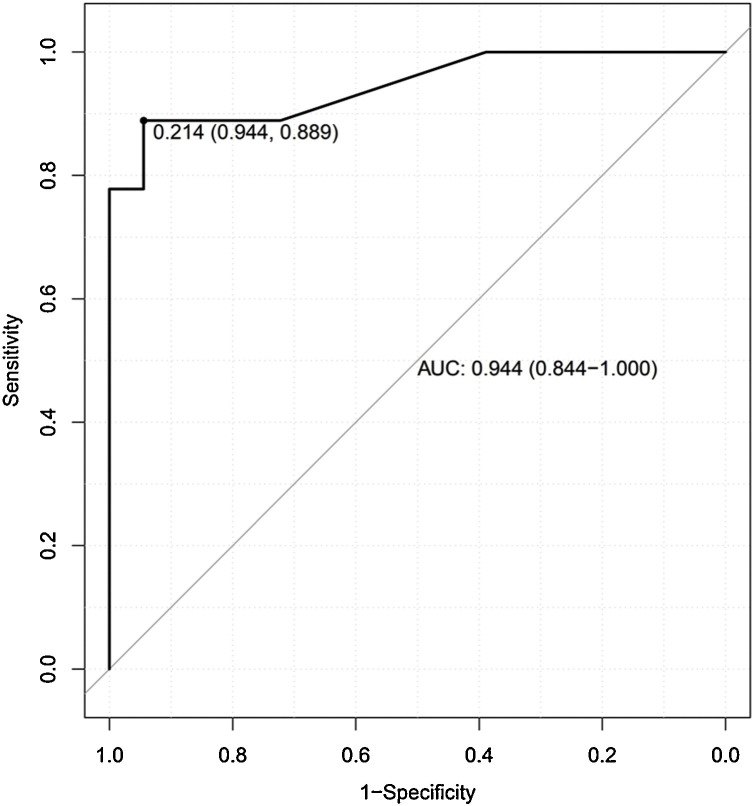
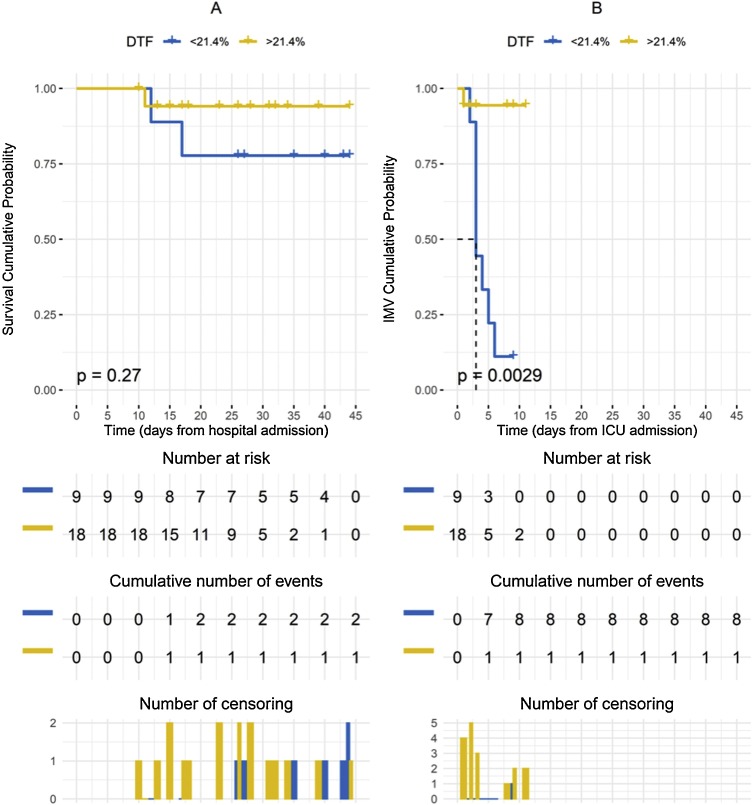
Results: Eighteen patients recovered with CPAP, whereas nine required invasive mechanical ventilation with longer stay in ICU (p < 0.001) and hospital (p = 0.003). At univariate logistic regression analysis, CPAP failure was significantly associated with low DTF [β: -0.396; OR: 0.673; p < 0.001] and high respiratory rate [β: 0.452; OR: 1.572; p < 0.001] but only DTF reached statistical significance at multivariate analysis [β: -0.384; OR: 0.681; p < 0.001]. The DTF best threshold predicting CPAP failure was 21.4 % (AUC: 0.944; sensitivity: 94.4 %, specificity: 88.9 %).
Conclusions: In critically ill patients with Covid-19 respiratory failure admitted to ICU, a reduced DTF could be a potential predictor of CPAP failure and requirement of invasive ventilation.
Keywords: Covid-19; Diaphragmatic thickening fraction; ICU; Non-invasive ventilation; Prediction; Respiratory failure.
Copyright © 2020 Elsevier B.V. All rights reserved.
Conflict of interest statement
The authors report no declarations of interest.
Figures
References
-
- Akaike H. A new look at the statistical model identification. IEEE T Automat Contr. 1974;19:716–723.
-
- Aliberti S., Radovanovic D., Billi F., Sotgiu G., Costanzo M., Pilocane T., Saderi L., Gramegna A., Rovellini A., Perotto L., Monzani V., Santus P., Blasi F. Helmet CPAP treatment in patients with COVID-19 pneumonia: a multicenter, cohort study. Eur. Respir. J. 2020 doi: 10.1183/13993003.01935-2020. - DOI - PMC - PubMed
-
- Bhatraju P.K., Ghassemieh B.J., Nichols M., Kim R., Jerome K.R., Nalla A.K., Greninger A.L., Pipavath S., Wurfel M.M., Evans L., Kritek P.A., West T.E., Luks A., Gerbino A., Dale C.R., Goldman J.D., O’Mahony S., Mikacenic C. Covid-19 in critically ill patients in the Seattle region - case series. N. Engl. J. Med. 2020;382:2012–2022. doi: 10.1056/NEJMoa2004500. - DOI - PMC - PubMed
-
- Brusasco C., Corradi F., Di Domenico A., Raggi F., Timossi G., Santori G., Brusasco V., Galliera CPAP-Covid-19 study group Continuous positive airway pressure in Covid-19 patients with moderate-to-severe respiratory failure. Eur. Respir. J. 2020 doi: 10.1183/13993003.02524-2020. - DOI - PMC - PubMed
Publication types
MeSH terms
LinkOut - more resources
Full Text Sources
Other Literature Sources
Medical
Miscellaneous
