Review
. 2020 Nov 12;21(22):8524.
doi: 10.3390/ijms21228524.

Tfh Cells in Health and Immunity: Potential Targets for Systems Biology Approaches to Vaccination

Affiliations
Review

Tfh Cells in Health and Immunity: Potential Targets for Systems Biology Approaches to Vaccination

Hannah Law et al. Int J Mol Sci. .

Abstract

T follicular helper (Tfh) cells are a specialised subset of CD4+ T cells that play a significant role in the adaptive immune response, providing critical help to B cells within the germinal centres (GC) of secondary lymphoid organs. The B cell receptors of GC B cells undergo multiple rounds of somatic hypermutation and affinity maturation within the GC response, a process dependent on cognate interactions with Tfh cells. B cells that receive sufficient help from Tfh cells form antibody-producing long-lived plasma and memory B cells that provide the basis of decades of effective and efficient protection and are considered the gold standard in correlates of protection post-vaccination. However, the T cell response to vaccination has been understudied, and over the last 10 years, exponential improvements in the technological underpinnings of sampling techniques, experimental and analytical tools have allowed multidisciplinary characterisation of the role of T cells and the immune system as a whole. Of particular interest to the field of vaccinology are GCs and Tfh cells, representing a unique target for improving immunisation strategies. Here, we discuss recent insights into the unique journey of Tfh cells from thymus to lymph node during differentiation and their role in the production of high-quality antibody responses as well as their journey back to the periphery as a population of memory cells. Further, we explore their function in health and disease and the power of next-generation sequencing techniques to uncover their potential as modulators of vaccine-induced immunity.

Keywords: T cell receptor (TCR); T follicular helper cells (Tfh); germinal centre (GC); lymph node (LN); scRNA-seq; systems biology.


Conflict of interest statement

The authors have no conflicts of interest to disclose.

Figures
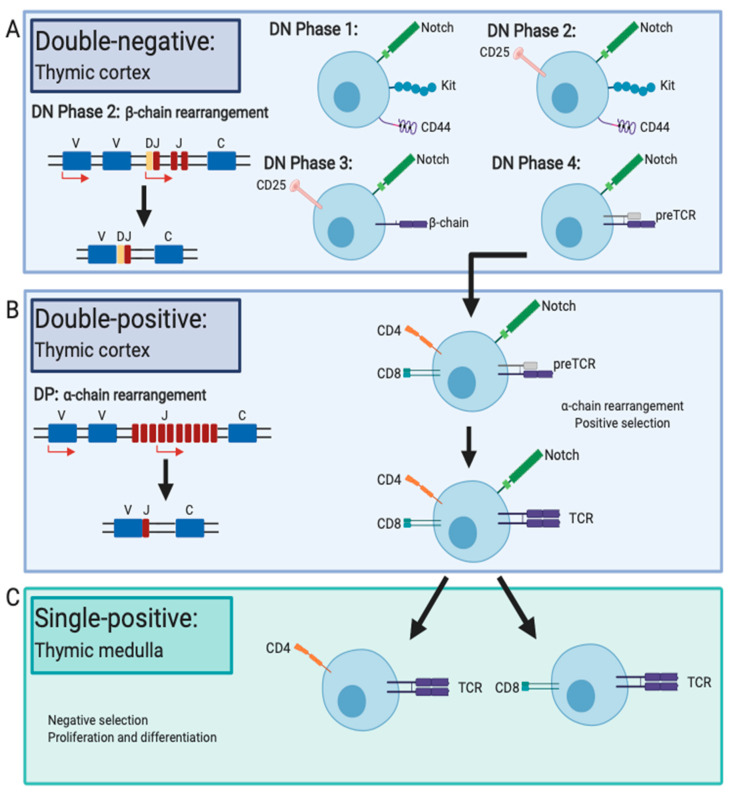
Figure 1
Figure 1
T cell differentiation in the thymus. (A) Immature thymocytes in the thymic cortex upregulate Notch, Kit and CD44 to begin differentiation in double-negative (DN) phase 1. As CD25 expression is upregulated, thymocytes progress into DN phase 2, where T cell receptor (TCR) β-chain rearrangement begins. Rearrangement of the β-chain locus of the TCR, from the Diversity β (Dβ) to the Joining β (Jβ) region, begins, and as expression of CD44 and Kit are reduced, Vβ to DβJβ rearrangements occur and cells progress into the DN3 phase. Only cells that successfully produce a reproductive β-chain survive and progress into DN phase 4, where the β-chain is paired with a surrogate pre-α chain to form the pre-TCR. (B) During the DN4 phase, expression of CD4 and CD8 are triggered, progressing cells into the double-positive (DP) phase of differentiation. It is here that α-chain rearrangement begins, and recombination of Vα to Jα gene segments continues until cell death or positive selection occurs. During the DP phase, cells produce a functional TCR and undergo positive selection so that ultimately only functionally competent and self-tolerant cells remain. (C) Thymocytes then migrate into the thymic medulla, where downregulation of Notch and either CD4 or CD8 occurs. This is the final phase of differentiation, termed the single-positive phase, where naïve T cells expressing either CD4 or CD8 and a functional TCR can exit the thymus and traffic to the periphery (created with BioRender.com).
Figure 2
Figure 2
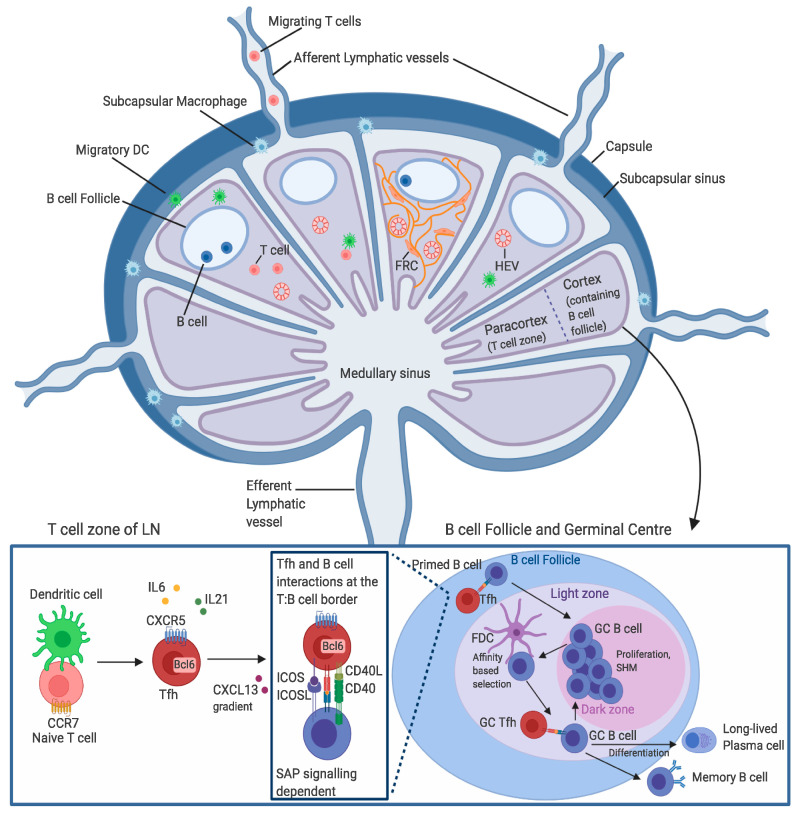
Tfh circulation in the lymph node (LN). Naïve T cells enter the LN either through afferent lymphatic vessels, or from the blood via the high endothelial venules (HEV). A complex adhesion cascade driven by interactions of CCR7 and CCL21 facilitate naïve T cell migration through the medulla and to the paracortex (T cell zone). Here, dendritic cells (DCs) prime naïve T cells, resulting in CCR7 downregulation and CXCR5 upregulation. CXCR5 expression promotes Tfh cell differentiation and migration to the border of the B cell follicle via a CXCL13 gradient. It is here, at the T–B cell border, that cognate interactions involving critical signalling through ICOS/ICOSL, CD40L/CD40, TCR/MHC-II and SAP/SLAM support further Tfh cell polarisation and differentiation, B cell help and germinal centre (GC) formation. The GC reaction begins with Tfh and B cell interactions, where B cells will either differentiate into short-lived antigen-secreting cells or enter the GC dark zone (DZ) to undergo multiple rounds of somatic hypermutation (SHM), selection and proliferation. B cells then exit the DZ and migrate into the light zone (LZ) of the GC, where they compete for antigen presented by follicular dendritic cells (FDC). Tfh cells then selectively provide help to B cells possessing high-affinity B cell receptors (BCRs). After these Tfh–B cell interactions, B cells either differentiate into memory B cells, differentiate into long-lived plasma cells or re-enter the DZ for further rounds of SHM and selection (created with BioRender.com).

References

    1. Centers for Disease Control and Prevention Control of infectious diseases. MMWR Morb. Mortal Wkly. Rep. 1999;48:621–629. - PubMed
    1. Sarkander J., Hojyo S., Tokoyoda K. Vaccination to gain humoral immune memory. Clin. Transl. Immunology. 2016;5:e120. doi: 10.1038/cti.2016.81. - DOI - PMC - PubMed
    1. Chen H., Ndhlovu Z.M., Liu D., Porter L.C., Fang J.W., Darko S., Brockman M.A., Miura T., Brumme Z.L., Schneidewind A., et al. TCR clonotypes modulate the protective effect of HLA class I molecules in HIV-1 infection. Nat. Immunol. 2012;13:691–700. doi: 10.1038/ni.2342. - DOI - PMC - PubMed
    1. Davenport M.P., Price D.A., McMichael A.J. The T cell repertoire in infection and vaccination: Implications for control of persistent viruses. Curr. Opin. Immunol. 2007;19:294–300. doi: 10.1016/j.coi.2007.04.001. - DOI - PubMed
    1. Piepenbrink K.H., Blevins S.J., Scott D.R., Baker B.M. The basis for limited specificity and MHC restriction in a T cell receptor interface. Nat. Commun. 2013;4:1948. doi: 10.1038/ncomms2948. - DOI - PMC - PubMed