Review
. 2020 Nov 12;12(11):3353.
doi: 10.3390/cancers12113353.

BH3 Mimetics for the Treatment of B-Cell Malignancies-Insights and Lessons from the Clinic

Affiliations
Review

BH3 Mimetics for the Treatment of B-Cell Malignancies-Insights and Lessons from the Clinic

Victor S Lin et al. Cancers (Basel). .

Abstract

The discovery of the link between defective apoptotic regulation and cancer cell survival engendered the idea of targeting aberrant components of the apoptotic machinery for cancer therapy. The intrinsic pathway of apoptosis is tightly controlled by interactions amongst members of three distinct subgroups of the B-cell lymphoma 2 (BCL2) family of proteins. The pro-survival BCL2 proteins prevent apoptosis by keeping the pro-apoptotic effector proteins BCL2-associated X protein (BAX) and BCL2 homologous antagonist/killer (BAK) in check, while the BH3-only proteins initiate apoptosis by either neutralizing the pro-survival BCL2 proteins or directly activating the pro-apoptotic effector proteins. This tripartite regulatory mechanism is commonly perturbed in B-cell malignancies facilitating cell death evasion. Over the past two decades, structure-based drug discovery has resulted in the development of a series of small molecules that mimic the function of BH3-only proteins called the BH3 mimetics. The most clinically advanced of these is venetoclax, which is a highly selective inhibitor of BCL2 that has transformed the treatment landscape for chronic lymphocytic leukemia (CLL). Other BH3 mimetics, which selectively target myeloid cell leukemia 1 (MCL1) and B-cell lymphoma extra large (BCLxL), are currently under investigation for use in diverse malignancies. Here, we review the current role of BH3 mimetics in the treatment of CLL and other B-cell malignancies and address open questions in this rapidly evolving field.

Keywords: B-cell malignancies; BCL2; BCLxL; BH3 mimetics; MCL1; apoptosis; leukemia; lymphoma; myeloma; venetoclax.


Conflict of interest statement

D.C.S.H. and R.T. are employees of the Walter and Eliza Hall Institute of Medical Research, which receives milestone and royalty payments related to venetoclax. D.C.S.H. has received research funding from Genentech and Servier.

Figures
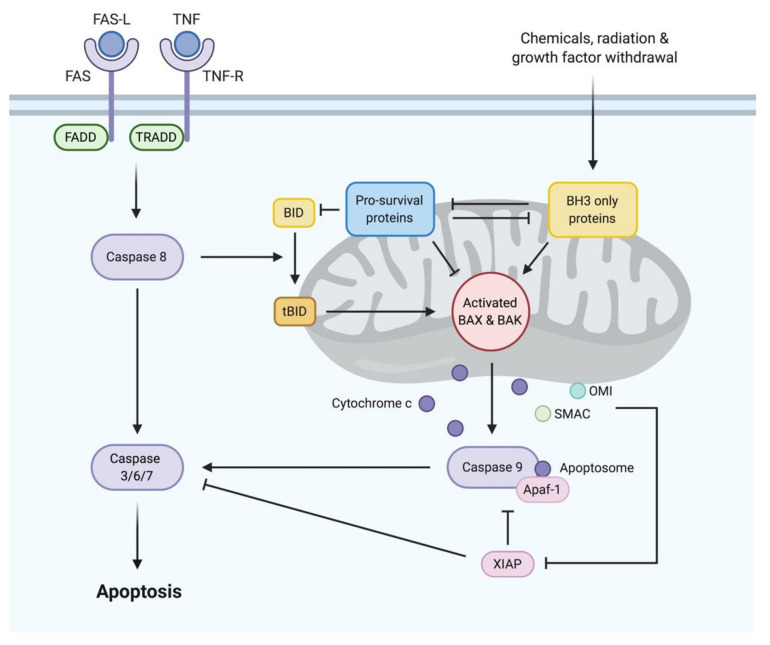
Figure 1
Figure 1
The extrinsic and intrinsic pathways to apoptosis. The extrinsic pathway is initiated when death receptor ligands (e.g., first apoptosis signal ligand [FAS-L], tumor necrosis factor (TNF)) bind to their cognate death receptors (e.g., first apoptosis signal [FAS], TNF receptor [TNFR]) on the plasma membrane, resulting in activation of caspase 8 via FAS-associated death domain protein (FADD) with or without TNFR-associated death domain protein (TRADD). The intrinsic pathway is triggered when diverse stress signals (e.g., DNA damage, growth factor deprivation) activate pro-apoptotic BH3-only proteins, which carry out their pro-apoptotic function by neutralizing pro-survival B-cell lymphoma 2 (BCL2) family proteins or, when these pro-survival proteins are saturated or absent, by directly activating BCL-associated X protein (BAX) and BCL2 homologous antagonist/killer (BAK), causing mitochondrial outer membrane permeabilization (MOMP). MOMP results in the release of a range of apoptogenic factors, including cytochrome c, from the intermembrane space of the mitochondria into the cytoplasm. In the cytoplasm, cytochrome c binds to apoptotic protease activating factor 1 (APAF1) to form the apoptosome, which mediates the activation of caspase 9. The extrinsic and intrinsic pathways converge with initiator caspases (e.g., caspase 8, caspase 9) activating executioner caspases (e.g., caspase 3, caspase 7, caspase 6), which mediate cellular destruction.
Figure 2
Figure 2
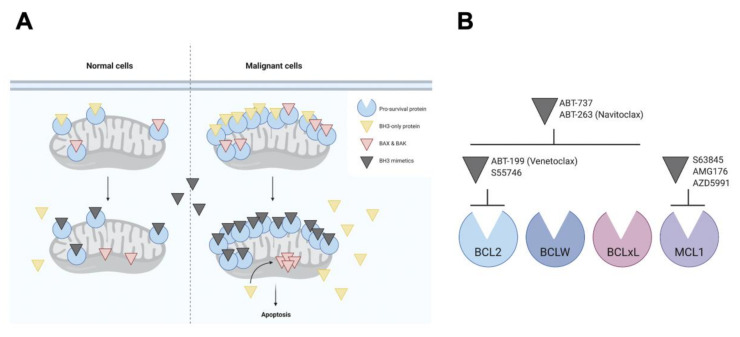
Mechanism of action of BH3 mimetics. (A) Pro-survival proteins (e.g., BCL2, B-cell lymphoma extra large [BCLxL], myeloid cell leukemia 1 [MCL1]), shown in blue, are commonly overexpressed in cancer cells, where they sequester high levels of pro-apoptotic proteins, including BH3-only proteins (e.g., BIM), shown in yellow, and pore-forming effector proteins (e.g., BAX, BAK), shown in red, through their BH3 motif to maintain cell survival. These cells are paradoxically “primed” for death, as inhibition of upregulated pro-survival proteins by BH3 mimetics would liberate large quantities of originally sequestered pro-apoptotic proteins, driving the cell toward apoptosis. (B) Different BH3 mimetics target different pro-survival proteins.
Figure 3
Figure 3
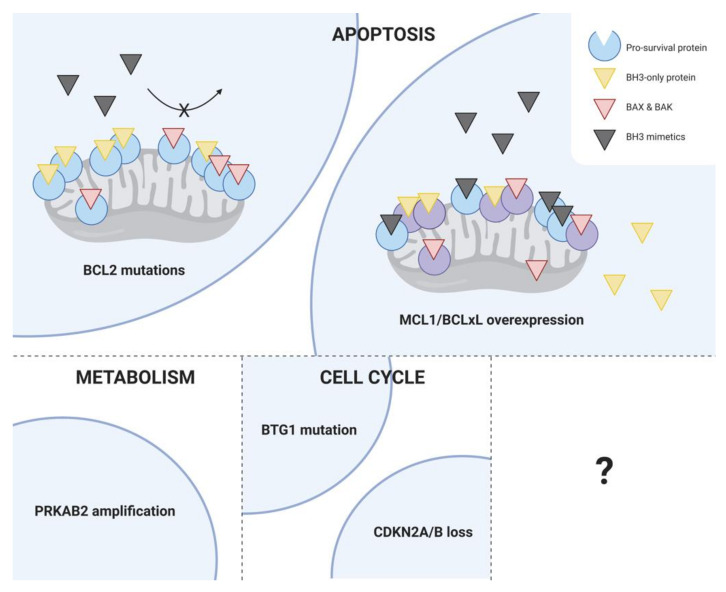
Mechanisms of acquired resistance to venetoclax in CLL. Although the factors contributing to disease progression on venetoclax are still the subject of ongoing research, available studies have identified a diverse range of mechanisms, which broadly target three cellular processes: apoptosis, metabolism, and the cell cycle. The most common recurrent mechanism of venetoclax resistance identified in CLL to date is the acquisition of the BCL2 G101V mutation, although other BCL2 mutations have also been detected (e.g., D103Y, D103E, D103V, V156D, R107_R110dup, A113G, R129L). Other mechanisms include the upregulation of alternative pro-survival proteins, particularly MCL1 and BCLxL, amplification of a positive regulatory subunit of AMPK called PRKAB2, leading to increased oxidative phosphorylation, homozygous deletions of CDKN2A/B, and BTG1 mutations.

References

    1. Kroemer G., Galluzzi L., Vandenabeele P., Abrams J., Alnemri E.S., Baehrecke E.H., Blagosklonny M.V., El-Deiry W.S., Golstein P., Green D.R., et al. Classification of cell death: Recommendations of the Nomenclature Committee on Cell Death 2009. Cell Death Diff. 2008;16:3–11. doi: 10.1038/cdd.2008.150. - DOI - PMC - PubMed
    1. Kerr J.F., Wyllie A.H., Currie A.R. Apoptosis: A basic biological phenomenon with wide-ranging implications in tissue kinetics. Br. J. Cancer. 1972;26:239–257. doi: 10.1038/bjc.1972.33. - DOI - PMC - PubMed
    1. Honarpour N., Gilbert S.L., Lahn B.T., Wang X., Herz J. Apaf-1 deficiency and neural tube closure defects are found in fog mice. Proc. Natl. Acad. Sci. USA. 2001;98:9683–9687. doi: 10.1073/pnas.171283198. - DOI - PMC - PubMed
    1. Ke F.F.S., Vanyai H.K., Cowan A.D., Delbridge A.R.D., Whitehead L., Grabow S., Czabotar P.E., Voss A.K., Strasser A. Embryogenesis and Adult Life in the Absence of Intrinsic Apoptosis Effectors BAX, BAK, and BOK. Cell. 2018;173:1217–1230.e17. doi: 10.1016/j.cell.2018.04.036. - DOI - PubMed
    1. Knudson C.M., Tung K.S., Tourtellotte W.G., Brown G.A., Korsmeyer S.J. Bax-deficient mice with lymphoid hyperplasia and male germ cell death. Science. 1995;270:96–99. doi: 10.1126/science.270.5233.96. - DOI - PubMed