Review
. 2020 Nov 12;10(11):852.
doi: 10.3390/brainsci10110852.

Emerging Neurological and Psychobiological Aspects of COVID-19 Infection

Affiliations
Review

Emerging Neurological and Psychobiological Aspects of COVID-19 Infection

Lyubka Tancheva et al. Brain Sci. .

Abstract

The SARS-CoV-2 virus, first reported in December 2019 in China, is the causative agent of the current COVID-19 pandemic that, at the time of writing (1 November 2020) has infected almost 43 million people and caused the death of more than 1 million people. The spectrum of clinical manifestations observed during COVID-19 infection varies from asymptomatic to critical life-threatening clinical conditions. Emerging evidence shows that COVID-19 affects far more organs than just the respiratory system, including the heart, kidneys, blood vessels, liver, as well as the central nervous system (CNS) and the peripheral nervous system (PNS). It is also becoming clear that the neurological and psychological disturbances that occur during the acute phase of the infection may persist well beyond the recovery. The aim of this review is to propel further this emerging and relevant field of research related to the pathophysiology of neurological manifestation of COVID-19 infection (Neuro-COVID). We will summarize the PNS and CNS symptoms experienced by people with COVID-19 both during infection and in the recovery phase. Diagnostic and pharmacological findings in this field of study are strongly warranted to address the neurological and psychological symptoms of COVID-19.

Keywords: COVID-19; Neuro-COVID; Parkinson’s disease; SARS-CoV-2; central nervous system; cytokines; peripheral nervous system.


Conflict of interest statement

The authors declare no conflict of interest.

Figures

Figure 1
Figure 1
Major organs are affected by the damaging effects of COVID-19 infection.
Figure 2
Figure 2
Coronaviruses pathogenesis, comorbidities and multi-organ damage [31].
Figure 3
Figure 3
SARS-CoV-2 distribution in human body. A—Viremia: SARS-SoV-2 virus dissemination throughout the body via the bloodstream. B—Neurotropism via circulation and/or an upper nasal transcribrial route that enables the COVID-19 to modify the function of the blood–brain barrier or directly reach the brain. C—Virus binding and engaging with the ACE2 receptors. D—SARS-CoV-2 docks on the ACE2 via spike protein (blue); major organs–lungs, heart, kidneys, intestines, brain, and testicles, that express ACE2 receptors and are possible targets of COVID-19 (D, golden spikes) [45].
Figure 4
Figure 4
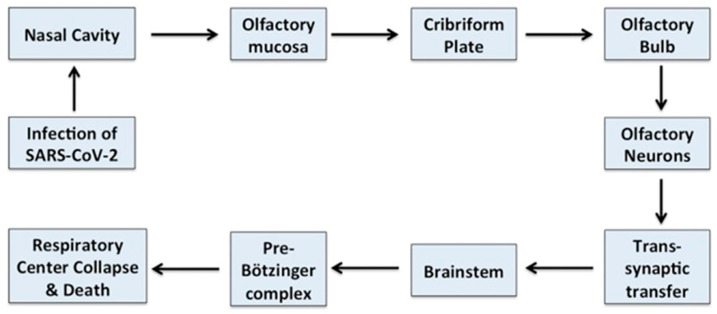
Schematic representation showing how SARSars-CoV-2 may infect the respiratory center of the brain. SARSars-CoV-2 may enter the brain through the olfactory mucosa present in the upper nasal cavity. From there, through olfactory axons, it may access the cribriform plate and project to the olfactory epithelium and olfactory bulb. SARSars-CoV-2 further migrates to deeper parts of the brain such as the thalamus and brainstem by trans-synaptic migration and targets the pre-Bötzinger complex, thus possibly causing the collapse of the respiratory center of the brain [62].
Figure 5
Figure 5
Mechanisms of coronaviral infection of the brain. SARS-CoV-2 can enter the nervous system directly through the olfactory nerve, and also through blood circulation and neuronal pathways, resulting in neurological disorders. Ab: antibody; ACE2: angiotensin-converting enzyme 2; CSF: cerebrospinal fluid; ER: endoplasmic reticulum; TNF: tumor necrosis factor. [72].
Figure 6
Figure 6
Major neurological abnormalities reported in COVID-19 [87]; AMS—Altered mental status; CVA—Cerebrovascular accidents; GBS—Guillain-Barre syndrome.

References

    1. Cascella M., Rajnik M., Cuomo A., Dulebohn S.C., Di Napoli R. Features, Evaluation and Treatment Coronavirus (COVID-19) StatPearls Publishing LLC; Tampa, FL, USA: 2020. - PubMed
    1. Baksh M., Ravat V., Zaidi A., Patel R.S. A Systematic Review of Cases of Acute Respiratory Distress Syndrome in the Coronavirus Disease 2019 Pandemic. Cureus. 2020;12 doi: 10.7759/cureus.8188. - DOI - PMC - PubMed
    1. Fan E., Beitler J.R., Brochard L., Calfee C.S., Ferguson N.D., Slutsky A.S., Brodie D. COVID-19-associated acute respiratory distress syndrome: Is a different approach to management warranted? Lancet Respir. Med. 2020;8:816–821. doi: 10.1016/S2213-2600(20)30304-0. - DOI - PMC - PubMed
    1. Collange O., Tacquard C., Delabranche X., Leonard-Lorant I., Ohana M., Onea M., Anheim M., Solis M., Sauer A., Baloglu S., et al. Coronavirus Disease 2019: Associated Multiple Organ Damage. Open Forum Infect. Dis. 2020;7:7. doi: 10.1093/ofid/ofaa249. - DOI - PMC - PubMed
    1. Wang T., Du Z., Zhu F., Cao Z., An Y., Gao Y., Jiang B. Comorbidities and multi-organ injuries in the treatment of COVID-19. Lancet. 2020;395:e52. doi: 10.1016/S0140-6736(20)30558-4. - DOI - PMC - PubMed

LinkOut - more resources