


A framework for indirect elicitation of the public health impact of gambling problems
- PMID: 33198709
- PMCID: PMC7670710
- DOI: 10.1186/s12889-020-09813-z
A framework for indirect elicitation of the public health impact of gambling problems
Abstract
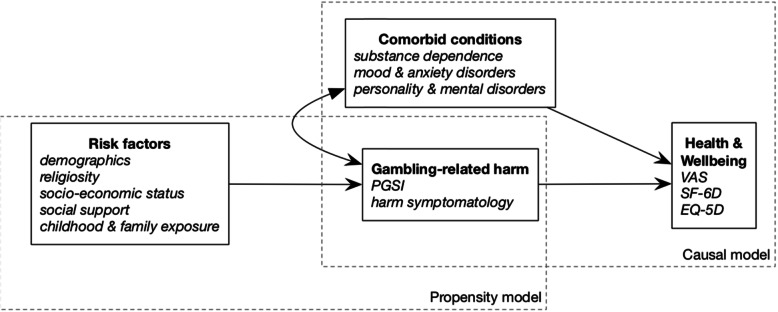
Gambling problems are increasingly understood as a health-related condition, with harms from excessive time and money expenditure contributing to significant population morbidity. In many countries, the prevalence of gambling problems is known with some precision. However, the true severity of gambling problems in terms of their impact on health and wellbeing is the subject of ongoing debate. We firstly review recent research that has attempted to estimate harm from gambling, including studies that estimate disability weights using direct elicitation. Limitations of prior approaches are discussed, most notably potential inflation due to non-independent comorbidity with other substance use and mental health conditions, and potential biases in the subjective attribution of morbidity to gambling. An alternative indirect elicitation approach is outlined, and a conceptual framework for its application to gambling is provided. Significant risk factors for propensity to develop gambling problems are enumerated, and relative risks for comorbidities are calculated from recent meta-analyses and reviews. Indirect elicitation provides a promising alternative framework for assessing the causal link between gambling problems and morbidity. This approach requires implementation of propensity score matching to estimate the counterfactual, and demands high quality information of risk factors and comorbid conditions, in order to estimate the unique contribution of gambling problems. Gambling harm is best understood as a decrement to health utility. However, achieving consensus on the severity of gambling problems requires triangulation of results from multiple methodologies. Indirect elicitation with propensity score matching and accounting for comorbidities would provide an important step towards full integration of gambling within a public health paradigm.
Keywords: Disability weights; Elicitation; Gambling; Gambling harm; Gambling problems; Global burden of disease; Health utility.
Conflict of interest statement
The authors declare that they have no competing interests.
Figures
References
-
- Costes J-M. A logical framework for the evaluation of a harm reduction policy for gambling. In: Bowden-Jones H, Dickson C, Dunand C, Simon O, editors. Harm reduction for gambling. London: Routledge; 2019. pp. 143–152.
-
- Browne M, Greer N, Rawat V, Rockloff M. A population-level metric for gambling-related harm. Int Gambl Stud. 2017;17(2):163–175. doi: 10.1080/14459795.2017.1304973. - DOI
Publication types
MeSH terms
LinkOut - more resources
Full Text Sources
Medical
