


Night shift work is associated with an increased risk of asthma
- PMID: 33199525
- PMCID: PMC7803886
- DOI: 10.1136/thoraxjnl-2020-215218
Night shift work is associated with an increased risk of asthma
Erratum in
-
Correction: Night shift work is associated with an increased risk of asthma.Thorax. 2023 Dec;78(12):e4. doi: 10.1136/thoraxjnl-2020-215218corr1. Thorax. 2023. PMID: 37984991 Free PMC article. No abstract available.
Abstract
Introduction: Shift work causes misalignment between internal circadian time and the external light/dark cycle and is associated with metabolic disorders and cancer. Approximately 20% of the working population in industrialised countries work permanent or rotating night shifts, exposing this large population to the risk of circadian misalignment-driven disease. Analysis of the impact of shift work on chronic inflammatory diseases is lacking. We investigated the association between shift work and asthma.
Methods: We describe the cross-sectional relationship between shift work and prevalent asthma in >280000 UK Biobank participants, making adjustments for major confounding factors (smoking history, ethnicity, socioeconomic status, physical activity, body mass index). We also investigated chronotype.
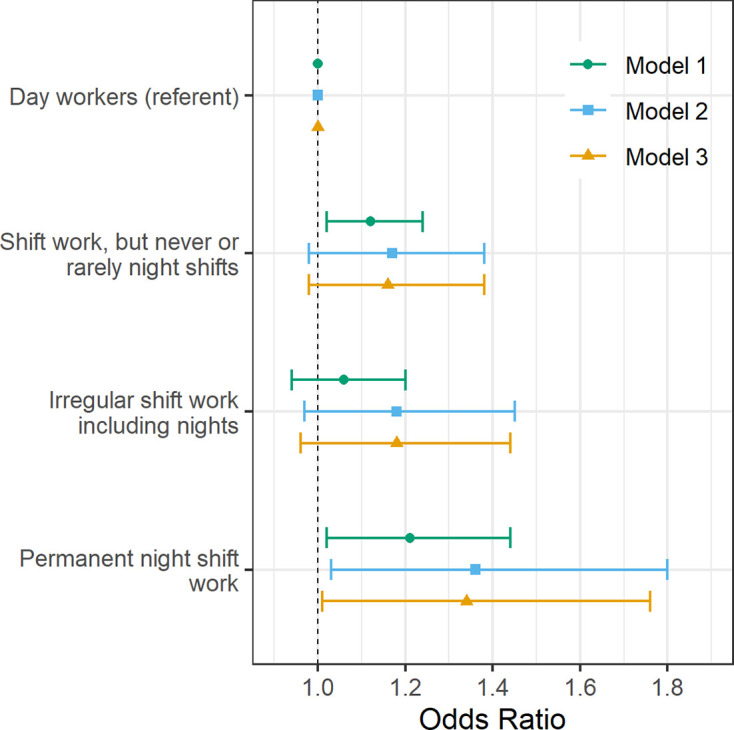
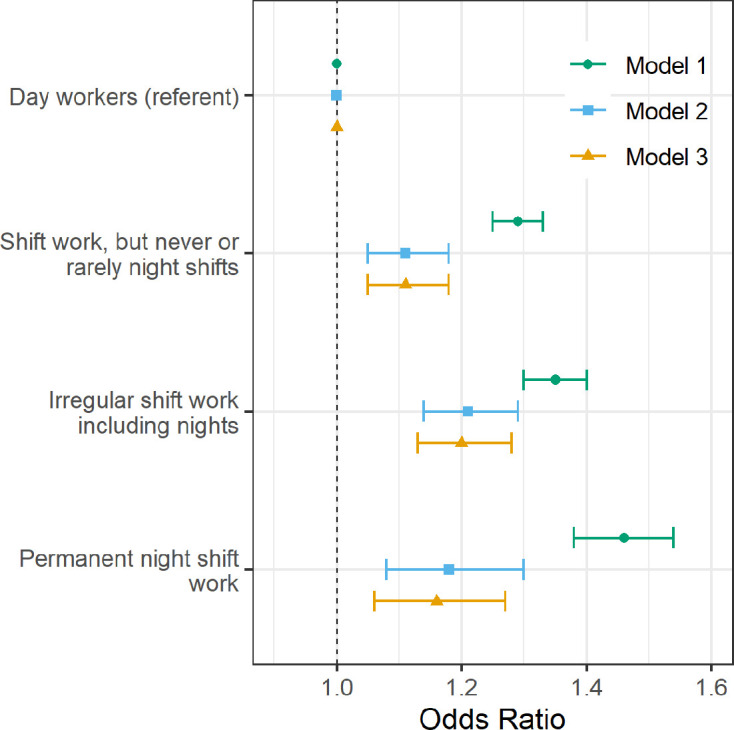
Results: Compared with day workers, 'permanent' night shift workers had a higher likelihood of moderate-severe asthma (OR 1.36 (95% CI 1.03 to 1.8)) and all asthma (OR 1.23 (95% CI 1.03 to 1.46)). Individuals doing any type of shift work had higher adjusted odds of wheeze/whistling in the chest. Shift workers who never or rarely worked on nights and people working permanent nights had a higher adjusted likelihood of having reduced lung function (FEV1 <80% predicted). We found an increase in the risk of moderate-severe asthma in morning chronotypes working irregular shifts, including nights (OR 1.55 (95% CI 1.06 to 2.27)).
Conclusions: The public health implications of these findings are far-reaching due to the high prevalence and co-occurrence of both asthma and shift work. Future longitudinal follow-up studies are needed to determine if modifying shift work schedules to take into account chronotype might present a public health measure to reduce the risk of developing inflammatory diseases such as asthma.
Keywords: asthma; asthma epidemiology.
© Author(s) (or their employer(s)) 2021. Re-use permitted under CC BY. Published by BMJ.
Conflict of interest statement
Competing interests: FS has received lecture fees from Bayer HealthCare (2016), Sentara HealthCare (2017), Philips (2017), Vanda Pharmaceuticals (2017) and Pfizer Pharmaceuticals (2018). DL has received research support from Medtronic Ltd and Roche Diagnostics for research unrelated to that presented here. MR has received speaker fees and research support from Novo Nordisk and Roche Diabetes Care for research unrelated to that presented here.
Figures
References
Publication types
MeSH terms
Grants and funding
- MR/P023576/2/MRC_/Medical Research Council/United Kingdom
- R01 HL125893/HL/NHLBI NIH HHS/United States
- MR/T032529/1/MRC_/Medical Research Council/United Kingdom
- MC_QA137853/MRC_/Medical Research Council/United Kingdom
- R01 HL142064/HL/NHLBI NIH HHS/United States
- MR/V029460/1/MRC_/Medical Research Council/United Kingdom
- MR/P023576/1/MRC_/Medical Research Council/United Kingdom
- 107851/Z/15/Z/WT_/Wellcome Trust/United Kingdom
- MR/L006499/1/MRC_/Medical Research Council/United Kingdom
- MC_PC_17228/MRC_/Medical Research Council/United Kingdom
- R01 DK105072/DK/NIDDK NIH HHS/United States
- R01 HL140577/HL/NHLBI NIH HHS/United States
- R01 DK107859/DK/NIDDK NIH HHS/United States
- R01 DK102696/DK/NIDDK NIH HHS/United States
- MC_UU_00011/6/MRC_/Medical Research Council/United Kingdom
