


Association between maternal blood lipids levels during pregnancy and risk of small-for-gestational-age infants
- PMID: 33199750
- PMCID: PMC7669834
- DOI: 10.1038/s41598-020-76845-1
Association between maternal blood lipids levels during pregnancy and risk of small-for-gestational-age infants
Abstract
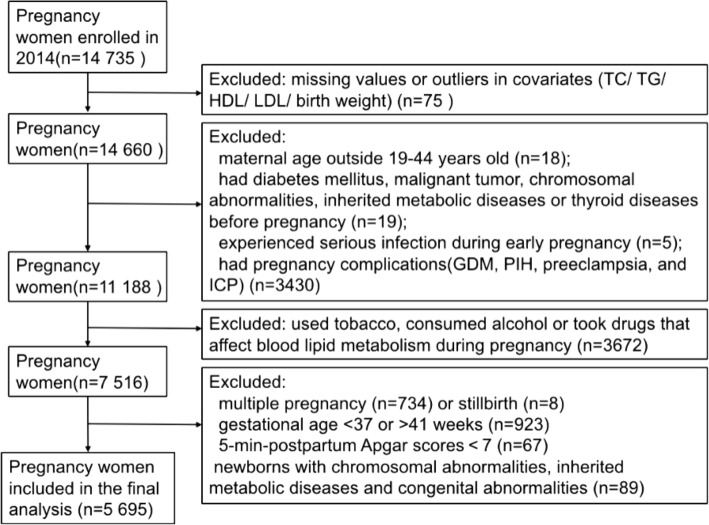
Dyslipidemia in pregnancy are associated with risk of adverse outcomes. As an adverse pregnancy outcome, small-for-gestational-age has been extensively studied in Western countries. However, similar studies have rarely been conducted in Asian countries. Data were derived from 5695 pairs of non-diabetic mothers and neonates between 1 Jan 2014 and 31 Dec 2014. 5.6% neonates in our study were SGA. Serum samples were collected during second and third trimesters for evaluation on fasting lipids levels. The present study intended to explore the associations between maternal lipid profile and small-for-gestational-age neonates. Odds ratios (ORs) and 95% confidence intervals (CIs) were calculated and adjusted via logistic regression analysis. After adjustments for confounders, third-trimester total cholesterol levels were associated with a decreased risk for small-for-gestational-age (aOR = 0.622, 95% CI 0.458-0.848, P = 0.002), and third-trimester high-density lipoprotein cholesterol and low-density lipoprotein cholesterol levels were associated with an increased risk for small-for-gestational-age (aOR = 1.955, 95% CI 1.465-2.578, P < 0.001; aOR = 1.403, 95% CI 1.014-1.944, P = 0.041).In the highest gestational weight gain strata, especially the third-trimester, the effect of high-density lipoprotein cholesterol levels on the risk for small-for-gestational-age is larger. High high-density lipoprotein cholesterol level during third trimester could be considered as indicators of a high-risk of small-for-gestational-age, regardless of gestational weight gain.
Conflict of interest statement
The authors declare no competing interests.
Figures
References
-
- ACOG Practice bulletin no. 204: Fetal growth restriction 2019. Obstet. Gynecol.133 (2), e97–e109. 10.1097/AOG.0000000000003070. - PubMed
-
- The investigation and management of the small for gestational age fetus. Green-top Guideline No.31 [S/OL]. (2013–22)[2019–05–10]. https://www.rcog.org.uk/en/guidelines-research-services/guidelines/gtg31/.
Publication types
MeSH terms
Substances
LinkOut - more resources
Full Text Sources
Research Materials
