. 2020 Nov 16;10(1):19887.
doi: 10.1038/s41598-020-76966-7.

The power struggle: assessing interacting global change stressors via experimental studies on sharks

Affiliations

The power struggle: assessing interacting global change stressors via experimental studies on sharks

Ian A Bouyoucos et al. Sci Rep. .

Abstract

Ocean warming and acidification act concurrently on marine ectotherms with the potential for detrimental, synergistic effects; yet, effects of these stressors remain understudied in large predatory fishes, including sharks. We tested for behavioural and physiological responses of blacktip reef shark (Carcharhinus melanopterus) neonates to climate change relevant changes in temperature (28 and 31 °C) and carbon dioxide partial pressures (pCO2; 650 and 1050 µatm) using a fully factorial design. Behavioural assays (lateralisation, activity level) were conducted upon 7-13 days of acclimation, and physiological assays (hypoxia tolerance, oxygen uptake rates, acid-base and haematological status) were conducted upon 14-17 days of acclimation. Haematocrit was higher in sharks acclimated to 31 °C than to 28 °C. Significant treatment effects were also detected for blood lactate and minimum oxygen uptake rate; although, these observations were not supported by adequate statistical power. Inter-individual variability was considerable for all measured traits, except for haematocrit. Moving forward, studies on similarly 'hard-to-study' species may account for large inter-individual variability by increasing replication, testing larger, yet ecologically relevant, differences in temperature and pCO2, and reducing measurement error. Robust experimental studies on elasmobranchs are critical to meaningfully assess the threat of global change stressors in these data-deficient species.


Conflict of interest statement

The authors declare no competing interests.

Figures

Figure 1
Figure 1
Behaviour of blacktip reef shark (Carcharhinus melanopterus) neonates measured under various temperatures and partial pressures of carbon dioxide (pCO2). Relative (LR; a) and absolute (LA; b) lateralisation indices, and activity levels (overall dynamic body acceleration, ODBA; c) were quantified for sharks acclimated to ambient (28 °C and 650 µatm pCO2), high pCO2 (28 °C and 1050 µatm pCO2), high temperature (31 °C and 650 µatm pCO2), and high temperature and high pCO2 (31 °C and 1050 µatm pCO2) conditions for 7–13 days. Dots represent individual observations.
Figure 2
Figure 2
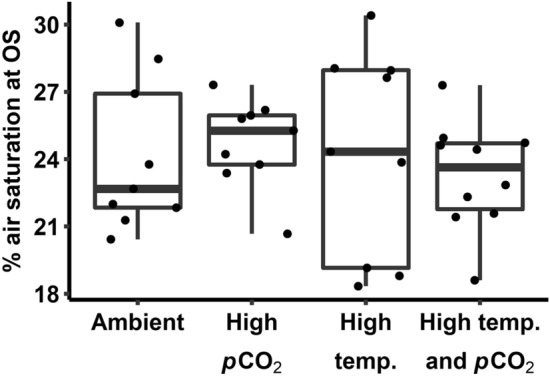
Hypoxia tolerance of blacktip reef shark (Carcharhinus melanopterus) neonates measured under various temperatures and partial pressures of carbon dioxide (pCO2). Hypoxia tolerance was quantified as the percent air saturation at which sharks exhibited the onset of muscle spasms (OS). Sharks were acclimated to ambient (28 °C and 650 µatm pCO2), high pCO2 (28 °C and 1050 µatm pCO2), high temperature (31 °C and 650 µatm pCO2), and high temperature and pCO2 (31 °C and 1050 µatm pCO2) conditions for 14 days. Dots represent individual observations.
Figure 3
Figure 3
Oxygen uptake rates (O2) of blacktip reef shark (Carcharhinus melanopterus) neonates measured under various temperatures and partial pressures of carbon dioxide (pCO2). Minimum (O2Min; a) and maximum (O2Max; b) oxygen uptake rates, absolute (AAS; c) and factorial aerobic scope (FAS; d), excess post-exercise oxygen consumption (EPOC; e), and time to recover O2 post-exercise (f) were quantified for sharks acclimated to ambient (28 °C and 650 µatm pCO2), high pCO2 (28 °C and 1050 µatm pCO2), high temperature (31 °C and 650 µatm pCO2), and high temperature and high pCO2 (31 °C and 1050 µatm pCO2) conditions for 16 days. Dots represent individual observations.
Figure 4
Figure 4
Acid-base and haematological status of blacktip reef shark (Carcharhinus melanopterus) neonates measured under various temperatures and partial pressures of carbon dioxide (pCO2). Blood pH (a) and lactate (b), haematocrit (Hct; c), haemoglobin concentration ([Hb]; d), and mean corpuscular haemoglobin concentration (MCHC; e) were quantified for sharks acclimated to ambient (28 °C and 650 µatm pCO2), high pCO2 (28 °C and 1050 µatm pCO2), high temperature (31 °C and 650 µatm pCO2), and high temperature and pCO2 (31 °C and 1050 µatm pCO2) conditions for 17 days. Dots represent individual observations.

References

    1. Lefevre S. Are global warming and ocean acidification conspiring against marine ectotherms? A meta-analysis of the respiratory effects of elevated temperature, high CO2 and their interaction. Conserv. Physiol. 2016;4:cow009. doi: 10.1093/conphys/cow009. - DOI - PMC - PubMed
    1. Field, C. B. et al. Technical Summary. Climate Change 2014: Impacts , Adaptation, and Vulnerability. Part A: Global and Sectoral Aspects. Contribution of the Working Group II to the Fifth assessment Report of the Intergovernmental Panel on Climate Change (2014).
    1. Pörtner H-O, Bock C, Mark FC. Oxygen- and capacity-limited thermal tolerance: Bridging ecology and physiology. J. Exp. Biol. 2017;220:2685–2696. doi: 10.1242/jeb.134585. - DOI - PubMed
    1. Clark TD, Sandblom E, Jutfelt F. Aerobic scope measurements of fishes in an era of climate change: Respirometry, relevance and recommendations. J. Exp. Biol. 2013;216:2771–2782. doi: 10.1242/jeb.084251. - DOI - PubMed
    1. Tresguerres M, Hamilton TJ. Acid–base physiology, neurobiology and behaviour in relation to CO2-induced ocean acidification. J. Exp. Biol. 2017;220:2136–2148. doi: 10.1242/jeb.144113. - DOI - PubMed

Publication types