. 2021 Feb;30(1):e13231.
doi: 10.1111/jsr.13231. Epub 2020 Nov 17.

Profiles of sleep changes during the COVID-19 pandemic: Demographic, behavioural and psychological factors

Affiliations

Profiles of sleep changes during the COVID-19 pandemic: Demographic, behavioural and psychological factors

Rebecca Robillard et al. J Sleep Res. 2021 Feb.

Abstract

This study aimed to evaluate changes in sleep during the COVID-19 outbreak, and used data-driven approaches to identify distinct profiles of changes in sleep-related behaviours. Demographic, behavioural and psychological factors associated with sleep changes were also investigated. An online population survey assessing sleep and mental health was distributed between 3 April and 24 June 2020. Retrospective questions were used to estimate temporal changes from before to during the outbreak. In 5,525 Canadian respondents (67.1% females, 16-95 years old: Mean ± SD = 55.6 ± 16.3 years), wake-up times were significantly delayed relative to pre-outbreak estimates (p < .001, ηp2 = 0.04). Occurrences of clinically meaningful sleep difficulties significantly increased from 36.0% before the outbreak to 50.5% during the outbreak (all p < .001, g ≥ 0.27). Three subgroups with distinct profiles of changes in sleep behaviours were identified: "Reduced Time in Bed", "Delayed Sleep" and "Extended Time in Bed". The "Reduced Time in Bed" and "Delayed Sleep" subgroups had more adverse sleep outcomes and psychological changes during the outbreak. The emergence of new sleep difficulties was independently associated with female sex, chronic illnesses, being employed, family responsibilities, earlier wake-up times, higher stress levels, as well as heavier alcohol use and television exposure. The heterogeneity of sleep changes in response to the pandemic highlights the need for tailored interventions to address sleep problems.

Keywords: COVID-19; chronotype; mental health; pandemic; sleep.


Conflict of interest statement

No conflict of interest declared.

Figures
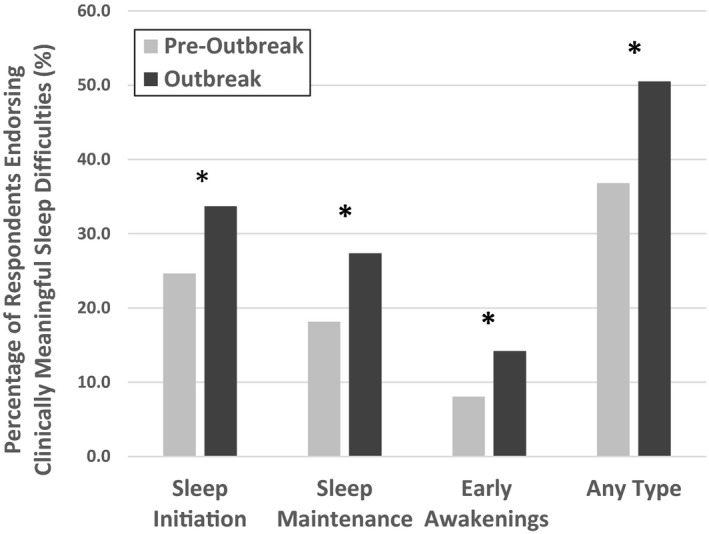
FIGURE 1
FIGURE 1
Changes in clinically meaningful sleep difficulties. Percentages of respondents endorsing clinically meaningful difficulties with sleep initiation, sleep maintenance, early awakening, or any type of sleep difficulties from pre‐outbreak to outbreak estimates. *p < .001, Cohen'sg ≥ 0.27 from McNemar's tests
FIGURE 2
FIGURE 2
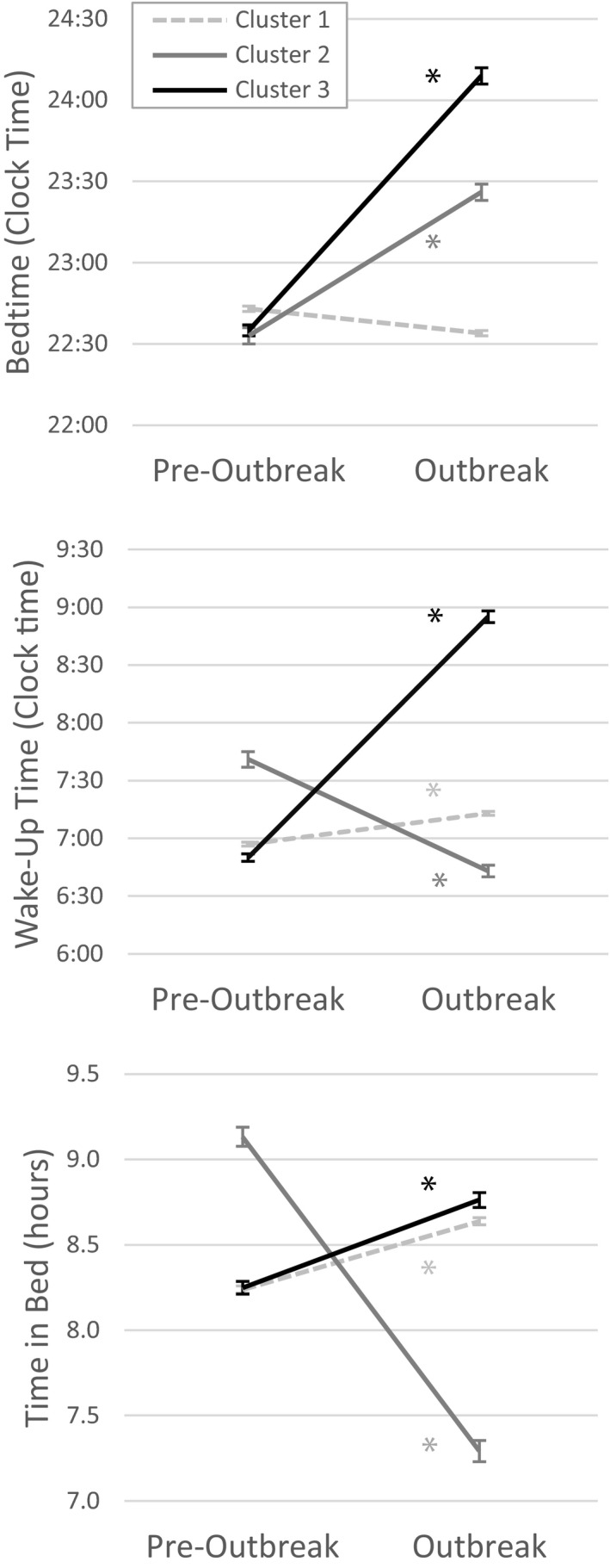
Cluster validation to identify subgroups with distinct profiles of changes in sleep behaviours. Validation of the cluster solution: pre‐outbreak to outbreak changes in the sleep behaviour variables included in the cluster analysis (bedtime [lower panel], wake‐up time [middle panel] and time in bed [lower panel]) across the three cluster groups. Error bars indicate the standard error of the mean. Cluster 1: “Extended TiB (Time in Bed)”; Cluster 2: “Reduced TiB”; Cluster 3: “Delayed Sleep” (*p ≤ .001,ηp2 ≥ 0.02)
FIGURE 3
FIGURE 3
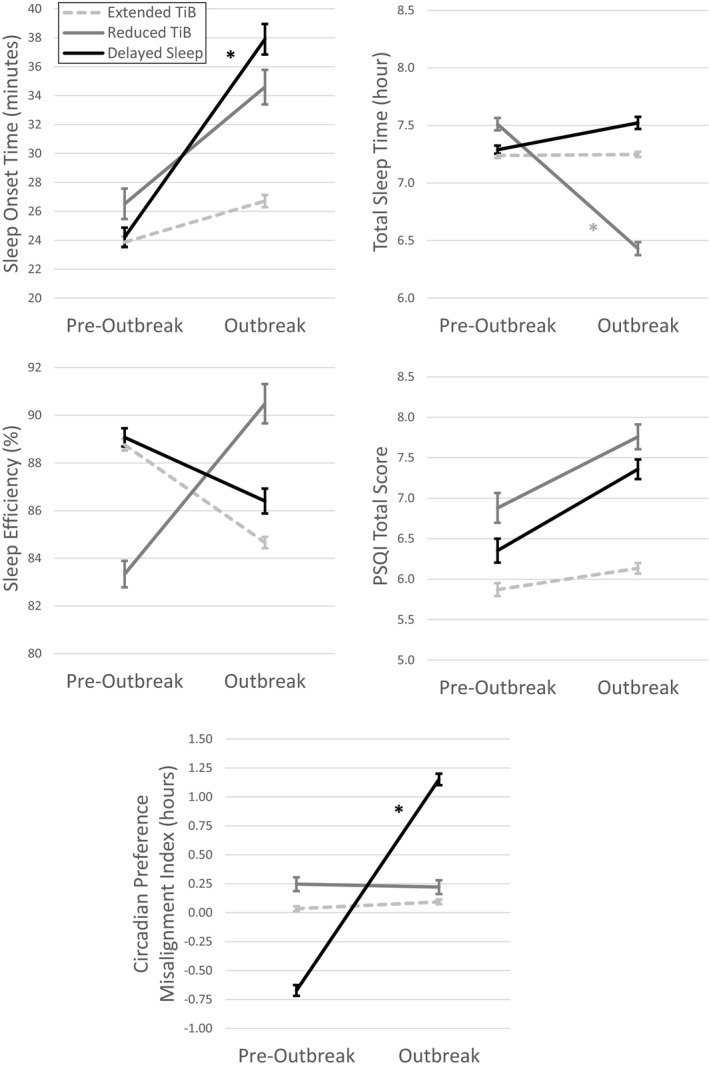
Pre‐outbreak to outbreak changes in sleep‐onset time, total sleep time, sleep efficiency, PSQI total score and the circadian preference misalignment index in each subgroup with distinct sleep behaviour profiles. Error bars indicate the standard error of the mean. TiB, time in bed; PSQI, Pittsburg Sleep Quality Index (*p < .05 andηp2 > 0.02)
FIGURE 4
FIGURE 4
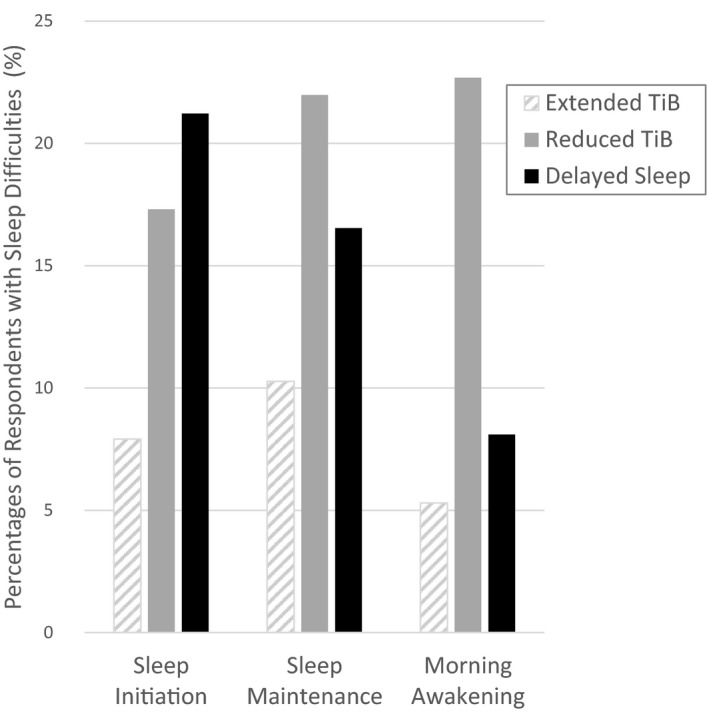
Proportions of respondents reporting new clinically meaningful difficulties with sleep initiation, sleep maintenance and morning awakening during the outbreak relative to pre‐outbreak estimates in subgroups with distinct profiles of sleep behaviours. TiB: time in bed. Chi‐squared (2) > 82.2, p < .001, V > 0.09
FIGURE 5
FIGURE 5
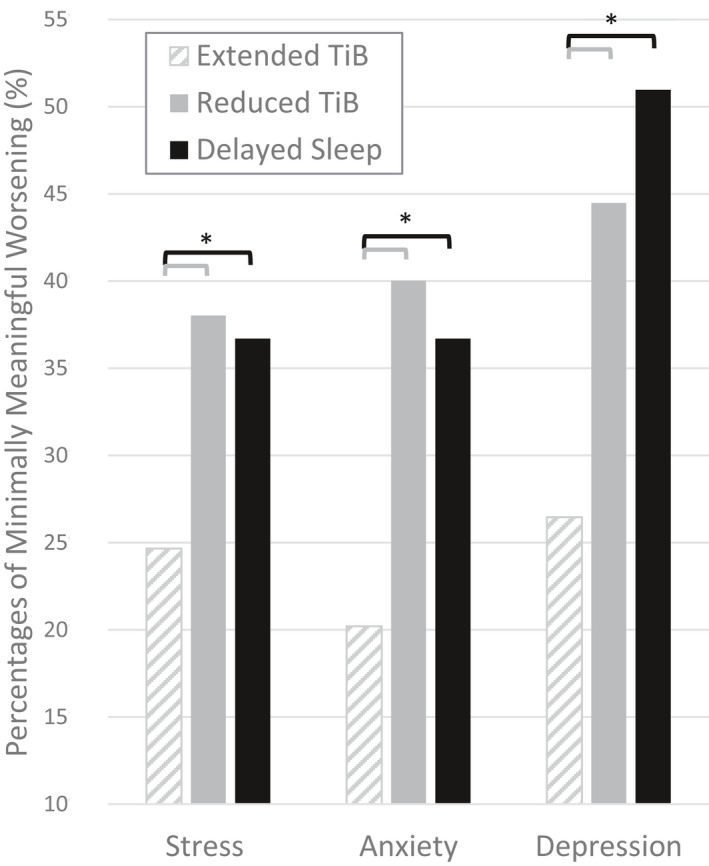
Proportions of respondents with minimally meaningful worsening of symptoms of stress, anxiety and depression from pre‐outbreak to during the outbreak in each subgroup with distinct sleep behaviour profiles. TiB: time in bed; Stress: Perceived Stress Scale; Anxiety: Generalized Anxiety Disorder 7; Depression: Quick Inventory of Depressive Symptomatology recalculated without the items pertaining to sleep (*p < .001, V > 0.11)

References

    1. Adan, A. , & Almirall, H. (1991). Horne & Östberg morningness‐eveningness questionnaire: A reduced scale. Personality and Individual Differences, 12(3), 241–253. 10.1016/0191-8869(91)90110-W - DOI
    1. Åkerstedt, T. (2006). Psychosocial stress and impaired sleep. Scandinavian Journal of Work, Environment and Health, 32(6), 493–501. 10.5271/sjweh.1054 - DOI - PubMed
    1. Altena, E. , Baglioni, C. , Espie, C. A. , Ellis, J. , Gavriloff, D. , Holzinger, B. , Schlarb, A. , Frase, L. , Jernelöv, S. , & Riemann, D. (2020). Dealing with sleep problems during home confinement due to the COVID‐19 outbreak: Practical recommendations from a task force of the European CBT‐I Academy. Journal of Sleep Research, 29(4), e13052, 10.1111/jsr.13052 - DOI - PubMed
    1. Beck, F. , Léger, D. , Fressard, L. , Peretti‐Watel, P. , & Verger, P. (2020). Covid‐19 health crisis and lockdown associated with high level of sleep complaints and hypnotic uptake at the population level. Journal of Sleep Research, e13119, 10.1111/jsr.13119 - DOI - PMC - PubMed
    1. Becker, S. P. , & Gregory, A. M. (2020). Editorial Perspective: Perils and promise for child and adolescent sleep and associated psychopathology during the COVID‐19 pandemic. Journal of Child Psychology and Psychiatry and Allied Disciplines, 61(7), 757–759. 10.1111/jcpp.13278 - DOI - PMC - PubMed

MeSH terms