


Establishment of COVID-19 testing laboratory in resource-limited settings: challenges and prospects reported from Ethiopia
- PMID: 33200686
- PMCID: PMC7671712
- DOI: 10.1080/16549716.2020.1841963
Establishment of COVID-19 testing laboratory in resource-limited settings: challenges and prospects reported from Ethiopia
Abstract
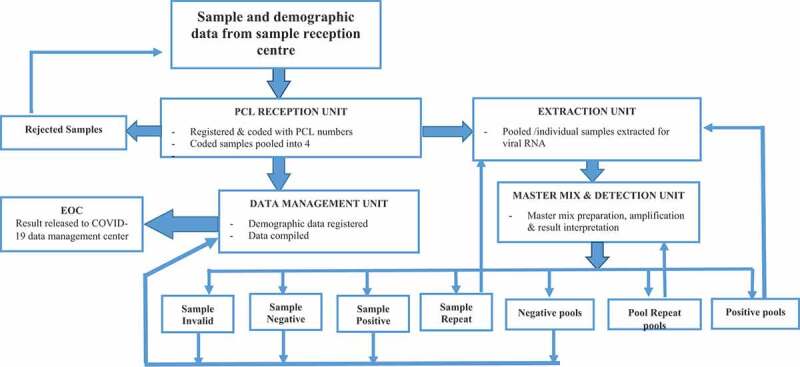
The Coronavirus pandemic is recording unprecedented deaths worldwide. The temporal distribution and burden of the disease varies from setting to setting based on economic status, demography and geographic location. A rapid increase in the number of COVID-19 cases is being reported in Africa as of June 2020. Ethiopia reported the first COVID-19 case on 13 March 2020. Limited molecular laboratory capacity in resource constrained settings is a challenge in the diagnosis of the ever-increasing cases and the overall management of the disease. In this article, the Ethiopian Public Health Institute (EPHI) shares the experience, challenges and prospects in the rapid establishment of one of its COVID-19 testing laboratories from available resources. The first steps in establishing the COVID-19 molecular testing laboratory were i) identifying a suitable space ii) renovating it and iii) mobilizing materials including consumables, mainly from the Malaria and Neglected Tropical Diseases (NTDs) research team at the EPHI. A chain of experimental design was set up with distinct laboratories to standardize the extraction of samples, preparation of the master mix and detection. At the commencement of sample reception and testing, laboratory contamination was among the primary challenges faced. The source of the contamination was identified in the master mix room and resolved. In summary, the established COVID-19 testing lab has tested more than 40,000 samples (August 2020) and is the preferred setting for research and training. The lessons learned may benefit the further establishment of emergency testing laboratories for COVID-19 and/or other epidemic/pandemic diseases in resource-limited settings.
Keywords: COVID-19; EPHI; Ethiopia; RT-PCR; SARS-CoV-2; laboratory; pandemic.
Conflict of interest statement
There is no conflict of interest. The authors alone are responsible for the views expressed in this publication. All authors have read and approved the manuscript.
Figures


References
-
- Zhou W, Qiang W, Ke H, et al. The coronavirus prevention handbook: science-based tips that could save your life. 1st ed. Wuhan, China: Hubei Science and Technology Press; 2020. p. 145. Available from: https://www.amazon.com/Coronavirus-Prevention-Handbook-Science-Based-Cou...
-
- Centres for Disease Control and Prevention . Atlanta: Coronavirus Disease 2019 (COVID-19). [cited 2020 April16]. Available from: https://www.cdc.gov/coronavirus/2019-ncov/hcp/return-to-work.html
-
- Sethuraman N, Jeremiah SS, Ryo A.. Interpreting diagnostic tests for SARS-CoV-2. JAMA. 2020;323:2249. - PubMed
-
- Nalla AK, Casto AM, Huang M-LW, et al. Comparative performance of SARS-CoV-2 detection assays using seven different primer/probe sets and one assay kit. J Clin Microbiol. 2020;58:e00557–7. Available from: https://jcm.asm.org/content/early/2020/04/06/JCM.00557-20 - PMC - PubMed
-
- World Health Organization . Coronavirus disease (COVID-19) pandemic. Geneva: World Health Organization; 2020. [cited 2020 April16]. Available from: https://www.who.int/emergencies/diseases/novel-coronavirus-2019
MeSH terms
Grants and funding
LinkOut - more resources
Full Text Sources
Medical
Miscellaneous
