


Association Between Proportion of Workday Treating COVID-19 and Depression, Anxiety, and PTSD Outcomes in US Physicians
- PMID: 33201021
- PMCID: PMC7864594
- DOI: 10.1097/JOM.0000000000002086
Association Between Proportion of Workday Treating COVID-19 and Depression, Anxiety, and PTSD Outcomes in US Physicians
Abstract
Objective: The primary objective of this cross-sectional study was to examine the association between time spent treating patients with Coronavirus disease 2019 (COVID-19) and levels of depression, anxiety, and posttraumatic stress disorder (PTSD) in US physicians.
Methods: The authors conducted an anonymous online survey of US physicians. Linear regression was used to test the association between proportion of day treating COVID-19 and symptoms of depression, anxiety, and PTSD.
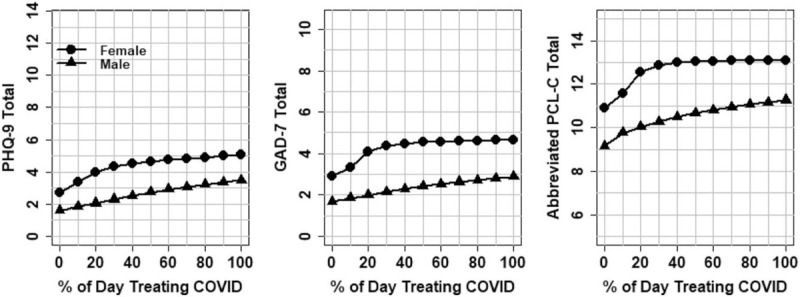
Results: In a sample of 1724 US physicians, proportion of day treating COVID-19 was positively and significantly associated with depression, anxiety, and PTSD scores (P < 0.001 for each).
Conclusions: Mental health resources should be provided to physicians who treat COVID-19 because the proportion of day treating COVID-19 is associated with depression, anxiety, and PTSD outcomes.
Copyright © 2020 American College of Occupational and Environmental Medicine.
Conflict of interest statement
Gainer, Nahhas, Bhatt, Merrill, and McCormack have no relationships/conditions/circumstances that present potential conflict of interest.
Figures



References
-
- Dyrbye LN, West CP, Satele D, et al. Burnout among U.S. medical students, residents, and early career physicians relative to the general U.S. population. Acad Med 2014; 89:443–451. - PubMed
