


Long-term persistence of gastric dysbiosis after eradication of Helicobacter pylori in patients who underwent endoscopic submucosal dissection for early gastric cancer
- PMID: 33201352
- PMCID: PMC8065006
- DOI: 10.1007/s10120-020-01141-w
Long-term persistence of gastric dysbiosis after eradication of Helicobacter pylori in patients who underwent endoscopic submucosal dissection for early gastric cancer
Abstract
Background: Gastric microbiome, other than Helicobacter pylori, plays a role in the tumorigenesis of gastric cancer (GC). Patients who undergo endoscopic submucosal dissection for early GC have a high risk of developing metachronous GC even after successful eradication of H. pylori. Thus, we investigated the microbial profiles and associated changes in such patients after the eradication of H. pylori.
Methods: A total of 19 H. pylori-infected patients with early GC who were or to be treated by endoscopic resection, with paired biopsy samples at pre- and post-eradication therapy, were retrospectively enrolled. Ten H. pylori-negative patients were enrolled as controls. Biopsy samples were analyzed using 16S rRNA sequencing.
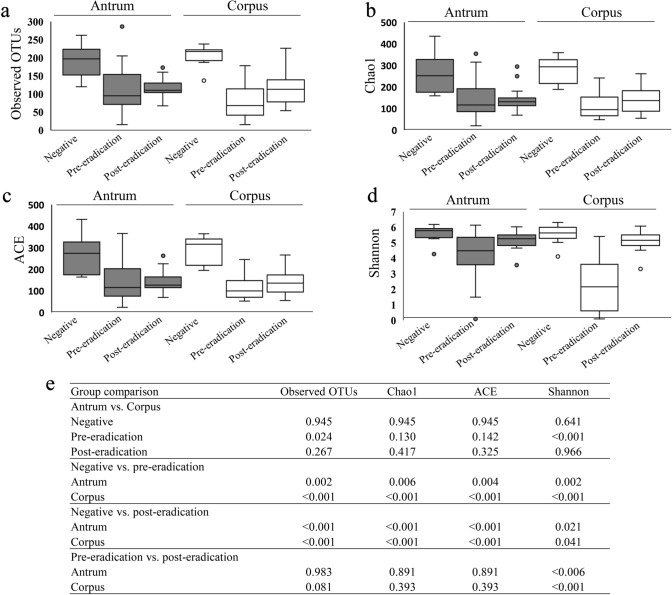
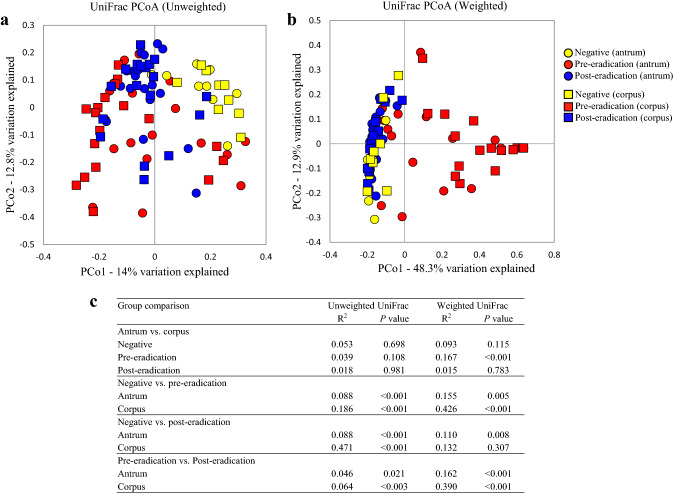
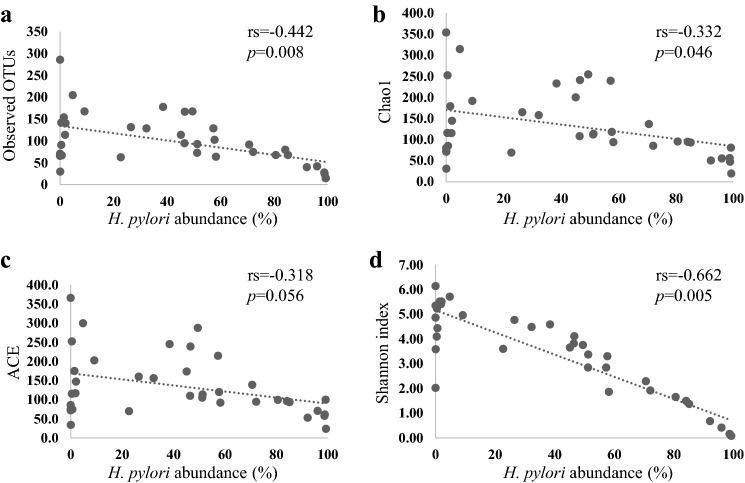
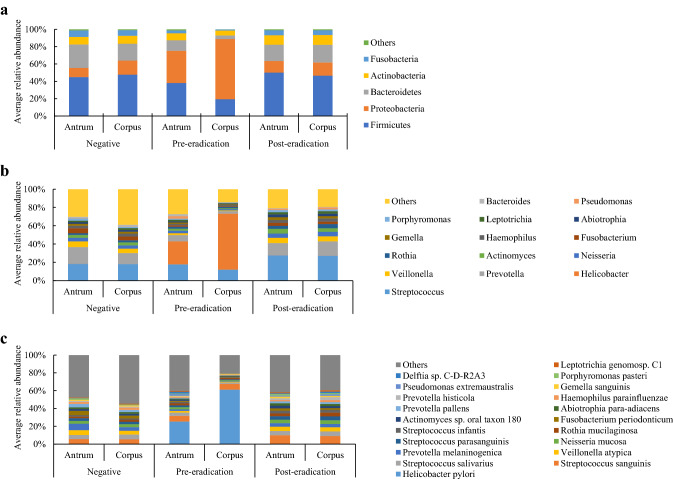
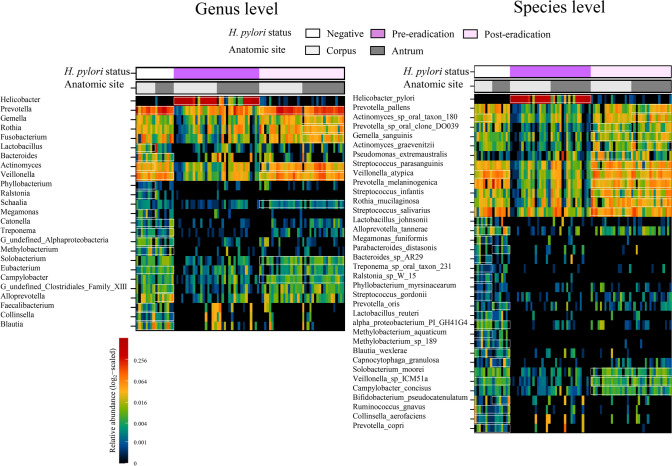
Results: H. pylori-positive patients exhibited low richness and evenness of bacteria with the deletion of several genera, including Blautia, Ralstonia, Faecalibacterium, Methylobacterium, and Megamonas. H. pylori eradication partially restored microbial diversity, as assessed during a median follow-up at 13 months after eradication therapy. However, post-eradication patients had less diversity than that in the controls and possessed a lower abundance of the five genera mentioned above. The eradication of H. pylori also altered the bacterial composition, but not to the same extent as that in controls. The microbial communities could be clustered into three separate groups: H. pylori-negative, pre-eradication, and post-eradication.
Conclusion: Changes in dysbiosis may persist long after the eradication of H. pylori in patients with a history of GC. Dysbiosis may be involved in the development of both primary and metachronous GC after the eradication of H. pylori in such patients.
Keywords: Dysbiosis; Eradication; Gastric cancer; Helicobacter pylori.
Conflict of interest statement
The authors declare that they have no conflict of interest.
Figures
Comment in
-
Comment on: "Long‑term persistence of gastric dysbiosis after eradication of Helicobacter pylori in patients who underwent endoscopic submucosal dissection for early gastric cancer. Gastric Cancer, 2020 Nov 17" by Watanabe et al.Gastric Cancer. 2021 Jul;24(4):978-979. doi: 10.1007/s10120-020-01152-7. Epub 2021 Jan 7. Gastric Cancer. 2021. PMID: 33411059 No abstract available.
-
Reply to the letter by Ouyang et al. regarding our manuscript "Long-term persistence of gastric dysbiosis after eradication of Helicobacter pylori in patients who underwent endoscopic submucosal dissection for early gastric cancer".Gastric Cancer. 2021 Jul;24(4):980-981. doi: 10.1007/s10120-021-01198-1. Epub 2021 May 19. Gastric Cancer. 2021. PMID: 34009534 No abstract available.
References
-
- Fukase K, Kato M, Kikuchi S, Inoue K, Uemura N, Okamoto S, et al. Effect of eradication of Helicobacter pylori on incidence of metachronous gastric carcinoma after endoscopic resection of early gastric cancer: an open-label, randomised controlled trial. Lancet. 2008;372(9636):392–397. doi: 10.1016/S0140-6736(08)61159-9. - DOI - PubMed
MeSH terms
Grants and funding
LinkOut - more resources
Full Text Sources
Medical
Miscellaneous
