


Assistive Technology Use and Provision During COVID-19: Results From a Rapid Global Survey
- PMID: 33201656
- PMCID: PMC9309903
- DOI: 10.34172/ijhpm.2020.210
Assistive Technology Use and Provision During COVID-19: Results From a Rapid Global Survey
Abstract
Background: The coronavirus disease 2019 (COVID-19) pandemic has impacted all segments of society, but it has posed particular challenges for the inclusion of persons with disabilities, those with chronic illness and older people regarding their participation in daily life. These groups often benefit from assistive technology (AT) and so it is important to understand how use of AT may be affected by or may help to mitigate the impacts of COVID-19. Objective: The objectives of this study were to explore the how AT use and provision have been affected during the initial stages of the COVID-19 pandemic, and how AT policies and systems may be made more resilient based on lessons learned during this global crisis.
Methods: This study was a rapid, international online qualitative survey in the 6 United Nations (UN) languages (English, French, Spanish, Russian, Arabic, Mandarin Chinese) facilitated by extant World Health Organization (WHO) and International Disability Alliance networks. Themes and subthemes of the qualitative responses were identified using Braun and Clarke's 6-phase analysis.
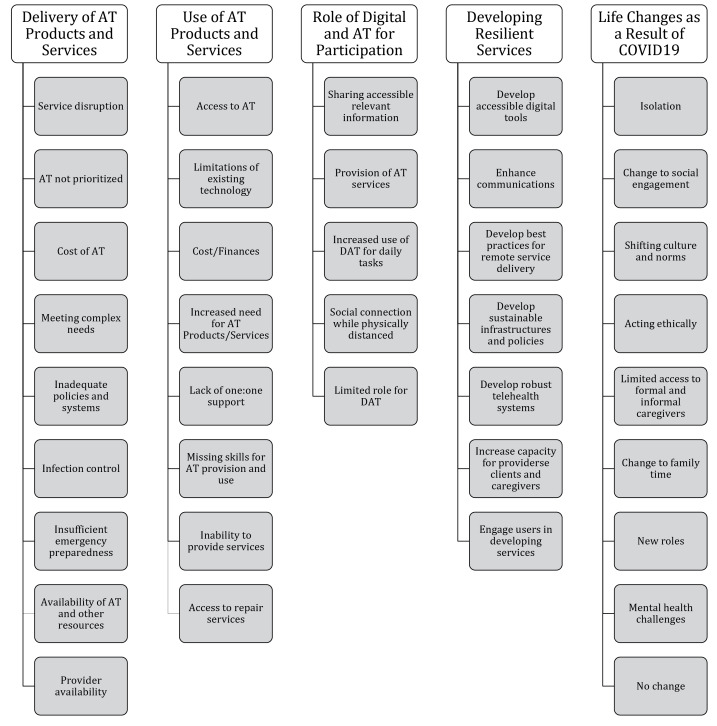
Results: Four primary themes were identified in in the data: Disruption of Services, Insufficient Emergency Preparedness, Limitations in Existing Technology, and Inadequate Policies and Systems. Subthemes were identified within each theme, including subthemes related to developing resilience in AT systems, based on learning from the pandemic.
Conclusion: COVID-19 has disrupted the delivery of AT services, primarily due to infection control measures resulting in lack of provider availability and diminished one-to-one services. This study identified a need for stronger user-centred development of funding policies and infrastructures that are more sustainable and resilient, best practices for remote service delivery, robust and accessible tools and systems, and increased capacity of clients, caregivers, and clinicians to respond to pandemic and other crisis situations.
Keywords: Ageing; Assistive Technology; Crises; Disability; Health Policy; Resilience.
© 2022 The Author(s); Published by Kerman University of Medical Sciences This is an open-access article distributed under the terms of the Creative Commons Attribution License (http://creativecommons.org/licenses/by/4.0), which permits unrestricted use, distribution, and reproduction in any medium, provided the original work is properly cited.


References
MeSH terms
LinkOut - more resources
Full Text Sources
Medical