


Natural language processing to measure the frequency and mode of communication between healthcare professionals and family members of critically ill patients
- PMID: 33201981
- PMCID: PMC7936522
- DOI: 10.1093/jamia/ocaa263
Natural language processing to measure the frequency and mode of communication between healthcare professionals and family members of critically ill patients
Abstract
Objective: To apply natural language processing (NLP) techniques to identify individual events and modes of communication between healthcare professionals and families of critically ill patients from electronic medical records (EMR).
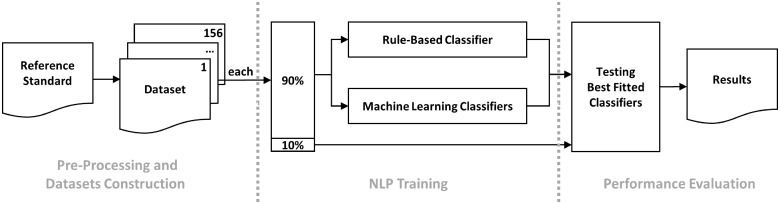
Materials and methods: Retrospective cohort study of 280 randomly selected adult patients admitted to 1 of 15 intensive care units (ICU) in Alberta, Canada from June 19, 2012 to June 11, 2018. Individual events and modes of communication were independently abstracted using NLP and manual chart review (reference standard). Preprocessing techniques and 2 NLP approaches (rule-based and machine learning) were evaluated using sensitivity, specificity, and area under the receiver operating characteristic curves (AUROC).
Results: Over 2700 combinations of NLP methods and hyperparameters were evaluated for each mode of communication using a holdout subset. The rule-based approach had the highest AUROC in 65 datasets compared to the machine learning approach in 21 datasets. Both approaches had similar performance in 17 datasets. The rule-based AUROC for the grouped categories of patient documented to have family or friends (0.972, 95% CI 0.934-1.000), visit by family/friend (0.882 95% CI 0.820-0.943) and phone call with family/friend (0.975, 95% CI: 0.952-0.998) were high.
Discussion: We report an automated method to quantify communication between healthcare professionals and family members of adult patients from free-text EMRs. A rule-based NLP approach had better overall operating characteristics than a machine learning approach.
Conclusion: NLP can automatically and accurately measure frequency and mode of documented family visitation and communication from unstructured free-text EMRs, to support patient- and family-centered care initiatives.
Keywords: communication; electronic medical records; family; intensive care units; natural language processing.
© The Author(s) 2020. Published by Oxford University Press on behalf of the American Medical Informatics Association. All rights reserved. For permissions, please email: journals.permissions@oup.com.
References
-
- Davidson JE, Aslakson RA, Long AC, et al. Guidelines for family-centered care in the neonatal, pediatric, and adult ICU. Crit Care Med 2017; 45 (1): 103–28. - PubMed
-
- Au SS, Roze Des Ordons AL, Amir Ali A, et al. Communication with patients’ families in the intensive care unit: a point prevalence study. J Crit Care 2019; 54: 235–8. - PubMed
Publication types
MeSH terms
LinkOut - more resources
Full Text Sources
Miscellaneous
