


Predicting Postpartum Depressive Symptoms from Pregnancy Biopsychosocial Factors: A Longitudinal Investigation Using Structural Equation Modeling
- PMID: 33202688
- PMCID: PMC7696025
- DOI: 10.3390/ijerph17228445
Predicting Postpartum Depressive Symptoms from Pregnancy Biopsychosocial Factors: A Longitudinal Investigation Using Structural Equation Modeling
Abstract
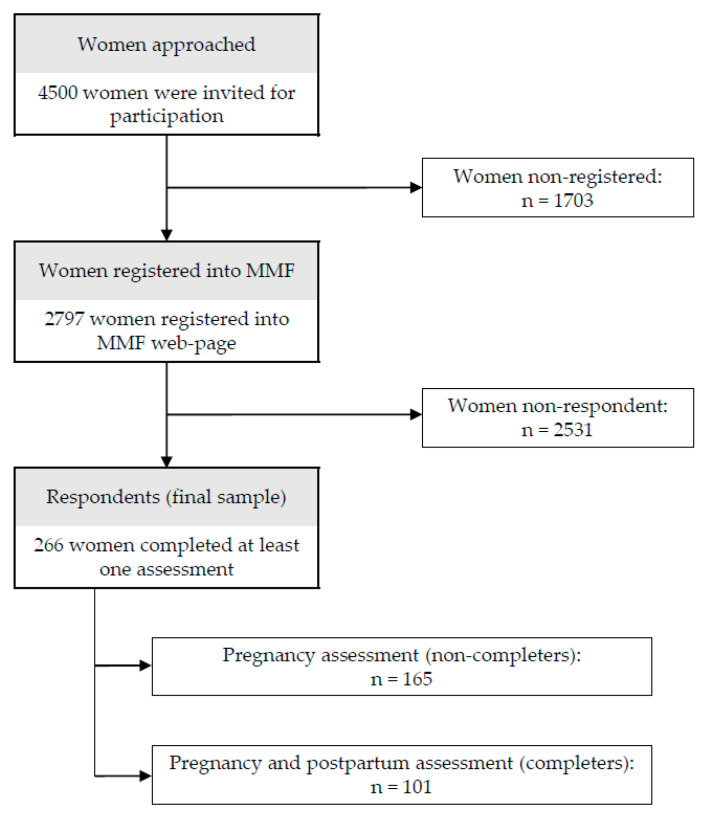
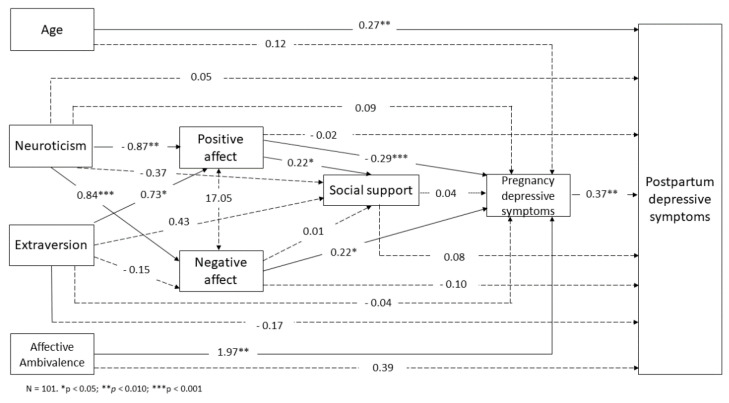
The prediction of postpartum depression (PPD) should be conceptualized from a biopsychosocial perspective. This study aims at exploring the longitudinal contribution of a set of biopsychosocial factors for PPD in perinatal women. A longitudinal study was conducted, assessment was made with a website and included biopsychosocial factors that were measured during pregnancy (n = 266, weeks 16-36), including age, affective ambivalence, personality characteristics, social support and depression. Depression was measured again at postpartum (n = 101, weeks 2-4). The analyses included bivariate associations and structural equation modeling (SEM). Age, affective ambivalence, neuroticism, positive, and negative affect at pregnancy were associated with concurrent depression during pregnancy (all p < 0.01). Age, affective ambivalence, positive affect, and depression at pregnancy correlated with PPD (all p < 0.05). Affective ambivalence (β = 1.97; p = 0.003) and positive (β = -0.29; p < 0.001) and negative affect (β = 0.22; p = 0.024) at pregnancy remained significant predictors of concurrent depression in the SEM, whereas only age (β = 0.27; p = 0.010) and depression (β = 0.37; p = 0.002) at pregnancy predicted PPD. Biopsychosocial factors are clearly associated with concurrent depression at pregnancy, but the stability of depression across time limits the prospective contribution of biopsychosocial factors. Depression should be screened early during pregnancy, as this is likely to persist after birth. The use of technology, as in the present investigation, might be a cost-effective option for this purpose.
Keywords: biopsychosocial; depressive symptoms; information and communication technologies; longitudinal studies; postpartum; pregnancy; risk factors.
Conflict of interest statement
The authors declare no conflict of interest.
Figures
References
-
- World Health Organization Maternal and Child Mental Health. [(accessed on 17 February 2020)]; Available online: http://www.who.int/mental_health/maternal-child/maternal_mental_health/en/
-
- Danaher B.G., Milgrom J., Seeley J.R., Stuart S., Schembri C., Tyler M.S., Ericksen J., Lester W., Gemmill A.W., Kosty D.B., et al. MomMoodBooster web-based intervention for postpartum depression: Feasibility trial results. J. Med. Internet Res. 2013;15:e242. doi: 10.2196/jmir.2876. - DOI - PMC - PubMed
Publication types
MeSH terms
LinkOut - more resources
Full Text Sources
Medical
