Review
. 2020 Nov 13;11(11):1346.
doi: 10.3390/genes11111346.

Ancient DNA Studies in Pre-Columbian Mesoamerica

Affiliations
Review

Ancient DNA Studies in Pre-Columbian Mesoamerica

Xavier Roca-Rada et al. Genes (Basel). .

Abstract

Mesoamerica is a historically and culturally defined geographic area comprising current central and south Mexico, Belize, Guatemala, El Salvador, and border regions of Honduras, western Nicaragua, and northwestern Costa Rica. The permanent settling of Mesoamerica was accompanied by the development of agriculture and pottery manufacturing (2500 BCE-150 CE), which led to the rise of several cultures connected by commerce and farming. Hence, Mesoamericans probably carried an invaluable genetic diversity partly lost during the Spanish conquest and the subsequent colonial period. Mesoamerican ancient DNA (aDNA) research has mainly focused on the study of mitochondrial DNA in the Basin of Mexico and the Yucatán Peninsula and its nearby territories, particularly during the Postclassic period (900-1519 CE). Despite limitations associated with the poor preservation of samples in tropical areas, recent methodological improvements pave the way for a deeper analysis of Mesoamerica. Here, we review how aDNA research has helped discern population dynamics patterns in the pre-Columbian Mesoamerican context, how it supports archaeological, linguistic, and anthropological conclusions, and finally, how it offers new working hypotheses.

Keywords: Mesoamerica; Native American ancestries; Native American founding lineages; Native American genetic history; Teotihuacan; ancient DNA; mtDNA.


Conflict of interest statement

The authors declare no conflict of interest.

Figures
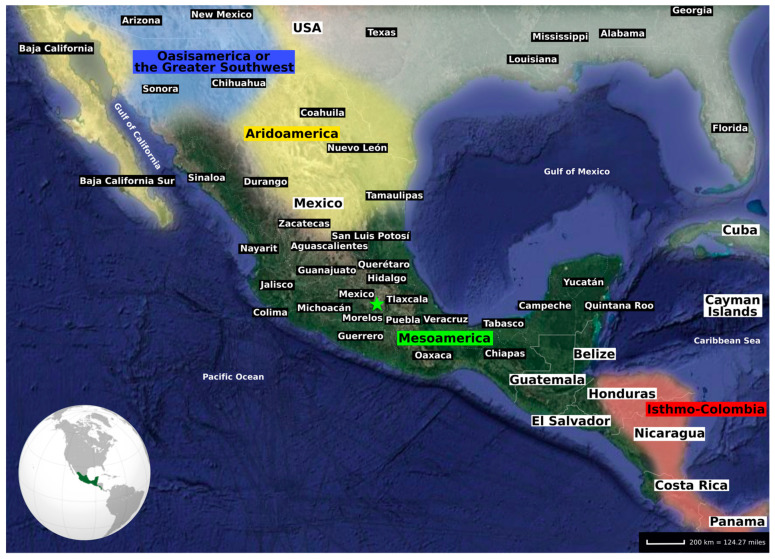
Figure 1
Figure 1
The historical and cultural area of Mesoamerica, as well as Isthmo-Colombia, Aridoamerica, and Oasisamerica (also known as the Greater Southwest) represented with coloured shades. Regions outside these areas are depicted with a white shade. Of note, Oasisamerica is occasionally included in Aridoamerica in the literature. White lines delineate the modern-day borders between countries and white dashed lines the borders between states. The green star is the localisation of present-day Mexico City.
Figure 2
Figure 2
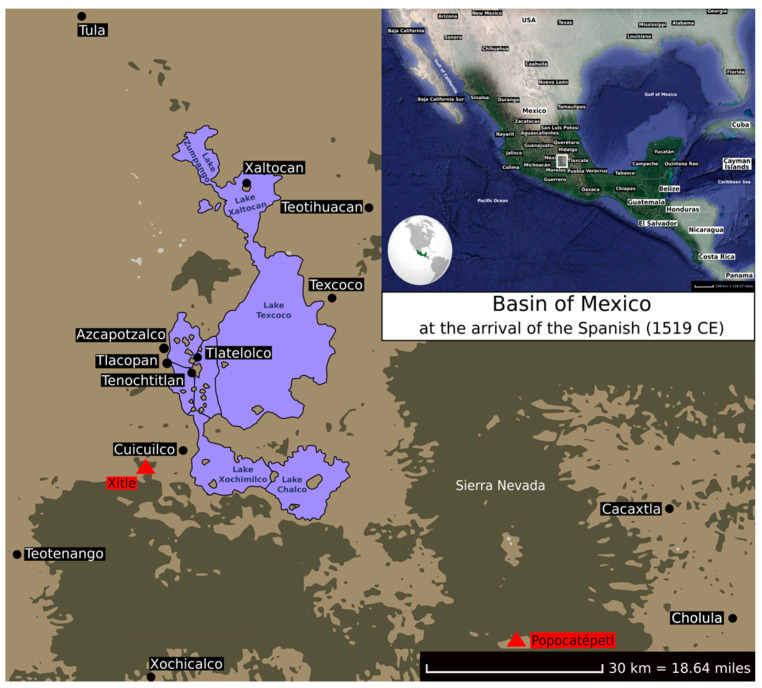
Approximate locations of the archaeological sites (black dots) and volcanoes (red triangles) in the Basin of Mexico at the arrival of the Spanish (1519 CE), as discussed in the present review.
Figure 3
Figure 3
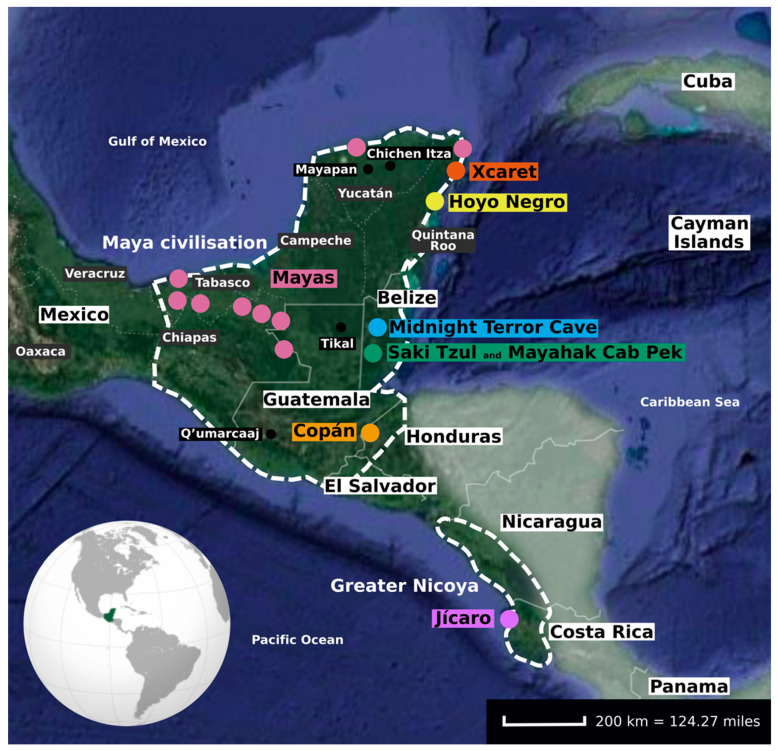
Locations of the archaeological sites in the Yucatán Peninsula and nearby territories, as discussed in the present review. Coloured dots represent the archaeological sites included in each aDNA study. Black dots represent archaeological sites mentioned in the present review with no aDNA data so far. The historical and cultural areas of the Maya civilisation and the Greater Nicoya are within the thick white dashed lines. The shaded area represents regions outside of Mesoamerica. White lines delineate current borders between countries, and thin white dashed lines borders between states.

References

    1. Scheib C.L., Li H., Desai T., Link V., Kendall C., Dewar G., Griffith P.W., Mörseburg A., Johnson J.R., Potter A., et al. Ancient human parallel lineages within North America contributed to a coastal expansion. Science. 2018;360:1024–1027. doi: 10.1126/science.aar6851. - DOI - PubMed
    1. Moreno-Mayar J.V., Vinner L., de Damgaard P.B., de la Fuente C., Chan J., Spence J.P., Allentoft M.E., Vimala T., Racimo F., Pinotti T., et al. Early human dispersals within the Americas. Science. 2018;362 doi: 10.1126/science.aav2621. - DOI - PubMed
    1. Posth C., Nakatsuka N., Lazaridis I., Skoglund P., Mallick S., Lamnidis T.C., Rohland N., Nägele K., Adamski N., Bertolini E., et al. Reconstructing the deep population history of central and South America. Cell. 2018;175:1185–1197. doi: 10.1016/j.cell.2018.10.027. - DOI - PMC - PubMed
    1. Sikora M., Pitulko V.V., Sousa V.C., Allentoft M.E., Vinner L., Rasmussen S., Margaryan A., de Barros Damgaard P., de la Fuente C., Renaud G., et al. The population history of northeastern Siberia since the Pleistocene. Nature. 2019;570:182–188. doi: 10.1038/s41586-019-1279-z. - DOI - PMC - PubMed
    1. Orlando L., Gilbert M.T.P., Willerslev E. Reconstructing ancient genomes and epigenomes. Nat. Rev. Genet. 2015;16:395–408. doi: 10.1038/nrg3935. - DOI - PubMed

LinkOut - more resources