. 2020 Nov 13;12(11):3368.
doi: 10.3390/cancers12113368.

Cancer Stem Cells and the Slow Cycling Phenotype: How to Cut the Gordian Knot Driving Resistance to Therapy in Melanoma

Affiliations

Cancer Stem Cells and the Slow Cycling Phenotype: How to Cut the Gordian Knot Driving Resistance to Therapy in Melanoma

Luigi Fattore et al. Cancers (Basel). .

Abstract

Cancer stem cells (CSCs) have historically been defined as slow cycling elements that are able to differentiate into mature cells but without dedifferentiation in the opposite direction. Thanks to advances in genomic and non-genomic technologies, the CSC theory has more recently been reconsidered in a dynamic manner according to a "phenotype switching" plastic model. Transcriptional reprogramming rewires this plasticity and enables heterogeneous tumors to influence cancer progression and to adapt themselves to drug exposure by selecting a subpopulation of slow cycling cells, similar in nature to the originally defined CSCs. This model has been conceptualized for malignant melanoma tailored to explain resistance to target therapies. Here, we conducted a bioinformatics analysis of available data directed to the identification of the molecular pathways sustaining slow cycling melanoma stem cells. Using this approach, we identified a signature of 25 genes that were assigned to four major clusters, namely 1) kinases and metabolic changes, 2) melanoma-associated proteins, 3) Hippo pathway and 4) slow cycling/CSCs factors. Furthermore, we show how a protein-protein interaction network may be the main driver of these melanoma cell subpopulations. Finally, mining The Cancer Genome Atlas (TCGA) data we evaluated the expression levels of this signature in the four melanoma mutational subtypes. The concomitant alteration of these genes correlates with the worst overall survival (OS) for melanoma patients harboring BRAF-mutations. All together these results underscore the potentiality to target this signature to selectively kill CSCs and to achieve disease control in melanoma.

Keywords: OXPHOS; cancer stem cells; drug resistance; lipid metabolism; melanoma; slow cycling phenotype; target therapy.


Conflict of interest statement

The authors declare no conflict of interest. The funders had no role in the design of the study; in the collection, analyses, or interpretation of data; in the writing of the manuscript, or in the decision to publish the results.

Figures

Figure 1
Figure 1
Schematic workflow of the study divided into three steps to obtain a list of 25 top genes for bioinformatics analyses.
Figure 2
Figure 2
Evidence, confidence and molecular function-based protein−protein interaction (PPI) networks performed using the list of 25 top genes relevant for melanoma cancer stem cells (CSCs) and resistance to target therapy. The legends indicate the meaning of the lines. Interaction score applied >0.4 (medium confidence). A total of 89 were hedges obtained with a PPI enrichment p < 1.0 × 10⁻¹⁶. https://string-db.org.
Figure 3
Figure 3
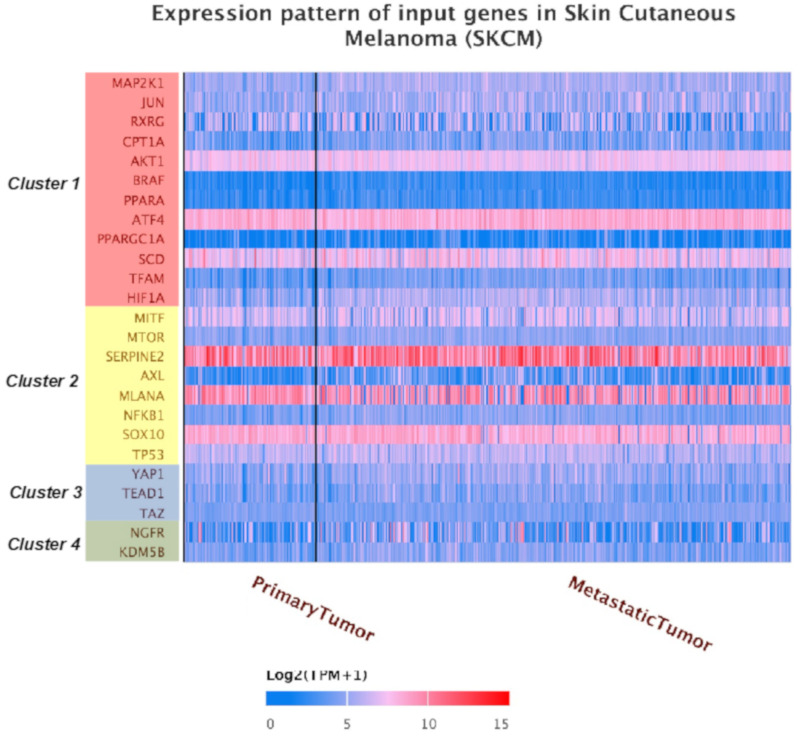
Expression levels of the 25 top genes relevant for melanoma CSCs and resistance to target therapy on 480 samples of skin cutaneous melanoma from The Cancer Genome Atlas. http://ualcan.path.uab.edu/index.html.
Figure 4
Figure 4
Melanoma stem cell signature (“MSCsign”) expression levels evaluated according to skin cutaneous melanoma mutational subtypes. (A) Cake graph representing the most common mutational subsets of metastatic melanoma. (B) OncoPrint evaluation of distinct genomic alterations. (C) Venn diagrams showing the overlapping of the patients belonging to the four mutational subtypes. (D) Heat-maps of the expression levels of the 25 genes of “MSCsign” clustered according to the mutational subsets. (E) Principal component analysis performed on the expression levels of “MSCsign” in the four mutational subtypes. Data from https://www.cbioportal.org/.
Figure 5
Figure 5
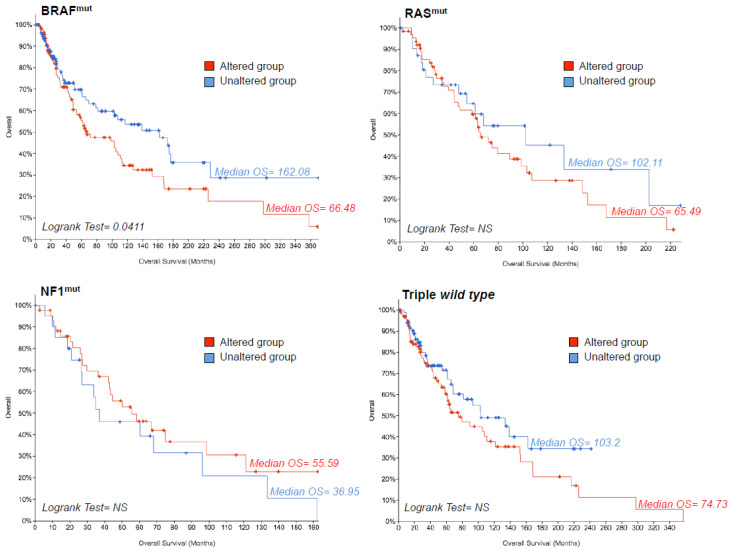
Kaplan–Meyer curves evaluating the prognostic value of “MSCsign” in the four mutational subtypes of skin cutaneous melanoma. Data plotted from https://www.cbioportal.org/.
Figure 6
Figure 6
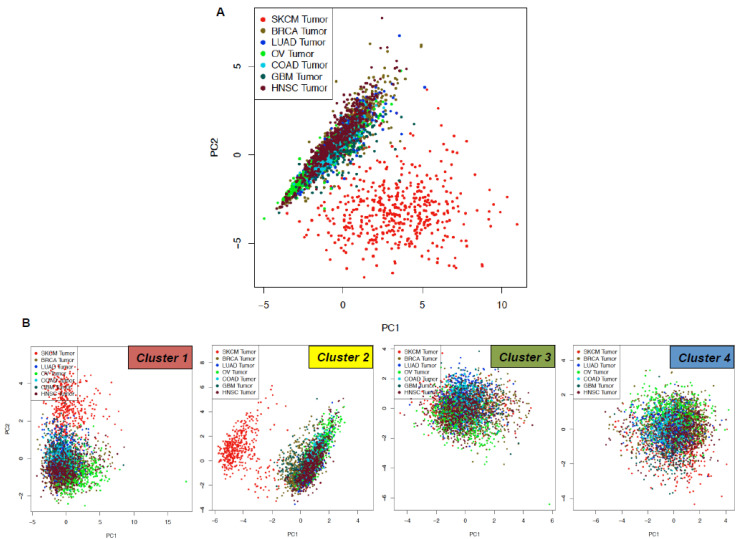
Principal component analyses performed using the expression levels of (A) all the 25 genes of “MSCsign” based on The Cancer Genome Atlas (TCGA) data and (B) divided according to the four different clusters identified. SKCM = Skin Cutaneous Melanoma, BRCA = Breast invasive carcinoma, LUAD = Lung adenocarcinoma, OV = Ovarian serous cystadenocarcinoma, COAD = colon adenocarcinoma, GBM = Glioblastoma multiforme, HNSC = Head and Neck squamous cell carcinoma. http://gepia.cancer-pku.cn/index.html.

References

    1. Siegel R.L., Miller K.D., Jemal A. Cancer Statistics, 2017. CA Cancer J. Clin. 2017;67:7–30. doi: 10.3322/caac.21387. - DOI - PubMed
    1. Marzagalli M., Moretti R.M., Messi E., Marelli M.M., Fontana F., Anastasia A., Bani M.R., Beretta G., Limonta P. Targeting melanoma stem cells with the Vitamin E derivative δ-tocotrienol. Sci. Rep. 2018;8:587. doi: 10.1038/s41598-017-19057-4. - DOI - PMC - PubMed
    1. Ottaviano M., De Placido S., Ascierto P.A. Recent success and limitations of immune checkpoint inhibitors for cancer: A lesson from melanoma. Virchows Arch. 2019;474:421–432. doi: 10.1007/s00428-019-02538-4. - DOI - PubMed
    1. Ugurel S., Röhmel J., Ascierto P.A., Flaherty K.T., Grob J.J., Hauschild A., Larkin J., Long G.V., Lorigan P., McArthur G.A., et al. Survival of patients with advanced metastatic melanoma: The impact of novel therapies. Eur. J. Cancer. 2016;53:125–134. doi: 10.1016/j.ejca.2015.09.013. - DOI - PubMed
    1. Pelster M.S., Amaria R.N. Combined targeted therapy and immunotherapy in melanoma: A review of the impact on the tumor microenvironment and outcomes of early clinical trials. Ther. Adv. Med. Oncol. 2019;11 doi: 10.1177/1758835919830826. - DOI - PMC - PubMed