


Key Elements of Gingival Epithelial Homeostasis upon Bacterial Interaction
- PMID: 33203318
- PMCID: PMC7989138
- DOI: 10.1177/0022034520973012
Key Elements of Gingival Epithelial Homeostasis upon Bacterial Interaction
Abstract
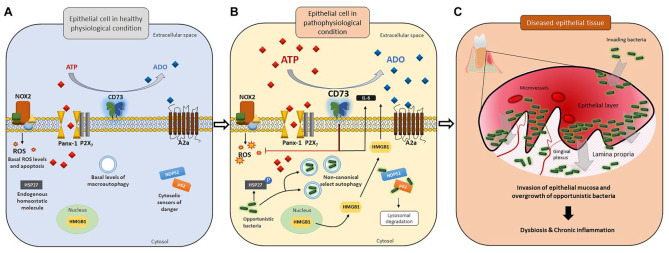
Epithelia are structurally integral elements in the fabric of oral mucosa with significant functional roles. Similarly, the gingival epithelium performs uniquely critical tasks in responding to a variety of external stimuli and dangers through the regulation of specific built-in molecular mechanisms in a context-dependent fashion at cellular levels. Gingival epithelial cells form an anatomic architecture that confers defense, robustness, and adaptation toward external aggressions, most critically to colonizing microorganisms, among other functions. Accordingly, recent studies unraveled previously uncharacterized response mechanisms in gingival epithelial cells that are constructed to rapidly exert biocidal effects against invader pathobiotic bacteria, such as Porphyromonas gingivalis, through small danger molecule signaling. The host-adapted bacteria, however, have developed adroit strategies to 1) exploit the epithelia as privileged growth niches and 2) chronically target cellular bactericidal and homeostatic metabolic pathways for successful bacterial persistence. As the overgrowth of colonizing microorganisms in the gingival mucosa can shift from homeostasis to dysbiosis or a diseased state, it is crucial to understand how the innate modulatory molecules are intricately involved in antibacterial pathways and how they shape susceptibility versus resistance in the epithelium toward pathogens. Thus, in this review, we highlight recent discoveries in gingival epithelial cell research in the context of bacterial colonizers. The current knowledge outlined here demonstrates the ability of epithelial cells to possess highly organized defense machineries, which can jointly regulate host-derived danger molecule signaling and integrate specific global responses against opportunistic bacteria to combat microbial incursion and maintain host homeostatic balance. These novel examples collectively suggest that the oral epithelia are equipped with a dynamically robust and interconnected defense system encompassing sensors and various effector molecules that arrange and achieve a fine-tuned and advanced response to diverse bacteria.
Keywords: chronic infection; danger signaling; epithelial defense mechanisms; epithelial homeostasis; gingival epithelia; opportunistic bacteria.
Conflict of interest statement
Figures
References
-
- Abdulkareem AA, Shelton RM, Landini G, Cooper PR, Milward MR. 2018. Potential role of periodontal pathogens in compromising epithelial barrier function by inducing epithelial-mesenchymal transition. J Periodontal Res. 53(4):565–574. - PubMed
-
- Alam MS, Kurtz CC, Wilson JM, Burnette BR, Wiznerowicz EB, Ross WG, Rieger JM, Figler RA, Linden J, Crowe SE, et al. 2009. A2A adenosine receptor (AR) activation inhibits pro-inflammatory cytokine production by human CD4+ helper T cells and regulates Helicobacter-induced gastritis and bacterial persistence. Mucosal Immunol. 2(3):232–242. - PMC - PubMed
Publication types
MeSH terms
Grants and funding
LinkOut - more resources
Full Text Sources
Research Materials
